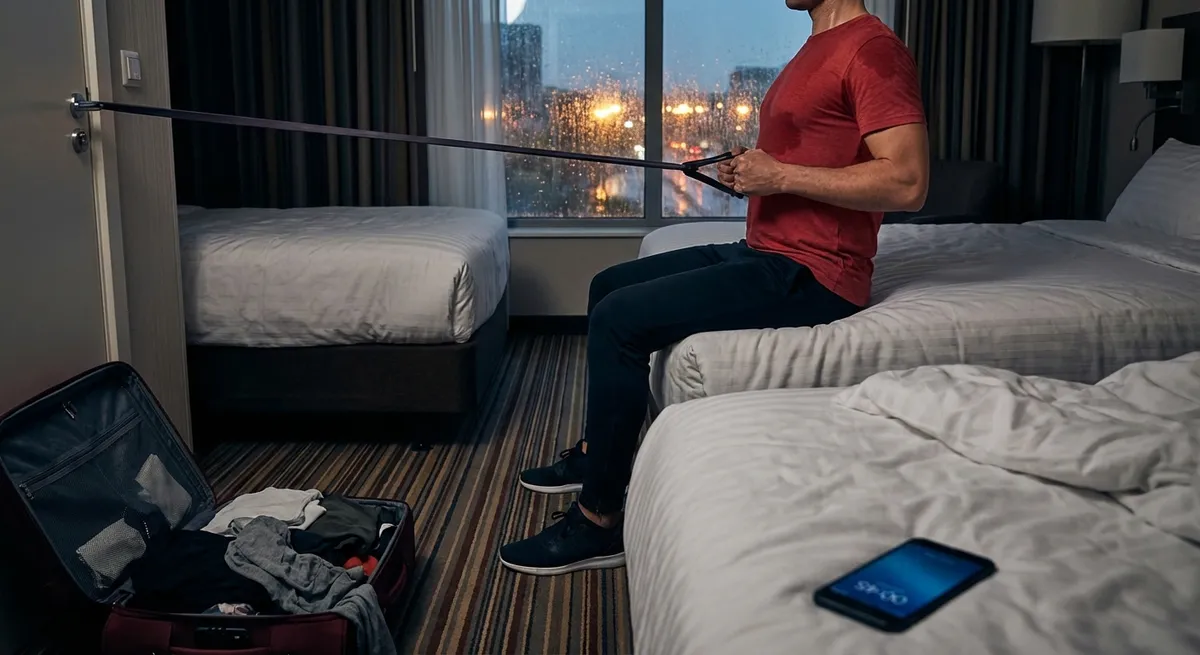
Hotel keys change, time zones shift, and your Wi-Fi signal comes and goes—but your body is the one piece of gear you drag into every new room. This is your mobile basecamp. If you’re bouncing between cities as a traveler or digital nomad, hotel fitness isn’t about chasing the perfect gym—it’s about deploying smart, portable tactics that keep you strong, clear-headed, and ready for whatever the road throws at you.
Turn the Room Into a Training Zone
Forget waiting to see if the hotel gym is open, stocked, or even real. Your default plan should assume the only equipment you have is your body, your bag, and some floor space. Start by claiming a “training lane”: a strip of floor between the bed and the wall, or a clear patch near the desk. That’s your daily deployment zone, non-negotiable.
Use the room itself as a training partner. The bed frame can anchor your feet for sit-ups or glute bridges. A sturdy desk edge can become your spot for incline push-ups or triceps dips. A doorframe can be a target for isometric holds—press your palms against either side and push hard for short bursts to wake up your upper body. Commit to a short, intense session tied to something you do every day on the road: first coffee, post-shower, or pre-dinner. When your workout is chained to an existing habit, it survives time zones and chaotic schedules.
Tip 1: Build a “No-Excuse” Bodyweight Circuit
Your most reliable gym is the one you never have to unpack. A simple, repeatable bodyweight circuit can hit every major muscle group without needing more than a towel and gravity. Think of it as your travel operating system—same commands, different coordinates.
For strength and conditioning, cycle through:
- Push variations (standard push-ups, incline push-ups on the desk, or knee push-ups)
- Squat variations (air squats, split squats using the bed for balance, or slow tempo squats)
- Hinge variations (glute bridges with feet on the bed, single-leg bridges for more challenge)
- Core work (planks, side planks, dead bugs on a towel)
- Cardio bursts (high knees in place, fast step-ups onto a low, stable surface, or shadow boxing)
Aim for 30–45 seconds of work with 15–30 seconds of rest, repeating the circuit 3–5 times depending on your time and energy. Keep the moves familiar so you can train even when you’re sleep-deprived or jet-lagged. The less thinking required, the more consistent you’ll be.
Tip 2: Pack a Pocket-Sized Power Kit
A few ultralight tools can turn any hotel room into a surprisingly capable training station, without turning your suitcase into a gym bag. The key is low volume, high versatility, and zero dependence on wall mounts or heavy fixtures you don’t trust.
Great travel-friendly options include:
- Mini-loop resistance bands: Perfect for glute activation, shoulder warm-ups, and light pulling movements. They weigh almost nothing and can live in your laptop sleeve.
- A long resistance band or tube with handles: Gives you pull and row options that bodyweight alone doesn’t easily cover—anchor it under your feet, around a heavy suitcase, or looped securely around a stable table leg.
- A lightweight jump rope: Ideal for short, intense conditioning sessions when you don’t want to leave the room. Just check ceiling height and light fixtures before you start swinging.
- Suspension trainer (optional upgrade): If you’re a frequent nomad, a compact suspension trainer can hook over sturdy doors for rows, presses, and core work. Always test the door stability first and avoid fire doors or loose frames.
Treat this kit like your passport: it never leaves your travel rotation. That way, no matter how bare-bones the hotel setup is, you’ve always got enough gear to build a serious session.
Tip 3: Use the Hotel Layout as Your Cardio Course
If the hotel gym is a treadmill graveyard or permanently “under renovation,” the building itself becomes your endurance playground. Think vertically and creatively. Hallways, stairwells, and nearby streets can form a simple, effective conditioning loop that doubles as a way to map out your new environment.
Stairs, in particular, are brutal—in a good way. Climb steadily for 5–10 minutes as a warm-up, or run power intervals: 1–2 flights fast, 2–3 flights walking, repeated for 10–15 minutes. Keep a hand on the rail and watch your footing; this is training, not a stunt. If you’re more comfortable staying inside, walk brisk laps on quieter floors early in the morning or late at night.
When it’s safe and the area feels secure, step outside and use a short route near the hotel as your “run loop.” Even a 500–800 meter circuit run multiple times can give you a solid 20–30 minutes of work. Treat these sessions as recon missions: you’re getting in shape while learning exits, landmarks, and local terrain.
Tip 4: Anchor Your Body Clock With Movement
Constant travel wrecks your sense of time. One of the best ways to reset your internal compass in a new city is through deliberate movement. Use short, targeted sessions to tell your body what time it is, especially after long flights or late arrivals.
When you land or check in, deploy a “reset sequence”: 5–10 minutes of mobility (neck rolls, hip circles, cat-cow on a towel, ankle rotations), then a few rounds of light bodyweight exercises at an easy pace. This isn’t about crushing a PR—it’s about telling your joints, muscles, and nervous system, “We’re here now. Wake up and adapt.”
In the morning, use movement to override grogginess: a quick mix of squats, push-ups, and jumping jacks or rope skips will do more than coffee alone. At night, shift to down-regulation: slower stretches, deep breathing, and gentle holds that calm your system. The goal is consistency, not intensity; these bookend sessions keep your body’s rhythm from dissolving in jet lag and strange pillows.
Tip 5: Align Training With Your Mission, Not the Hotel Amenities
The road rewards clarity. If your training plan depends on “only if the hotel has X,” it’s already fragile. Instead, define your non-negotiables before you ever look at the photos of the gym on the booking site. Are you trying to maintain strength, keep your conditioning sharp, stay pain-free, or just not lose momentum entirely between longer training blocks?
Once you know your mission, build flexible “modules” you can deploy anywhere:
- Strength maintenance module: 20–30 minutes of slower, controlled bodyweight moves with pauses and tempo (e.g., 3-second descent squats, push-ups with a 2-second hold at the bottom, single-leg bridges).
- Conditioning module: 10–20 minutes of intervals using stairs, rope, or in-place cardio like high knees and fast feet.
- Mobility and recovery module: 10–15 minutes focused on hips, shoulders, and spine, especially after flights or long laptop sessions.
Each day, choose the module (or two) that fits your energy, schedule, and space. This way, you aren’t at the mercy of whatever random dumbbells or broken treadmills the hotel offers. You’re running your own program—just in different coordinates around the map.
Conclusion
Every hotel room is a new chapter, but your body doesn’t need a full reset with every check-in. When you treat your training as a portable system—built on bodyweight, minimal gear, and adaptable plans—you stay sharp, strong, and mission-ready no matter what the front desk hands you. The room is temporary. The city is temporary. Your passport stamps will blur together. But the habits you carry and the way you choose to move in each new space—that’s the through-line.
Travel doesn’t have to be a pause button on your fitness. It can be the pressure test that proves your routines are rugged enough to go anywhere with you.
Sources
- [American College of Sports Medicine – Staying Active While Traveling](https://www.acsm.org/docs/default-source/files-for-resource-library/staying-active-while-traveling.pdf) - Practical guidance from ACSM on maintaining physical activity away from home
- [CDC – Physical Activity Basics](https://www.cdc.gov/physicalactivity/basics/index.htm) - Evidence-based recommendations for weekly activity levels and intensity
- [Harvard T.H. Chan School of Public Health – Benefits of Physical Activity](https://www.hsph.harvard.edu/nutritionsource/benefits-physical-activity/) - Overview of how regular movement supports long-term health
- [Mayo Clinic – Fitness: Tips for Staying Motivated](https://www.mayoclinic.org/healthy-lifestyle/fitness/in-depth/fitness/art-20048269) - Strategies for consistency that translate well to life on the road
- [Sleep Foundation – Jet Lag and Sleep](https://www.sleepfoundation.org/jet-lag) - Explains how time zone shifts impact the body and how routines (including movement) help reset your clock
Key Takeaway
The most important thing to remember from this article is that this information can change how you think about Hotel Fitness.