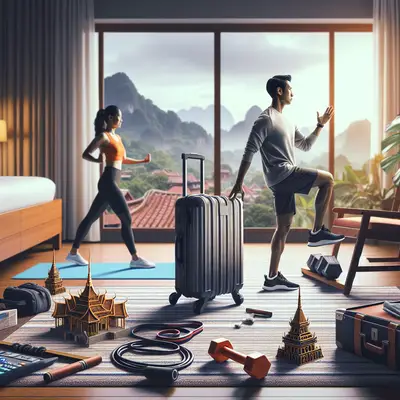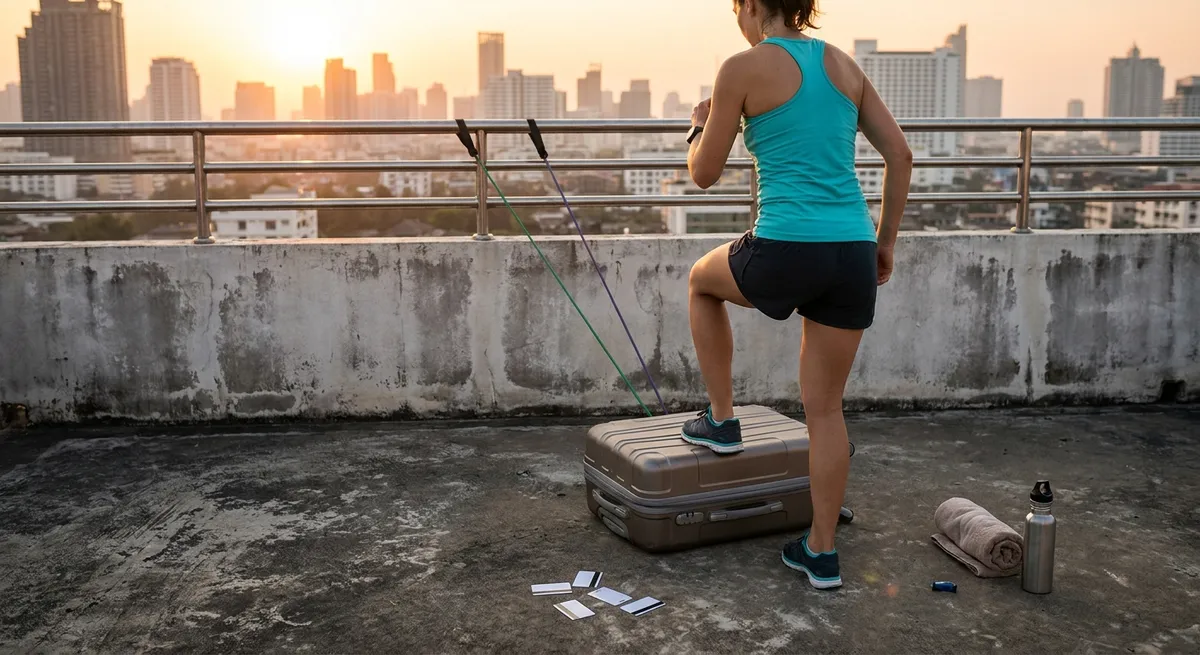
When your “home” changes every few days, your body can easily feel like carry-on luggage—dragged from place to place instead of leading the adventure. But hotels don’t have to be the place where your training goes to die. With a bit of creativity and a traveler’s mindset, that generic room key can unlock a surprisingly effective training environment. This isn’t about perfection or six-piece dumbbell sets; it’s about staying strong, agile, and ready for whatever the next city, trail, or timezone throws at you.
Rethinking the Hotel Room: From Crash Pad to Micro-Gym
Most people see a hotel room as a place to collapse after a long travel day. You’re going to see it as a compact training lab.
Look at the space through a movement lens: the bed becomes an incline platform, the floor is your mat, the doorway frames your mobility work. That ugly luggage bench? Perfect for step-ups, elevated push-ups, and Bulgarian split squats. A sturdy chair can support dips and single-leg balance drills—suddenly, the room is more than beige wallpaper and blackout curtains.
You don’t need a full hour or a full gym. Ten focused minutes in a tight space can maintain strength, power, and mobility far better than “I’ll restart when I get home.” Think short bursts tethered to hotel rhythms: a 10-minute wake-up circuit before breakfast, a mobility reset after long calls, a conditioning finisher before your evening shower. The goal isn’t to mimic your home gym; it’s to keep your body “adventure-ready” in any zip code.
Tip 1: Use the Room Layout to Build a Functional Circuit
Your room’s layout dictates your training map. Instead of fighting the space, design a circuit around it.
Pick 4–6 movements that flow from one end of the room to the other with minimal setup:
- Bed edge: Incline push-ups or decline push-ups (feet on the bed)
- Open floor: Squats, lunges, plank variations, mountain climbers
- Luggage bench or sturdy chair: Step-ups, Bulgarian split squats, triceps dips
- Wall: Wall sits, wall-supported single-leg Romanian deadlifts, shoulder mobility
Sample “hotel circuit” you can run in almost any room:
10–15 incline or decline push-ups (bed)
12–16 walking lunges or split squats (floor)
30–45 seconds of mountain climbers (floor)
10–12 step-ups per leg (bench or chair)
30–45 seconds wall sit (wall)
20–30 seconds plank or side plank (floor)
Cycle through 3–5 rounds, resting 30–45 seconds between moves as needed. In 15–20 minutes, you’ve hit upper body, lower body, core, and conditioning without a single dumbbell. This sort of practical, use-what’s-there approach keeps you consistent regardless of whether you’re in a capsule hotel in Tokyo or a highway motel in the middle of nowhere.
Tip 2: Build a Pocket-Sized Hotel Gym Kit
The best hotel gym is the one that fits in your backpack. A few lightweight tools dramatically amplify what you can do in a small room.
Consider packing:
- Mini resistance bands: Great for glute activation, shoulder work, and added tension on squats, deadlifts, and push-ups.
- Long resistance band (loop): Allows rows, pull-throughs, assisted or resisted push-ups, face pulls, and hip hinges.
- Jump rope: Compact, high-intensity conditioning tool when running outside isn’t an option.
- Massage ball or lacrosse ball: For self-massage on tight calves, glutes, and upper back after long flights or laptop marathons.
With one long band alone, you can create a full-body strength session:
- Band-resisted squats or good mornings (anchored under your feet)
- Single-arm rows (band looped around a door hinge or heavy furniture)
- Overhead presses and band pull-aparts (shoulders and upper back)
- Deadlifts/hip hinges (hinge pattern without needing a barbell)
These tools weigh less than a pair of jeans and turn “equipment-free” into “equipment-flexible.” You’re not relying on the hotel to deliver your workout—you’re carrying the essentials with you.
Tip 3: Make the Hallways and Stairs Your Cardio Playground
If the hotel gym is overcrowded, under-equipped, or just sad, the building itself becomes your cardio course.
Stairs are your best ally:
- Power climbs: Walk or jog up one or two flights, then walk down for recovery.
- Intervals: 20–30 seconds fast stair climbing, 40–60 seconds easy walking or standing rest.
- Loaded carries: If it’s safe and not disruptive, carry your backpack or suitcase up a few flights for a loaded conditioning challenge.
Hallways can also be useful during quiet hours:
- Walking lunges down the hall (if the carpet and noise level won’t disturb guests)
- Fast walking laps around your floor for low-impact steady-state cardio
- Brisk stair + hallway combos: Up one flight, down the hall and back, then repeat
Always be mindful of other guests and hotel staff. Keep it quiet, don’t block access, and avoid peak activity times. But used respectfully, stairs and hallways are more interesting than grinding away on yet another hotel treadmill facing a blank wall.
Tip 4: Sync Short Workouts to Your Travel Schedule, Not the Other Way Around
The most effective hotel routine is the one that bends around flight schedules, late check-ins, and early calls—without demanding heroic discipline.
Think in micro-sessions:
- Wake-up primer (5–8 minutes): Light mobility (neck, hips, thoracic spine), 2–3 sets of bodyweight squats, wall slides, and easy push-ups. This signals to your body: “We move, even on the road.”
- Midday decompression (8–12 minutes): After long work blocks, do a quick block of hip flexor stretches, glute bridges, band pull-aparts, and plank variations. You’ll focus better afterward.
- Evening finisher (10–15 minutes): Rotate between strength-focused days (slow, controlled squats, push-ups, rows if you have a band) and conditioning days (circuits of burpees, mountain climbers, jump rope, or stairs).
You can also anchor training to consistent “hotel moments”:
- After brushing your teeth each night, do one short core circuit.
- Before you open emails in the morning, do five minutes of mobility.
- After dropping your bag in the room at check-in, do a quick reset: 20 bodyweight squats, 10 push-ups, 30 seconds of deep breathing.
By hitching small training habits to daily travel rituals, you preserve your athletic baseline without needing perfect circumstances. The adventure continues; your fitness comes along for the ride.
Tip 5: Prioritize Recovery So Your Body Can Actually Enjoy the Journey
Training on the road isn’t just about doing more—sometimes it’s about recovering better than the people around you. Hotel environments can sabotage rest: weird mattresses, late-night noise, new time zones. If your recovery craters, your performance and mood follow.
Simple, travel-proof recovery tactics:
- Hydration reset: Every time you arrive in a new room, pour a full glass of water and finish it before you start unpacking. Flights, AC, and coffee all dehydrate you quickly.
- Hotel-room mobility: Use 5–10 minutes before bed for hip flexor stretches, hamstring flossing, and thoracic rotations. Your back and hips will thank you the next morning.
- Sleep-friendly setup: Use the luggage rack or extra blanket to block any annoying light leaks under the door or around curtains. Turn the room slightly cool and, if needed, use a white-noise app to drown out hallway sounds.
- Low-intensity movement days: On particularly long travel days, treat movement as circulation, not training intensity: easy walking, band stretches, a few rounds of cat-camel and child’s pose. Not every day needs to be a max-effort grind.
Recovery isn’t passive; it’s strategic. By protecting sleep, hydration, and mobility, you keep your body ready for the next hike, surf session, or crowded city exploration—even if you spent half the day in transit.
Conclusion
Hotel rooms don’t have to be the dead zone of your fitness journey. With a bit of creativity and a few portable tools, every check-in becomes another chance to reinforce that you’re not just visiting the world—you’re moving through it with strength and intent. Use the room’s layout, the building’s stairs, and your own routine anchors to build a sustainable, repeatable system that works in any country and on any schedule.
You don’t need a perfect gym to stay adventure-ready. You just need a willingness to turn ordinary hotel space into a training ground—and the discipline to keep showing up, one short session at a time.
Sources
- [American College of Sports Medicine – Staying Active While Traveling](https://www.acsm.org/docs/default-source/files-for-resource-library/staying-active-while-traveling.pdf) - Practical guidance from ACSM on maintaining activity levels on the road
- [Mayo Clinic – Exercise: 7 Benefits of Regular Physical Activity](https://www.mayoclinic.org/healthy-lifestyle/fitness/in-depth/exercise/art-20048389) - Overview of why consistent movement matters for health and performance
- [CDC – Physical Activity Guidelines for Adults](https://www.cdc.gov/physical-activity-basics/guidelines/adults.html) - Evidence-based recommendations on weekly activity targets
- [Harvard Health Publishing – The Importance of Stretching](https://www.health.harvard.edu/staying-healthy/the-importance-of-stretching) - Details on mobility and stretching for joint health and recovery
- [Sleep Foundation – Travel and Sleep](https://www.sleepfoundation.org/travel-and-sleep) - Research-backed strategies to protect sleep quality while traveling
Key Takeaway
The most important thing to remember from this article is that this information can change how you think about Hotel Fitness.