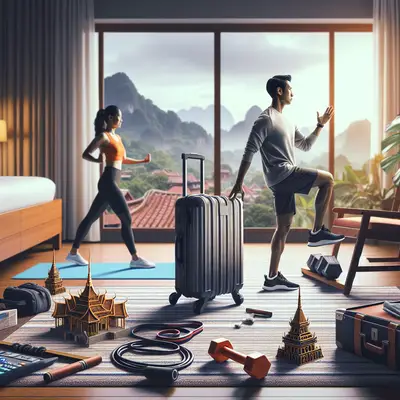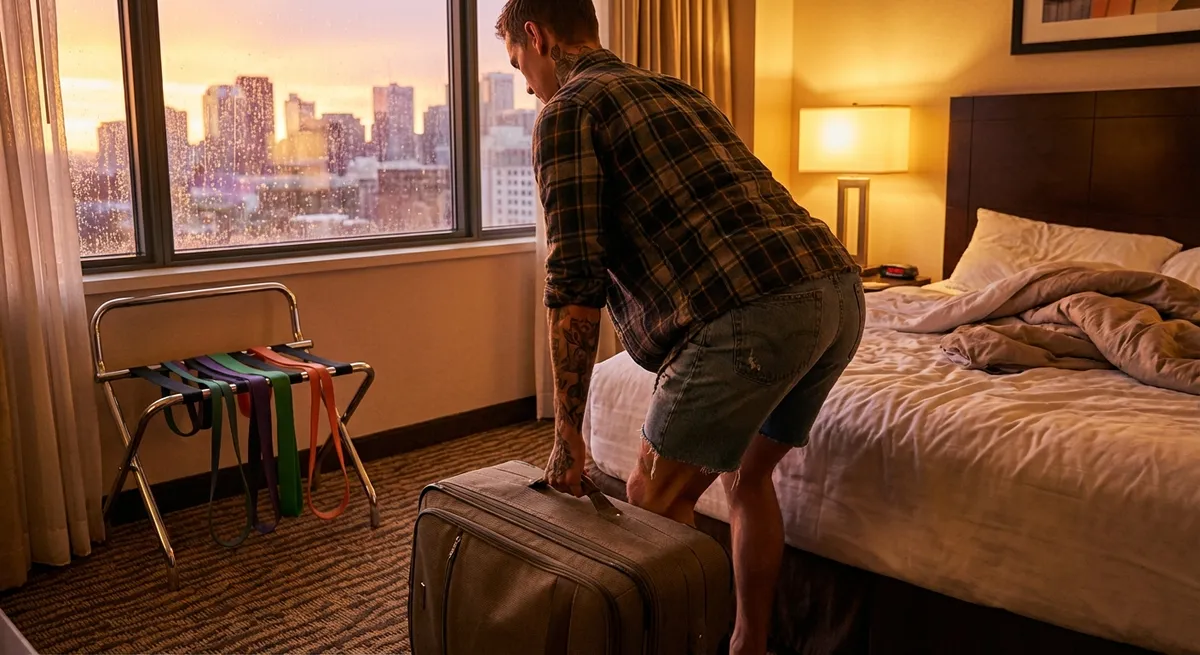
Hotel key in one hand, backpack in the other, and your “gym” is supposedly closed for maintenance. Perfect. Core On Tour travelers don’t wait for ideal conditions—we build strength in real-world chaos. This guide turns anonymous hotel hallways, tiny rooms, and random furniture into a portable training ground so you stay strong, mobile, and adventure-ready no matter where you wake up tomorrow.
Rethinking the Hotel Room: From Crash Pad to Training Base
Most people see a hotel room as a place to sleep off jet lag. You’re going to treat it like a compact performance lab.
Start by scanning the room like an explorer: sturdy desk, heavy chair, clear wall, patch of floor, doorframe, maybe a balcony rail. Each of these can become equipment with the right plan. Instead of mourning the lack of barbells, you’ll lean into bodyweight, time under tension, and clever leverage.
Travel days are unpredictable, so think in “modules,” not full-blown gym sessions. Ten focused minutes before a morning meeting. Seven minutes while your coffee cools. Twelve minutes after a long train ride. Stack two or three modules throughout the day, and you’ve trained harder than most people who “had no time.”
The goal isn’t to set personal records—it’s to keep your joints happy, your muscles switched on, and your core ready for the next flight, hike, or scooter sprint through traffic. With that mindset, hotel fitness stops being a consolation prize and becomes your secret edge.
Tip 1: Build a No-Excuse Hotel Room Circuit
Anchor your travel training around a simple, equipment-light circuit that fits into almost any space. Aim for 15–20 minutes, rotating through movements with minimal rest.
Sample full-body hotel circuit:
- Push variation (push-ups on floor, hands on desk for incline, or feet on bed for decline)
- Squat variation (air squats, suitcase squats with backpack, or split squats using the bed)
- Hip hinge / glutes (glute bridges on the floor, single-leg hip thrusts with shoulders on the bed)
- Core anti-rotation (plank variations; add suitcase drag—pull your backpack or carry-on side to side)
- Cardio burst (jumping jacks, high knees in place, or fast “shadow stair-climb” steps on the spot)
Work each movement for 30–45 seconds, rest 15–20 seconds, and repeat the circuit 3–5 times. If your room is tiny, train in a narrow strip next to the bed—just clear bags and random furniture first.
To progress week to week as you travel: slow down the lowering phase of each rep (3–4 seconds), add pauses at the bottom of movements, or increase working time. These tweaks turn a simple bodyweight circuit into a serious strength and conditioning tool without a single dumbbell.
Tip 2: Travel-Smart Gear That Fits in a Carry-On
You don’t need a mobile gym—but a few ultra-portable tools can make hotel sessions feel less improvised and more intentional.
Packable, high-impact gear:
- Mini resistance bands (loops): Great for glute activation, shoulder work, and adding load to squats, deadlifts, or push-ups. They weigh almost nothing and roll into any side pocket.
- Long resistance band: One or two thick bands can mimic rows, presses, deadlifts, and assisted pull-ups using doors or heavy furniture as anchors.
- Jump rope: Ideal for quick conditioning bursts in hotel garages, courtyards, or quiet hallways. If sound is an issue, do “ghost jumps” without the rope but keep the timing.
- Collapsible massage ball or lacrosse ball: For tackling tight hips, calves, and upper back after flights or long bus rides.
- Lightweight suspension trainer (optional): Clips around a solid door or beam, turning nearly any room into a bodyweight gym. Perfect if you know you’ll be on the road for months.
Stow these in a small mesh sack inside your backpack. The rule: gear must earn its space. If it doesn’t dramatically expand your training options or recovery, it stays home.
Tip 3: Turn the Entire Hotel into Your Playground
Your “gym” doesn’t stop at your door. The building itself is an obstacle course waiting to be explored.
Stealth hotel-exploration workout ideas:
- Stair missions: Skip the elevator. Power-walk or lightly jog stairs for 5–10 minutes, adding a push-up set on each landing. For a strength twist, carry your loaded backpack like a ruck.
- Hallway intervals: If it’s quiet and you’re respectful, use a corridor for shuttle runs, side shuffles, or walking lunges. Keep it short, controlled, and avoid peak noise hours.
- Parking lot power: Early mornings often mean empty lots. Great for sprints, jump rope, or band-resisted walks. Use lines on the ground as distance markers.
- Bench and railing workouts: Solid benches or low walls near entrances can double as platforms for step-ups, Bulgarian split squats, or incline push-ups.
Always scan surfaces for stability and slipperiness, stay out of the way of staff and guests, and keep noise low. Think “urban ninja,” not “gym bro disturbing the peace.” You’re training, but you’re also a guest.
Tip 4: Protect Your Back and Hips from Travel Damage
The real enemy of the traveling body isn’t lack of heavy weights—it's immobility. Long flights, buses, and hours at a laptop wreck your hips, back, and shoulders if you don’t fight back.
Use a quick daily “reset” when you first reach your room:
- Hip flexor stretch: Half-kneeling with the rear leg on a towel or pillow, gently press hips forward, keeping ribs down. Hold 30–45 seconds per side.
- Glute activation: Mini-band lateral walks across the room, then glute bridges on the floor or bed—10–15 slow reps, 2–3 sets.
- Thoracic spine opener: Lie on your back with arms out, knees bent, and gently drop knees side to side (controlled windshield wipers). Or, place a rolled-up towel under your upper back and extend over it.
- Neck and shoulder reset: Simple chin tucks, shoulder blade squeezes, and slow neck rotations to counter laptop posture.
Work this reset after every major travel segment or at the end of long laptop blocks. It doesn’t look heroic, but it keeps you from stiffening up like old luggage and lets you move freely when it’s time to surf, hike, or roam a new city on foot.
Tip 5: Use Micro-Workouts to Outsmart Jet Lag and “No Time”
On the road, consistency beats intensity. Micro-workouts—tiny sessions scattered through the day—are a traveler’s best weapon against fatigue, time crunches, and motivation dips.
Practical micro-session ideas:
- Wake-up charge (3–5 minutes)
- 10–15 squats
- 10 push-ups (incline on desk if needed)
- 20–30 seconds of high knees or jumping jacks
- Laptop break reset (2–4 minutes)
- 20–30 seconds plank
- 10–12 glute bridges
- 10–12 band pull-aparts (if you packed a band)
- Pre-shower finisher (5–7 minutes)
- Odd minutes: 12–15 lunges total
- Even minutes: 8–12 slow push-ups
2 rounds of:
EMOM (every minute on the minute) for 5–7 minutes:
Even on chaotic days, you can usually carve out a handful of these slivers. By evening, you’ve quietly amassed 20–30 minutes of real training without needing a full uninterrupted block or a fancy facility. The side effect: better circulation, sharper focus for remote work, and less brutal jet lag.
Conclusion
Hotel fitness doesn’t have to feel like a compromise session in a sad basement gym. When you treat the building as terrain, your backpack as equipment, and your schedule as a series of small opportunities, every destination becomes part of your training story.
You don’t need perfect conditions—you need portable habits: a reliable room circuit, a few grams of smart gear, stair missions, mobility resets, and micro-workouts that survive time zones and late check-ins. Keep that mindset, and no matter where you land—budget hostel, luxury high-rise, or roadside motel—you’ll always have your body ready for the next adventure.
Sources
- [American Council on Exercise (ACE) – Travel Workouts](https://www.acefitness.org/resources/everyone/blog/7900/how-to-stay-fit-while-traveling/) - Practical guidance on staying fit while traveling and sample bodyweight workouts
- [NHS (UK) – Exercise Health Benefits](https://www.nhs.uk/live-well/exercise/exercise-health-benefits/) - Overview of why consistent physical activity matters for health, useful context for travel training
- [Harvard Health – The Importance of Stretching](https://www.health.harvard.edu/staying-healthy/the-importance-of-stretching) - Explains benefits of stretching and mobility, supporting the daily reset strategy
- [Mayo Clinic – Interval Training Basics](https://www.mayoclinic.org/healthy-lifestyle/fitness/in-depth/interval-training/art-20044588) - Details on how and why short interval-style workouts (like hotel circuits and micro-sessions) are effective
- [CDC – Physical Activity Guidelines for Adults](https://www.cdc.gov/physicalactivity/basics/adults/index.htm) - Evidence-based recommendations for weekly activity levels that travelers can aim to meet on the road
Key Takeaway
The most important thing to remember from this article is that this information can change how you think about Hotel Fitness.