Between airport gates, bus stations, and borrowed desks, your body can quietly slide into “permanent sitting mode.” The mission: stay strong, mobile, and energized without hauling a full gym in your carry-on. Portable equipment is your stowaway advantage—compact tools that vanish into your backpack but can turn a balcony, hostel, or park bench into a training ground.
This guide breaks down smart, space-saving gear and five field-tested fitness tips for travelers and digital nomads who want performance, not just souvenirs.
Building a Micro-Gym That Fits in Your Backpack
Your goal isn’t to recreate a commercial gym; it’s to build a micro-gym that travels everywhere without fighting airline baggage limits.
Start with ultra-versatile gear: resistance bands, a lightweight suspension trainer, and a compact jump rope cover strength, cardio, and mobility in a footprint smaller than a laptop. Add a mini massage ball or travel-sized roller, and you’ve locked in recovery, too.
Prioritize durability over gimmicks. Look for bands with reinforced attachment points, carabiners on suspension trainers rated for bodyweight loads, and ropes with tangle-resistant cables. If a piece of equipment can’t handle being stuffed into a backpack and used in questionable hotel doorframes, it doesn’t belong in your kit.
Color-code and compartmentalize your gear in separate pouches so setup is fast. When you land exhausted after a red-eye, you’re far more likely to train if you can grab one pouch, clip your trainer to a solid anchor, and move. Think like a traveler, not a gym tourist—your gear should be field-ready in under two minutes.
Essential Portable Gear That Punches Above Its Weight
The right portable equipment gives you leverage: minimal weight, maximal training options.
- Long Resistance Bands (Loop or Tube)
These anchor to railings, doors, and posts, giving you rows, presses, pulls, hip hinges, and assisted movements. They’re also great for mobility sessions before long-haul flights.
- Mini-Bands (Small Loops)
Lightweight and tiny, mini-bands upgrade bodyweight moves like squats, bridges, and lateral walks. Perfect for waking up sleepy glutes after marathon laptop sessions.
- Suspension Trainer (Straps + Handles)
With a sturdy door or beam, you can train your entire body: rows, push-ups, single-leg squats, core work. Because you adjust angles easily, you can scale intensity whether you’re on a 10th-floor hotel or a beach cabana.
- Compact Jump Rope
Packs smaller than a t-shirt but delivers serious cardio and footwork training. Great for when the local “gym” is just a treadmill with a missing safety clip.
- Mini Recovery Tools (Ball, Stick, or Travel Roller)
After overnight buses, cramped flights, or unfamiliar mattresses, a lacrosse ball or palm-sized roller can restore your back, hips, and feet in a few minutes.
Aim for a kit that weighs around 1–2 kg (2–4 lb) and fits into a laptop slot or packing cube. That’s a tiny tradeoff for the ability to train anywhere on the planet.
Five Field-Proven Fitness Tips for Travelers and Digital Nomads
These tips are built specifically for people who live out of backpacks, suitcases, and short-term rentals—and they all integrate portable equipment.
1. Turn Transit Time into Prep Time, Not Lost Time
Before travel days, treat 10–15 minutes with bands or a rope as “flight armor.” Use long bands for hip hinges, pull-aparts, and shoulder openers; use a mini-band for glute activation. You’re not chasing PRs—you’re priming joints and muscles so hours of sitting don’t wreck you. On arrival, a short, light resistance circuit acts as a “reboot,” waking up your core and posture before you slip into couch mode.
2. Lock in a Non-Negotiable 15-Minute Base Routine
Instead of vague promises to “work out when I have time,” create a minimalist core routine that never changes, no matter the city or timezone. For example:
- Suspension rows
- Band-resisted squats or lunges
- Push-ups (floor or elevated)
- Band-resisted hip hinge or good morning
- Core finisher (body saws, dead bugs, or banded anti-rotation holds)
Cycle through 2–3 rounds. This is your default: when you’re tired, jet-lagged, or short on space, you run the base routine and you’re done. On better days, you add extras—but you never drop the base.
3. Train “Anchor Awareness” Everywhere You Go
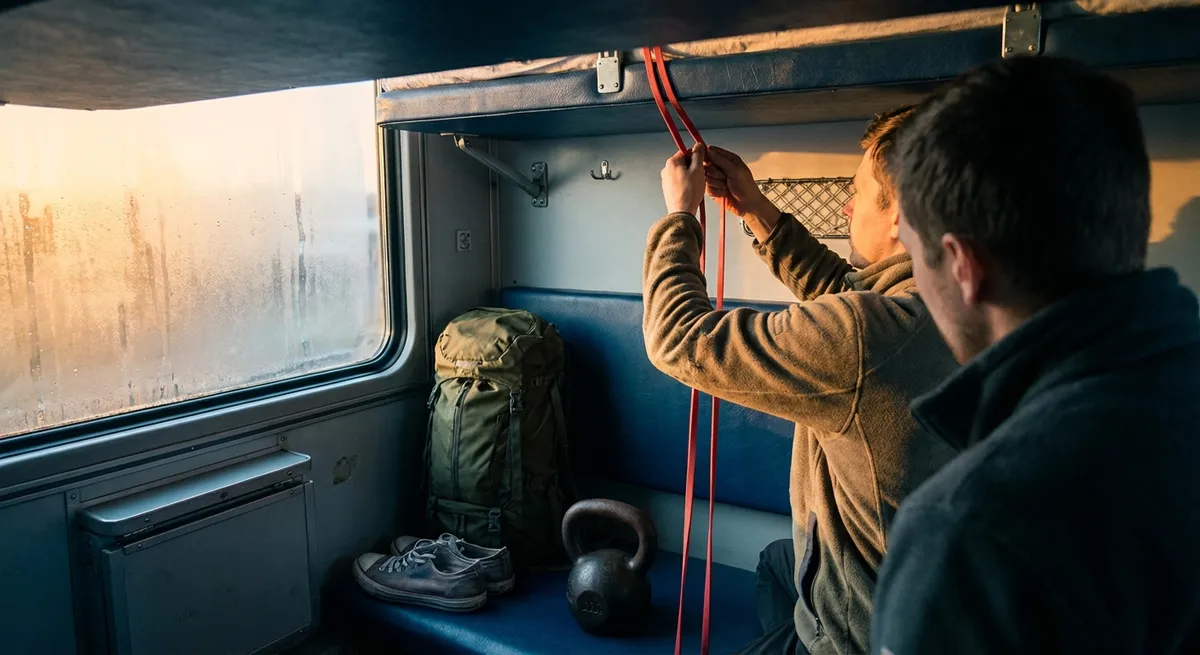
Any place you land, scan for potential anchors: sturdy doorframes, pillars, railings, playground bars, thick tree branches. Your portability power comes from knowing how to safely attach your equipment to the environment.
Use door anchors on doors that close toward you and latch securely. Test railings and beams with a quick pull at low intensity before committing your full bodyweight. This mindset turns any new location into a potential training field instead of an excuse.
4. Rotate Focus by Destination, Not by Day of the Week
When your schedule and timezone swing unpredictably, traditional “Monday = chest, Tuesday = legs” splits fall apart. Instead, rotate focus blocks across your stops. For example:
- City A (3–4 days): Emphasize lower-body and conditioning with bands and rope.
- City B (a week): Emphasize upper-body strength and core with suspension work.
- City C (short layover): Mobility, light band work, and recovery focus.
This flexible structure lets you adjust to late check-ins, unpredictable Wi-Fi, and local obligations while still progressing over time.
5. Pair Work Sprints with Micro-Sessions, Not Marathon Workouts
Digital nomads often chain long laptop sessions with zero movement. Use portable gear to insert “micro-sessions” between work blocks:
- Finish a 60–90 minute deep work sprint.
- Do 5–8 minutes of band rows, push-ups, and mini-band walks.
- Sit back down with better posture and more focus.
You’ll accumulate meaningful training volume across the day without needing a full hour in one shot. This pattern is ideal when you’re sharing co-working spaces or tiny apartments where long, intense workouts feel disruptive.
Adapting to Tight Spaces, Noise Limits, and Unfamiliar Terrain
You won’t always have a park, terrace, or quiet room. Portable equipment is your workaround for tight, noisy, or shared environments.
In thin-walled rentals, swap out high-impact jumps and loud landings for controlled, time-under-tension band and suspension work. Slow eccentrics (lowering phases) and pauses at the hardest point of a movement can make light equipment brutally effective without annoying the downstairs neighbor.
In cramped rooms, prioritize vertical and diagonal movement patterns using your suspension trainer: rows, presses, face pulls, and anti-rotation core drills. If you can stand with arms extended, you can train. Use your bed, luggage, or a sturdy chair as elevation for incline push-ups or hip thrusts.
When you’re unsure about floor cleanliness or have limited room, favor standing trails: banded deadlifts, good mornings, overhead presses (if the ceiling allows), lateral walks, and pull-aparts. This lets you avoid the ground and still hit every major muscle group.
Conclusion
Your passport takes you places; your portable gear keeps you ready for all of them. When your micro-gym lives in your backpack, you’re no longer dependent on hotel facilities, local gym day passes, or perfect schedules.
Build a simple, rugged kit. Lock in a 15-minute non-negotiable routine. Treat every new city like a training opportunity, not a disruption. With a few bands, a set of straps, and a rope, you’re not just passing through the world—you’re moving through it stronger, sharper, and ready for whatever the next stop throws at you.
Sources
- [American Council on Exercise – Resistance Band Training](https://www.acefitness.org/resources/everyone/blog/7907/what-are-the-benefits-of-resistance-bands/) - Overview of benefits, versatility, and effectiveness of resistance-band workouts
- [Harvard Health Publishing – The importance of stretching and mobility](https://www.health.harvard.edu/staying-healthy/the-importance-of-stretching) - Explains why mobility and stretching matter, especially for people who sit or travel frequently
- [Mayo Clinic – Exercise: 7 benefits of regular physical activity](https://www.mayoclinic.org/healthy-lifestyle/fitness/in-depth/exercise/art-20048389) - Evidence-based benefits of consistent exercise, relevant to maintaining routines on the road
- [CDC – Physical Activity Guidelines for Adults](https://www.cdc.gov/physical-activity-basics/guidelines/adults.html) - Official recommendations for frequency and intensity of physical activity
- [Cleveland Clinic – Foam Rolling and Self-Myofascial Release](https://health.clevelandclinic.org/does-foam-rolling-really-work) - Discusses how compact recovery tools like rollers and balls support muscle recovery and mobility
Key Takeaway
The most important thing to remember from this article is that this information can change how you think about Portable Equipment.