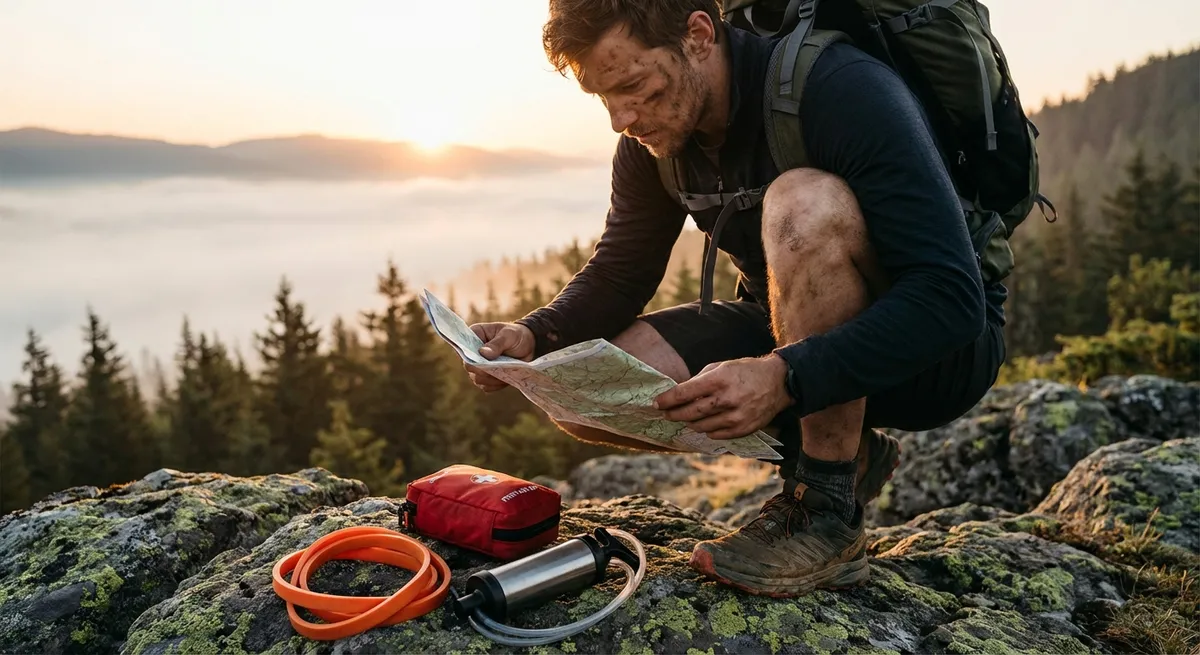
Your backpack is half-packed, your next border crossing is bookmarked, and your “real” gym is somewhere thousands of miles behind you. Nomad life is the dream—until your body reminds you that airports, overnight buses, and laptop marathons aren’t exactly performance fuel.
This isn’t about chasing six-pack selfies between flights. It’s about building a body that can haul a pack up a volcano, sleep on questionable mattresses, sprint for a closing gate, and still feel ready for whatever weird, wonderful adventure tomorrow throws at you.
Let’s dial in a nomad health strategy that actually fits in your carry-on—starting with five portable, zero-excuse fitness habits you can run anywhere on the planet.
Nomad Health Is Expedition Health
When you’re a traveler or digital nomad, your body is on a long-term expedition, not a weekend getaway. That means your “training plan” has to survive red-eye flights, unfamiliar food, patchy Wi‑Fi, and days that swing from 10 hours of sitting to sudden bursts of hiking, surfing, or scooter dodging.
Forget perfect programs. Think field-tested principles:
- Your body is your primary gear. You can lose luggage, but not your joints, lungs, and spine.
- Training must be frictionless. If it needs a schedule, a squat rack, or ideal conditions, it won’t last.
- Recovery is performance. Sleep, hydration, and basic mobility beat heroic, random workouts.
- Consistency beats intensity. A small, repeatable routine will outwork one big “when I have time” session every time.
With that in mind, here are five rugged, travel-ready fitness tips designed for people who live out of bags and chase new coordinates.
Fitness Tip 1: Anchor Your Day With a 10-Minute “Arrival Reset”
Every new city throws off your rhythm—different time zones, beds, noise, and routines. Instead of pretending you’ll suddenly “find a gym later,” establish one rule: every time you arrive somewhere (accommodation, airport, coworking), you run a 10-minute reset.
Here’s a simple circuit that needs no equipment and almost no space:
- 1 minute: brisk walking in place or marching with high knees
- 1 minute: slow, deep squats (use a chair or bed frame for balance if needed)
- 1 minute: push-ups (against a wall, desk, bed, or floor—pick your level)
- 1 minute: hip hinge “good mornings” (hands on hips, soft knees, bow forward and stand tall)
- 1 minute: plank (on hands, against the bed, or on the floor)
- 1 minute: arm circles and shoulder rolls
- 1 minute: alternating lunges or split squats (hold onto a wall if balance is tricky)
- 1 minute: glute bridges (lying on your back, feet on the floor, lift hips)
- 1 minute: gentle spinal twists (seated or standing)
- 1 minute: deep breathing—4 seconds in, 6–8 seconds out
No timer? Count 10 slow breaths per “minute.” Too wrecked to move? Do just the last two minutes of breathing and twisting. The rule isn’t “do it perfectly,” it’s “do something every single arrival.”
Over time, your brain links “new place” with “reset my body,” which is a powerful anchor when everything else in your life keeps changing.
Fitness Tip 2: Turn Transit Time Into Micro-Training
Travel days are normally brutal on your body: cramped hips, swollen ankles, stiff backs, and that heavy, foggy feeling after hours of sitting. You can’t control legroom, but you can control how often you become a statue.
Use a simple framework: no more than 30 minutes without moving something on purpose.
On planes, trains, and buses, cycle these micro-moves:
- Ankle pumps and circles: 20–30 reps each side to keep blood moving.
- Seated marches: Lift one knee, then the other, under your tray table.
- Isometric squeezes: Press your palms together, squeeze your glutes, or pinch your shoulder blades back for 10 seconds.
- Neck resets: Gently tuck your chin, reach the crown of your head toward the ceiling, and hold for 10 seconds.
Whenever you get a chance to stand (boarding lines, layovers, gas stops), go for movement that opens what sitting closes:
- Slow, deep lunges or split squats
- Standing quad stretch (heel to butt, hold a wall for balance)
- Chest openers (hands behind back, gently lift)
If you treat every queue and layover as a chance to un-stick your body, you’ll arrive ready to move, not ready to collapse.
Fitness Tip 3: Build a “Floor-Only” Strength Routine
Gyms are optional. Floors are everywhere: hostels, small apartments, airport corners, shady park spots, even ferry decks. That’s enough for serious strength, if you know what to do.
Create a floor-only session you can run in 20 minutes, 2–3 times per week:
Do 3 rounds, resting 30–60 seconds between exercises:
- Push pattern:
- Push-ups (floor, knees, or hands on bed/desk) – 8–15 reps
- Pull pattern (no pull-up bar version):
- Backpack rows (fill with clothes/books, hinge at hips, row to ribs) – 10–15 reps
- Squat pattern:
- Air squats or sitting-to-standing from a chair – 10–20 reps
- Hip hinge / posterior chain:
- Single-leg Romanian deadlifts (bodyweight, light touch to wall for balance) – 8–12 each leg
- Core / anti-rotation:
- Side plank (knees or feet) – 15–30 seconds each side
If you find a playground bar, hostel pull-up bar, or sturdy tree branch, add:
- 2–4 sets of assisted pull-ups or hangs for grip and shoulder health.
This minimalist template hits major movement patterns, builds functional strength for real-world adventures, and doesn’t rely on any particular country, currency, or gym app.
Fitness Tip 4: Pack One “Cheat Code” Tool in Your Bag
You don’t need a full mobile gym, but one smart, portable tool makes your training more fun and more flexible. Pick one of these to be your “cheat code”:
- Long resistance band (loop or tube):
- Adds resistance to squats, deadlifts, and presses
- Allows rows, pulldowns, face pulls, and hip work even in tiny rooms
- Light suspension trainer (like TRX-style straps):
- Attaches to doors, beams, or trees
- Lets you do rows, assisted squats, hip hinges, and challenging core moves
- Jump rope:
- Perfect for quick conditioning in alleys, courtyards, or rooftops
- Folds into any pocket and torches energy in a few minutes
Then build a go-to “anywhere session” around that tool. For example, with a resistance band:
- Band rows – 12–15
- Band-resisted squats – 10–15
- Overhead presses – 8–12
- Good mornings (band behind neck, under feet) – 10–15
- Paloff press (band anchored to something, press out in front) – 8–12 each side
3–4 rounds and you’re done. The goal is not gear collection; it’s one small piece of kit that multiplies your options.
Fitness Tip 5: Treat Sleep and Hydration Like Critical Gear
Adventure culture glorifies red-eyes, late nights, and “I’ll sleep when I’m dead.” Your nervous system disagrees. If you want to hike at sunrise, climb safely, surf strong, or even think clearly at your laptop, you need recovery habits that survive constant change.
Use this stripped-down protocol:
Sleep:
- Aim for a consistent sleep window, even across time zones—e.g., 11 p.m.–7 a.m., then shift gradually.
- Bring two low-bulk essentials: a sleep mask and simple earplugs. They’re tiny but transform noisy hostels and bright city rooms.
- When you land in a new place, expose yourself to morning daylight for 15–30 minutes to anchor your body clock faster.
- If you must nap, keep it under 30 minutes and before mid-afternoon.
Hydration:
- Start every day with a full bottle or big glass of water before caffeine.
- On travel days, drink small, frequent sips instead of chugging once an hour.
- In hot or high-altitude spots, add a pinch of salt or an electrolyte packet to one bottle per day to help retention.
- Check your urine color: pale yellow is the sweet spot; dark gold means you’re running dry.
You don’t control the mattresses, climate, or flight schedules—but you do control a handful of small, repeatable behaviors that keep your energy stable enough to say “yes” to the good stuff.
Conclusion
Nomad health isn’t a side quest; it’s the main engine that lets you keep chasing new maps without breaking down halfway.
You don’t need a perfect program, boutique gyms, or a checked bag full of equipment. You need:
- A simple 10-minute “arrival reset”
- Micro-movements built into transit
- A floor-only strength routine that fits any room
- One smart, portable training tool
- Sleep and hydration habits that travel as well as you do
Build these into your life, and your body stops being the limiting factor—and starts feeling like the ultimate adventure rig: strong enough to haul gear, mobile enough to explore hard-to-reach corners, and resilient enough to bounce back for tomorrow’s unknown.
Your passport gets you into countries. Your habits decide what you can actually do once you’re there.
Sources
- [Centers for Disease Control and Prevention – Physical Activity Guidelines](https://www.cdc.gov/physicalactivity/basics/adults/index.htm) – Evidence-based recommendations on weekly strength and aerobic activity for adults
- [World Health Organization – Physical Activity and Adults](https://www.who.int/news-room/fact-sheets/detail/physical-activity) – Global guidelines and health impacts of regular movement
- [American Heart Association – Travel and Heart Health](https://www.heart.org/en/healthy-living/healthy-lifestyle/stress-management/travel-and-heart-health) – Practical advice on staying active and managing health during travel
- [Harvard Medical School – Importance of Sleep](https://www.health.harvard.edu/newsletter_article/importance-of-sleep-your-guide-to-a-good-nights-rest) – Overview of why consistent, quality sleep matters for performance and health
- [National Institutes of Health – Hydration and Health](https://www.ncbi.nlm.nih.gov/pmc/articles/PMC2908954/) – Research review on water intake, hydration status, and overall health outcomes
Key Takeaway
The most important thing to remember from this article is that this information can change how you think about Nomad Health.