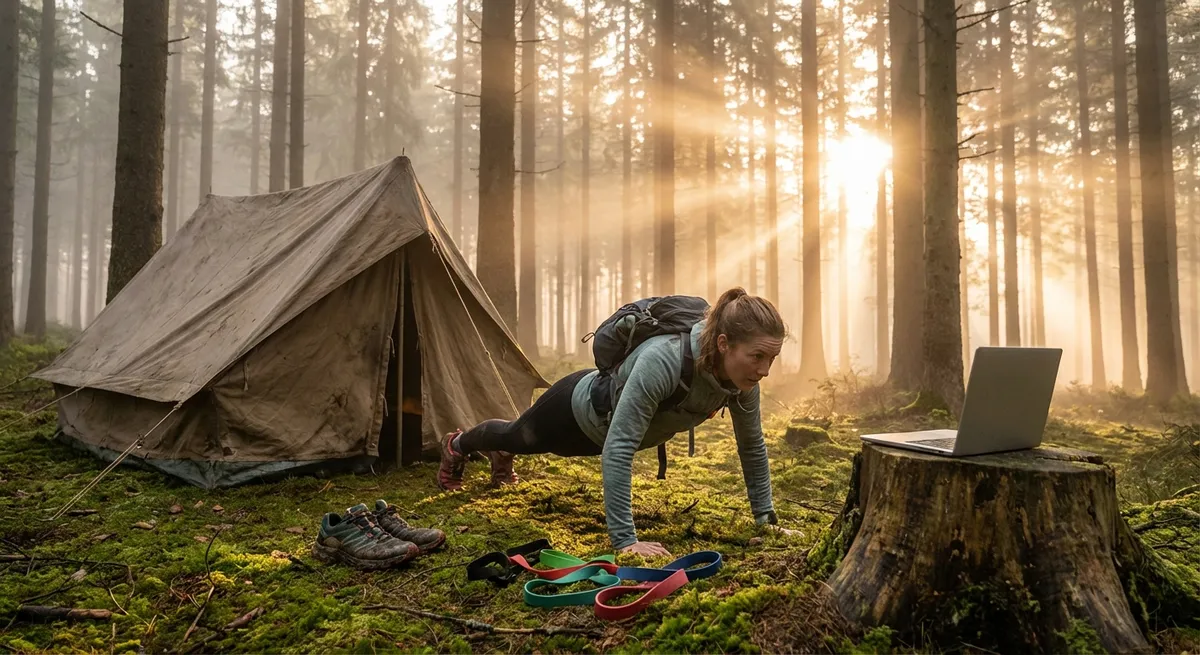
You don’t need a home gym, a perfect routine, or a stable zip code to stay strong. You need a body, a bit of creativity, and the willingness to turn layovers, hostels, and side streets into training grounds. This guide is for the digital nomad who wants to chase sunsets and PRs, without lugging a suitcase full of iron along for the ride.
Build a “Non-Negotiable” Movement Ritual
When your environment is always changing, your ritual becomes your anchor. Think of a short, portable sequence that you do every single day, no matter what country, climate, or time zone you’re in.
Pick 3–5 movements that require no equipment and minimal space—like squats, push-ups, hip hinges, and a plank variation. Your goal isn’t to crush yourself; it’s to signal to your brain and body: “We move, every day, everywhere.” Aim for something you can finish in 8–12 minutes so it survives early flights, late check-ins, and chaotic travel days.
Link the ritual to a trigger that exists in every destination: your first coffee, brushing your teeth, or opening your laptop. Over time, this becomes your portable “gym membership,” independent of hotel amenities or weather. When everything else about your day is uncertain, this ritual gives you one solid, repeatable win.
Treat Every City as an Unofficial Training Park
Forget the idea that workouts only happen in gyms. Cities, villages, and coastal towns are full of unbranded fitness equipment if you know how to look.
Stairs become your cardio intervals and calf burners. Park benches turn into platforms for step-ups, incline/decline push-ups, and Bulgarian split squats. Low walls and railings are perfect for dips and isometric holds. Even quiet side streets or waterfront promenades can be your sprint lanes or tempo run routes.
Before you settle in somewhere new, take a 15–20 minute “movement recon walk.” Scout for staircases, parks, flat stretches of pavement, and any structure sturdy enough to lean, hang, or push against. Save locations in an offline map app so you can find your “training loop” even without signal. This way, each new stop on your journey doubles as a fresh adventure course instead of an excuse to skip training.
Five Travel-Ready Fitness Tips for Nomads
These are practical, pack-light tactics you can deploy on the road without needing a perfect schedule or a dedicated gym.
Use Time Blocks, Not Fixed Schedules
Time zones and transit delays destroy rigid workout plans. Instead of “I train at 7 a.m.,” think “I train in the first 3 waking hours of my day” or “I train before my main work block.” This flexible window adapts to red-eyes, overnight buses, and surprise agenda changes while still protecting your health as a priority.
Adopt a “Minimum Effective Dose” Strength Set
Keep a short strength circuit on standby, especially for cramped rooms or layovers: for example, 10 squats, 10 push-ups, 10 hip hinges (good mornings), and a 30-second plank. Repeat 3–5 rounds based on your energy and time. This hits major muscle groups, preserves strength, and keeps joints happy without needing equipment or a lot of space.
Move Every Time You Transition
Use transitions—before a shower, after a Zoom call, while your coffee brews—as micro-workout prompts. Do a quick set of lunges, a short mobility flow, or a few rounds of shadowboxing. These “movement snacks” add up across your day, counteract long sitting sessions, and keep your body from stiffening up after buses or flights.
Carry One Ultra-Portable Tool
While bodyweight is enough, a tiny piece of gear can unlock dozens of variations. A loop resistance band or a light suspension trainer (that attaches to doors or sturdy structures) weighs almost nothing but lets you train rows, presses, pulls, and core work more intensely. This helps maintain muscle and joint integrity when you’re away from full gyms for weeks at a time.
Sync Recovery With Your Travel Rhythm
Travel stress, jet lag, and broken sleep can quietly wreck your training if you ignore them. Prioritize simple recovery levers that travel well: a consistent wind-down routine (screens off, dim lights), hydration checks (especially after flights), and basic pre-bed stretching. Think of recovery as your all-terrain armor—without it, even light training starts to feel like a grind.
Make Movement Your Navigation System
One of the easiest ways to stay active on the road is to explore on foot or by bike. Instead of hopping into ride shares or scooters by default, deliberately “earn” your views and meals with walking routes, stair-heavy paths, and detours through hills or waterfronts.
Use walking or running as your first pass at mapping a new city. Choose a landmark—like a market, a viewpoint, or a local café—as your destination, then take the long way there. Turn your GPS off for part of the route and navigate by curiosity (while keeping basic safety in mind). You’re not just exercising; you’re building a mental map of your surroundings, discovering quieter streets, and spotting future workout spots and food options.
If available and safe, renting a bike can give you a cardio hit while expanding your exploration radius. Hills and bridges become natural interval training. In rural or coastal locations, trail runs and hikes offer extra strength demands: uneven terrain recruits stabilizer muscles and boosts balance—perfect insurance for a body that lives out of a backpack.
Design Your Pack to Support a Strong Body
Your backpack or suitcase isn’t just baggage—it’s a piece of wearable equipment that influences your posture, mobility, and energy all day. Treat packing as part of your health strategy.
Keep your main carry as light and evenly balanced as possible. Excess weight and poor distribution can strain your neck, shoulders, and lower back, making it harder to train or even sit comfortably to work. If your gear is heavy by necessity, use that to your advantage: walk a few extra blocks once a day with good posture, engaging your core as a loaded carry exercise instead of just “hauling stuff.”
Include a tiny “recovery kit” in your bag: a lacrosse or massage ball, a short resistance band, or even a rolled-up towel you can use for basic mobility and self-massage. After flights or long bus rides, spend 5–10 minutes addressing tight hips, lower back, and upper back. This makes your next workout better and turns hotels, hostels, and airport corners into impromptu recovery lounges instead of just waiting rooms.
Conclusion
You don’t have to choose between a passport full of stamps and a body that feels powerful. When you treat every destination as a potential training ground and your routine as a portable ritual, fitness stops being another thing you “fit in” and becomes part of how you travel.
The nomad life will always be unpredictable. That’s the point. But your commitment to move, explore, and protect your health can be rock solid—no gym membership, no fixed address, just a body that’s ready for whatever the next border crossing throws at it.
Sources
- [Centers for Disease Control and Prevention – Physical Activity Basics](https://www.cdc.gov/physicalactivity/basics/index.htm) - Overview of recommended activity levels and health benefits of regular movement
- [World Health Organization – Physical Activity](https://www.who.int/news-room/fact-sheets/detail/physical-activity) - Global guidelines and data on how physical activity impacts health
- [Harvard T.H. Chan School of Public Health – The Nutrition Source: Staying Active](https://www.hsph.harvard.edu/nutritionsource/staying-active/) - Evidence-based recommendations for integrating activity into daily life
- [American Council on Exercise – Tips for Staying Fit While Traveling](https://www.acefitness.org/resources/everyone/blog/7631/tips-to-stay-fit-while-traveling/) - Practical strategies for workouts on the road
- [Sleep Foundation – Jet Lag and Sleep](https://www.sleepfoundation.org/jet-lag) - Research-backed guidance on managing jet lag and supporting recovery while traveling
Key Takeaway
The most important thing to remember from this article is that this information can change how you think about Nomad Health.