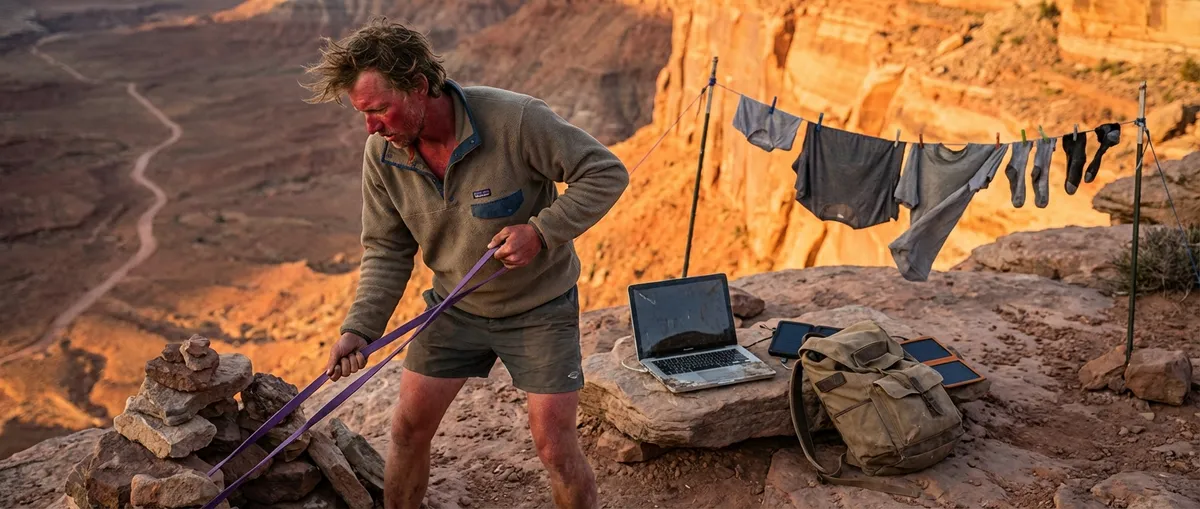
Constantly moving, chasing new horizons, and living out of carry-ons doesn’t mean your strength, stamina, or health has to fade into the background. Nomad life comes with jet lag, cramped buses, street food gambles, and work calls across time zones—but it also gives you endless ways to test your body in the real world, not just in a climate‑controlled gym.
This guide is for travelers and digital nomads who want a body that keeps up with their passport. No excuses, no perfect conditions—just portable strategies and simple systems you can throw into any backpack and any city.
Building a Nomad Body: Strong Enough for Every Detour
A “nomad-ready” body isn’t about aesthetics; it’s about reliability. Can you haul your pack up four flights of stairs in a guesthouse with no elevator? Sprint to a gate during a tight layover? Spend six hours on a scooter and still feel like a human at the end?
Think of your training as risk management for adventure. Grip strength means you can hang onto train rails and climbing holds. Strong legs mean you can say yes to last‑minute hikes without worrying about your knees. A durable back and core mean fewer injury flare‑ups when you’re sleeping on terrible mattresses and sitting in questionable chairs.
The trick is to build a minimal, repeatable framework you can deploy anywhere:
- A short, default routine you can run in 20–25 minutes with almost no gear
- A handful of go‑to foods that work in most countries and grocery stores
- Recovery tactics that don’t require ice baths or fancy tools
- A mindset that treats imperfect training as normal, not a failure
You’re not chasing “perfect.” You’re building resilience that survives red‑eye flights, visa runs, and unexpected detours.
Tip 1: Use the “Compass Routine” to Stay Grounded in Any Time Zone
When your environment changes constantly, your body needs one anchor. The Compass Routine is a simple, four‑direction structure you can run in tiny spaces with or without equipment:
- North (Push) – Push‑ups, elevated push‑ups, pike push‑ups, band presses
- South (Pull) – Doorframe rows, towel rows around a sturdy pole, band pull‑aparts
- East (Hinge/Posterior Chain) – Hip hinges, single‑leg Romanian deadlifts (bodyweight), glute bridges
- West (Squat/Lunge) – Squats, split squats, reverse lunges, step‑ups onto a chair or low wall
Pick one move in each direction and run them as a circuit:
Push x 8–15 reps
Pull x 8–15 reps
Hinge x 10–20 reps
Squat/Lunge x 8–15 reps per leg
Rest 30–60 seconds between moves, and complete 3–5 rounds. This structure works in a hostel dorm, airport hotel, or tiny Airbnb living room. If you’re short on time, hit just one round for a “minimum viable session” and move on with your day.
The goal isn’t to destroy yourself; it’s to keep the “movement signal” loud enough that your body remembers what it’s for: carrying you into the next adventure without breaking down.
Tip 2: Pack a “Pocket Gym” That Won’t Get You Flagged at Security
You don’t need a trunk full of gear to train hard on the road. You do need a few tools that are:
- Lightweight
- Multi‑use
- TSA‑friendly
- Cheap to replace
A solid pocket gym might look like this:
- Long resistance band (medium or heavy):
Use it for rows, presses, face pulls, good mornings, and assisted pull‑ups when you find a bar or sturdy tree branch. Wrap it around a hotel door (hinge side, not handle) for anchored work.
- Mini loop band:
Perfect for glute activation, lateral walks, and adding difficulty to squats or hip hinges. Takes up almost no space.
- Light suspension trainer or strong yoga strap:
If you can hang it safely from a door, tree, or beam, you’ve got rowing, core, and lower‑body options with adjustable difficulty.
- Collapsible water bottle or dry bag:
Fill it with water, sand, or rocks and you suddenly have a makeshift “kettlebell” or sandbag for carries, squats, presses, and rows.
Store this kit in a single pouch that lives in your backpack. When you check into a new place, part of your setup ritual is the same as plugging in your laptop: find a safe anchor point, identify a training space, and mentally mark your “gym.”
Tip 3: Travel-Day Movement Protocol for Bus, Train, and Flight Marathons
All‑day travel is where bodies go to stiffen and swell. Instead of writing those days off, treat them like active recovery days.
Here’s a simple Travel-Day Protocol that doesn’t make you that person doing burpees by the gate:
Before you leave (10–12 minutes):
- 1–2 minutes of easy squats and hip circles
- 1–2 minutes of arm circles and shoulder rolls
- 2 sets of 10–15 glute bridges
- 2 sets of 20–30 calf raises while brushing teeth or waiting for your ride
During the journey (every 60–90 minutes when possible):
- Stand, walk the aisle or platform, or do a slow lap of the terminal
- 10–15 standing calf raises
- 10–15 mini squats or sit‑to‑stands if you have space
- Simple neck movements (look left/right, up/down) and shoulder rolls
After arrival (8–10 minutes):
- 30–60 seconds per side of hip flexor stretch (half‑kneeling lunge)
- 30–60 seconds per side of hamstring stretch (foot on chair or low step)
- 10–15 gentle air squats
- 30–60 seconds of slow, deep nasal breathing lying on your back
You’re not aiming for performance on travel days; you’re preserving circulation, joint movement, and mental clarity. Plus, making this a ritual helps combat jet lag and that “bus hangover” feeling.
Tip 4: Build a Global Menu: Reliable Fuel in Unfamiliar Places
You won’t always have full kitchens, but you can still avoid the energy roller coaster that wrecks training and work sessions.
Think in food patterns, not exact meals. Wherever you land, scan local groceries and cafes for:
- Simple protein sources:
Hard‑boiled eggs, canned tuna/salmon, Greek yogurt, cottage cheese, rotisserie chicken, tofu, tempeh, lentil dishes, or local grilled meats.
- Portable carbs:
Oats, rice, potatoes, bananas, whole‑grain bread, local flatbreads, fruit cups.
- Healthy fats:
Nuts, seeds, peanut or almond butter, olive oil, avocado.
Then build a few “default meals” you can recreate almost anywhere:
- Breakfast pattern:
- Fast lunch pattern:
- Packable snack pattern:
Oats + yogurt + fruit + nuts
Rice + local protein + vegetables
Nuts + fruit + jerky or cheese or hummus
For hydration, aim for a refillable bottle and keep it in your line of sight while working. Flights, heat, and alcohol compound dehydration quickly. As a rule of thumb, check urine color: pale straw is good; dark yellow means drink more water.
You don’t need perfection. You need enough protein and plants to support recovery and enough carbs to fuel walking, exploring, and training.
Tip 5: Create a “Nomad Training Contract” With Yourself
When routines and time zones keep shifting, motivation is unreliable. Systems are not.
Write a simple Nomad Training Contract—a personal rule set that fits your life on the road:
- Movement frequency:
“I move with intent at least 5 days per week.” That could be a structured workout, a long hike, or 45 minutes of brisk city walking.
- Strength floor:
“I do at least two strength-focused sessions every week, even if they’re 15–20 minutes.”
- Minimum viable session:
- 2 sets of push‑ups
- 2 sets of squats
- 60 seconds of a plank
Define your bare minimum for chaotic days, for example:
If you hit that, you’ve honored the contract.
- Recovery rule:
“If I sleep fewer than 6 hours, I either dial intensity down or focus on walking and mobility.”
Treat this contract as a flexible framework, not a prison. The aim is consistency across months, not perfection each week. If you miss a day, your only job is to restart the contract at the next opportunity—no guilt, no drama.
You’re not a tourist doing a temporary health kick. You’re building a roaming lifestyle where your body is as prepared for border crossings as your documents.
Conclusion
Nomad life is a stress test for both your passport and your physiology. The constant movement can either grind you down or forge you into someone who can carry a pack through foreign streets at midnight, climb trails on a whim, and still be sharp enough to hit a deadline in a noisy café.
Anchor yourself with a simple Compass Routine, a pocket gym that fits in your hand luggage, a travel-day movement protocol, global default meals, and a clear training contract. With those in place, every new city becomes not just a backdrop for photos, but a training ground for a body that’s built to roam.
Your next border crossing can be more than a stamp—it can be another checkpoint in the story of a body that refused to get weaker just because the scenery kept changing.
Sources
- [Centers for Disease Control and Prevention – Healthy Travel](https://wwwnc.cdc.gov/travel/page/healthy-travel) - Guidance on staying healthy during international travel, including hydration, activity, and general wellness tips
- [World Health Organization – Physical Activity Factsheet](https://www.who.int/news-room/fact-sheets/detail/physical-activity) - Evidence-based recommendations on activity levels for adults and the benefits of regular movement
- [American Council on Exercise – Resistance Band Training 101](https://www.acefitness.org/resources/pros/expert-articles/5934/resistance-band-training-101/) - Practical overview of how to use resistance bands effectively for strength training
- [Harvard T.H. Chan School of Public Health – The Nutrition Source](https://www.hsph.harvard.edu/nutritionsource/) - Research-backed information on building balanced meals and understanding macronutrients
- [National Sleep Foundation – Travel & Sleep](https://www.thensf.org/how-travel-affects-your-sleep/) - Explains how travel and jet lag impact sleep and offers strategies to maintain rest on the road
Key Takeaway
The most important thing to remember from this article is that this information can change how you think about Nomad Health.