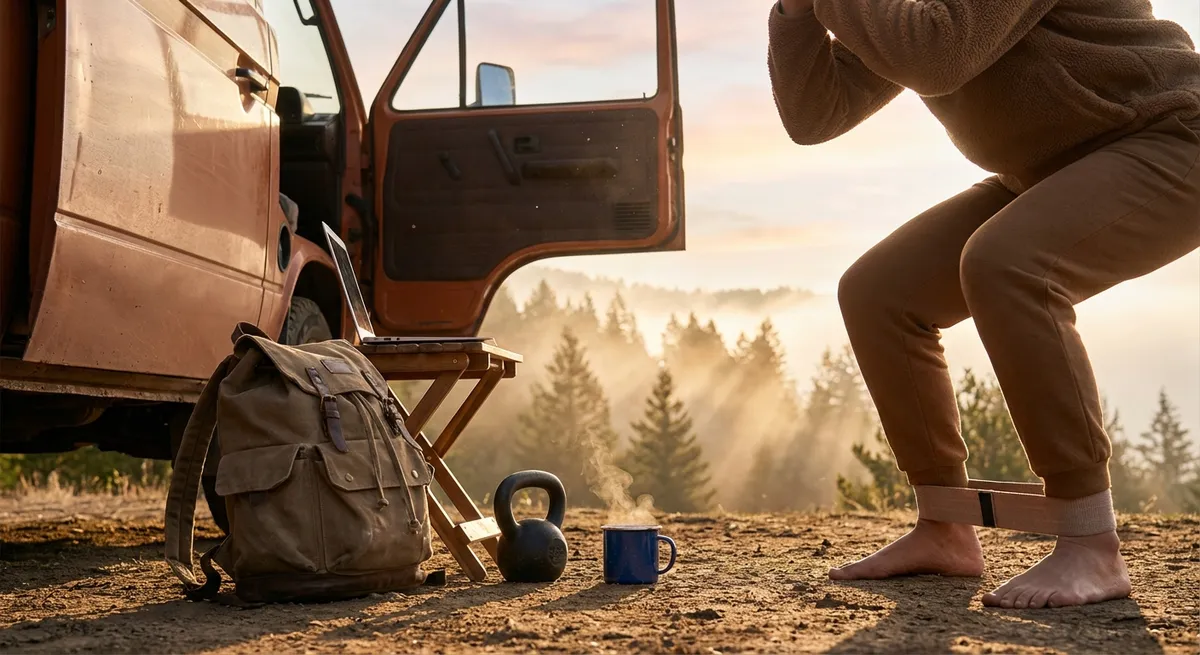
Your body doesn’t care if your “gym” is a jungle hostel, a night train, or a co-working space above a noodle shop—it just wants you to move. As a traveler or digital nomad, your health is the engine that keeps visas, client calls, and last‑minute flights from grinding you down. The good news: you don’t need a squat rack, a smoothie bar, or a stable postal address to stay strong.
You need portable habits, packable tools, and a mindset that treats every border crossing as a new training ground. This isn’t about perfection; it’s about staying adventure‑ready instead of spending your trips recovering from them.
Turn Transit Into A Training Ground
Layovers, bus stations, and long immigration lines are usually wasted, slouch-heavy time—but they can double as stealth training sessions. While waiting to board or staring down a departure screen, drop into standing calf raises, slow controlled squats, or isometric glute squeezes no one notices. Use columns or walls for supported single‑leg holds to wake up your hips after flights. On trains, walk the aisles every 30–40 minutes, adding walking lunges in the emptier sections. If you’re stuck in a cramped seat, cycle through ankle circles, seated marches, and tension holds where you press your knees into your hands for resistance. Treat every piece of downtime as a micro‑workout and it stops being “lost time” and becomes a moving, rolling gym schedule that doesn’t care what timezone you’re in.
Build A Three-Move “Anywhere Strength” Ritual
Instead of chasing perfect programs you can’t sustain on the road, lock in a tiny, non‑negotiable strength ritual you can do in a hostel hallway or a 2‑meter Airbnb balcony. Pick three compound moves that hit your whole body—like pushups, hip hinges or glute bridges, and a squat or lunge variation—and give them 10–15 focused minutes. Rotate hand positions or elevation for pushups to match your level, from hands-on-counter to feet-on-bed variations. Use backpacks as loading for slow good mornings or Romanian deadlifts, keeping your spine neutral while your hamstrings do the work. For legs, mix in reverse lunges, skater squats holding a doorframe, or slow tempo squats to make bodyweight challenging. Do this ritual on travel days and work days alike; let it become your reset button so your body knows, “No matter where we are, we’re still strong.”
Pack A Micro-Gym That Weighs Less Than Your Laptop
You don’t need heavy plates; you need smart tension. A flat resistance band loop, a long pull-up style band, and a lightweight jump rope can turn any room or rooftop into a training zone. Use the long band for rows by looping it around stair rails, balcony posts, or sturdy door hinges, balancing all that laptop hunching with upper-back strength. The loop band adds serious burn to monster walks, glute bridges, and pushups by applying sideways or downward tension. The rope is your portable conditioning tool: even five minutes of intervals—30 seconds skipping, 30 seconds rest—can light you up more than another half-hearted jog through an unfamiliar neighborhood. Store this micro-gym in an easy-to-grab pouch inside your daypack; when gear is frictionless to reach, workouts stop feeling like production and start feeling like a natural part of getting settled.
Sync Your Training With The Landscape You’re In
Your surroundings are free, ever‑changing equipment if you train your eyes to see them that way. Beach? Use the sand for barefoot sprints, lateral shuffles, and walking lunges that challenge your stabilizers. Mountain town? Turn gentle trails into uphill power hikes, using your backpack as added weight and pausing for sets of incline pushups on rocks or benches. City center? Stairs become your interval training: climb fast, walk down slow, add calf raises at the top, and switch to single-leg step-ups on lower steps. Jungle or park? Find a sturdy tree branch or park bar for hangs, rows, and assisted pullups. By letting the environment dictate the session—rather than forcing a “perfect” plan—you stay adaptable, less bored, and more connected to the actual place you’re in.
Treat Recovery Like An Essential Visa Stamp
Constant motion, time zone jumps, and new beds are a subtle form of stress that can quietly ambush your health if you ignore recovery. Keep a nightly wind‑down mobility circuit that takes 5–10 minutes: deep breathing, hip flexor stretches, thoracic spine rotations, and simple neck releases from long laptop sessions. Use a tennis ball or lacrosse ball (easy to pack) against a wall to roll out your upper back, glutes, and feet after long walks or flights. Hydration should be a daily mission—carry a collapsible bottle and set a rough target to refill it several times, especially in hot climates or high altitudes. Guard your sleep like you guard your passport: eye mask, earplugs, and a consistent “screens off” window before bed do more for your long-term performance than another espresso ever will. A nomad body that recovers well isn’t just fit; it’s durable enough to say yes to last-minute treks, sunrise hikes, and unexpected detours.
Conclusion
You don’t have to choose between real adventure and real fitness. With a few portable tools, a simple strength ritual, and the habit of turning every station, street, and stairwell into training space, your health becomes as mobile as your passport. The more your body can handle the chaos of travel, the more freedom you have to push beyond tourist mode and live like you actually belong on the road.
Pack light, move often, and let every new border be an invitation to explore what your body can do—not just where your ticket can take you.
Key Takeaway
The most important thing to remember from this article is that this information can change how you think about Nomad Health.