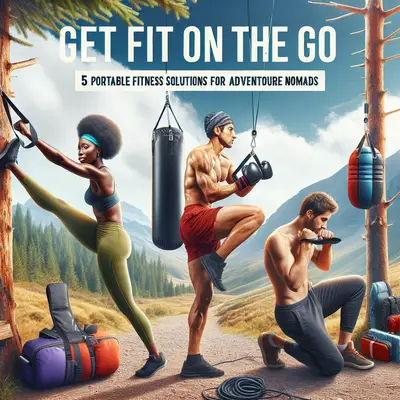
Travel doesn’t have to be a detour from getting stronger—it can be the upgrade. If your life swings between airport gates, night buses, and coworking spaces, your training needs to move as hard as you do. The right portable equipment turns train platforms into warm-up zones, rooftop terraces into strength labs, and tiny rentals into real training grounds.
This guide dives into practical, packable tools and five field-tested fitness tips for travelers and digital nomads who want adventure and progress, not one or the other.
Building a Pack That Trains as Hard as You Travel
Think of your bag as a mobile gym—every gram has to justify its spot. Instead of chasing fancy gadgets, focus on tools that multiply your options without eating your luggage allowance.
Start with gear that bends, folds, or compresses flat. Mini resistance bands weigh less than a pair of socks, yet can crush your glutes, shoulders, and core. A lightweight suspension trainer anchors to doors, trees, and sturdy beams, turning any stop into a full-body strength station. A compact jump rope can live in a side pocket and deliver brutal conditioning in minutes.
The key is overlap: pick tools that cover multiple movement patterns—push, pull, hinge, squat, carry, rotate. For example, one long loop band can become a row machine, deadlift bar, or loaded squat tool. Pack for versatility, not novelty. If a piece of gear doesn’t unlock at least five solid exercises, it probably doesn’t belong in a travel bag that already has to carry your whole life.
Core Portable Gear That Earns Its Luggage Space
Before your next flight, build a minimalist kit that punches above its weight. You don’t need everything—choose the mix that fits your style, space, and mode of travel.
- Long loop resistance band (medium–heavy)
This is your barbell stand‑in. Use it for banded deadlifts, rows, presses, good mornings, and assisted pull‑ups when you find a bar. Anchor it around poles, railings, or bed frames (sturdy ones only) and you’ve got instant resistance almost anywhere.
- Mini loop bands (light–medium)
These are joint‑friendly powerhouses. Fire up glutes before long walking days, stabilize hips after too many hours sitting, and build shoulder stability from cramped laptop sessions. They disappear into any backpack pocket.
- Suspension trainer or DIY strap system
Clip it to a door, tree branch, or playground bar and you’ve got rows, presses, lunges, curls, fallouts, and core work. It scales both ways: step closer for easier, step back for brutal. Ideal for long stays when you know you’ll have something to anchor to.
- Collapsible jump rope
Conditioning without treadmills or trackers. Ten minutes of intervals can outwork a long slog on a cardio machine. Rope work also hammers coordination, timing, and footwork—useful when you’re scrambling over rocks or sprinting for last‑call boarding.
- Packable yoga mat or towel alternative
Thin travel mats roll tight and fit in daypacks. If you’re ultralight, designate a microfiber towel or sarong as your floor layer. You’ll use it for mobility flows, core work, and post‑hike stretching without grinding your elbows into concrete.
Choose 2–4 of these and you’ve built a modular system that can shift from hotel room to beach, from bus stop to back alley without missing a session.
Five Field-Proven Fitness Tips for Travelers & Nomads
These tactics keep your training alive when your “gym” is a constantly changing continent.
1. Program for Chaos, Not Perfection
On the road, routine is a luxury. Instead of a delicate program that collapses when you miss a day, build a rugged framework that survives flight delays and surprise adventures.
Pick three pillars: push, pull, and legs/core. Rotate through them in order, no matter what day it is. If Monday’s flight kills your planned session, Tuesday simply becomes the next pillar. This reduces decision fatigue—when you land, you know exactly what type of session is next.
Even a 15–20 minute “micro‑session” per pillar keeps your strength signal loud enough that your body won’t downshift into “vacation mode” and start giving away hard‑earned muscle.
2. Train in Micro-Doses Throughout the Day
Long blocks of training are hard to protect when every day is a new city or new coworking pass. Micro‑dosing your training turns motion into your default state, not a scheduled event.
Use portable gear to drip-feed movement:
- Five banded squats and rows every time you finish a work sprint
- Ten pushups + 20 seconds of hollow hold between calls
- One short jump rope burst before showers or before leaving your room
Stack these mini‑sets across a day and you’ve logged serious volume without needing a 60-minute fortress of solitude. Your body doesn’t care if your total work arrives in one block or ten—effort still counts.
3. Anchor Workouts to Fixed Daily Milestones
Time zones shift; anchor points don’t. Attach training to events that always happen, no matter where you are: waking up, first coffee, or end of laptop time.
Examples:
- Wake-up anchor: 8–12 minutes of mobility and band work before you even check your phone.
- Pre‑work anchor: 10 minutes of strength (rows, squats, presses) with your bands or suspension trainer.
- Shutdown anchor: A short stretch flow on your travel mat to unload your spine after another day hunched over a screen.
By using events instead of clock times, you side‑step jet lag and scheduling collisions. The habit follows the ritual, not the time zone.
4. Use Your Destination as a Training Partner
Let the terrain become part of the program. Your portable gear doesn’t compete with your surroundings—it amplifies them.
- Beach in front of you? Warm up with bands, then sprint the shoreline.
- City park nearby? Anchor a band to a bench or rail and superset rows with step‑ups.
- Staircases in old towns or subway stations? Turn them into weighted climbs with your pack.
This approach keeps training aligned with the spirit of travel: explore, adapt, improvise. Your workouts start to feel less like “time stolen from the trip” and more like a deeper way of meeting the place you’re in.
5. Protect Your Joints from Laptop & Luggage Warfare
Travel and remote work are rough on joints: tight hip flexors from long sits, locked‑up upper backs from backpacks, angry wrists from marathon typing sessions. Portable gear is your counter‑attack.
Work in quick, joint‑focused drills:
- Mini band walks and clamshells to keep glutes online and knees happy
- Band pull‑aparts, face pulls, and Y‑raises to wake up neglected upper‑back muscles
- Light band curls and triceps pressdowns to pump blood into elbows and wrists after long keyboard sessions
Treat these as non‑negotiable maintenance, not “extra credit.” Strong, well‑lubricated joints let you actually enjoy long hikes, surf sessions, or that spontaneous street workout without feeling like you’re made of old airplane seat foam.
Making Portable Training a Permanent Part of Your Adventure
Portable equipment is more than a compromise for when you “can’t get to a gym.” It’s a mindset: be ready to train wherever your passport takes you. With a few smart tools and a chaos‑proof set of strategies, you can move countries, not just machines, and still keep your strength trending upward.
Instead of asking, “Is there a gym nearby?” you start asking, “What can I turn into training here, today?” That’s when travel and training stop colliding and start collaborating—your body becomes part of every trip’s story, not just the baggage that comes along for the ride.
Pack light, move often, and let your gear earn its ticket.
Sources
- [American Council on Exercise – Resistance Band Training 101](https://www.acefitness.org/resources/everyone/blog/7447/resistance-bands-101/) – Overview of benefits, safety, and exercise options with bands
- [Mayo Clinic – Exercise: 7 Benefits of Regular Physical Activity](https://www.mayoclinic.org/healthy-lifestyle/fitness/in-depth/exercise/art-20048389) – Evidence-backed reasons to maintain consistent movement while traveling
- [Harvard Health Publishing – Why Stretching Is Important](https://www.health.harvard.edu/staying-healthy/the-importance-of-stretching) – Details on mobility and flexibility for joint health on the road
- [Cleveland Clinic – Jump Rope Workout Benefits](https://health.clevelandclinic.org/jump-rope-workout) – Breakdown of cardiovascular and coordination benefits of jump rope training
- [Centers for Disease Control and Prevention – Physical Activity Guidelines for Adults](https://www.cdc.gov/physicalactivity/basics/adults/index.htm) – Official recommendations to help structure travel-friendly activity levels
Key Takeaway
The most important thing to remember from this article is that this information can change how you think about Portable Equipment.