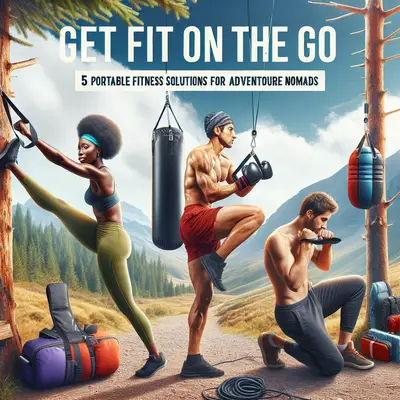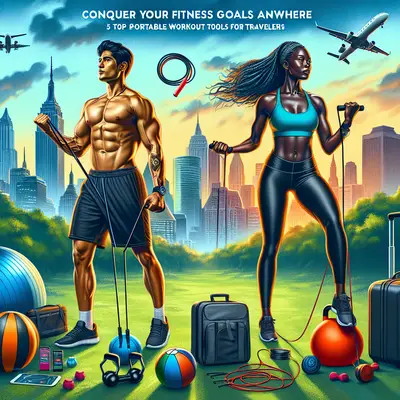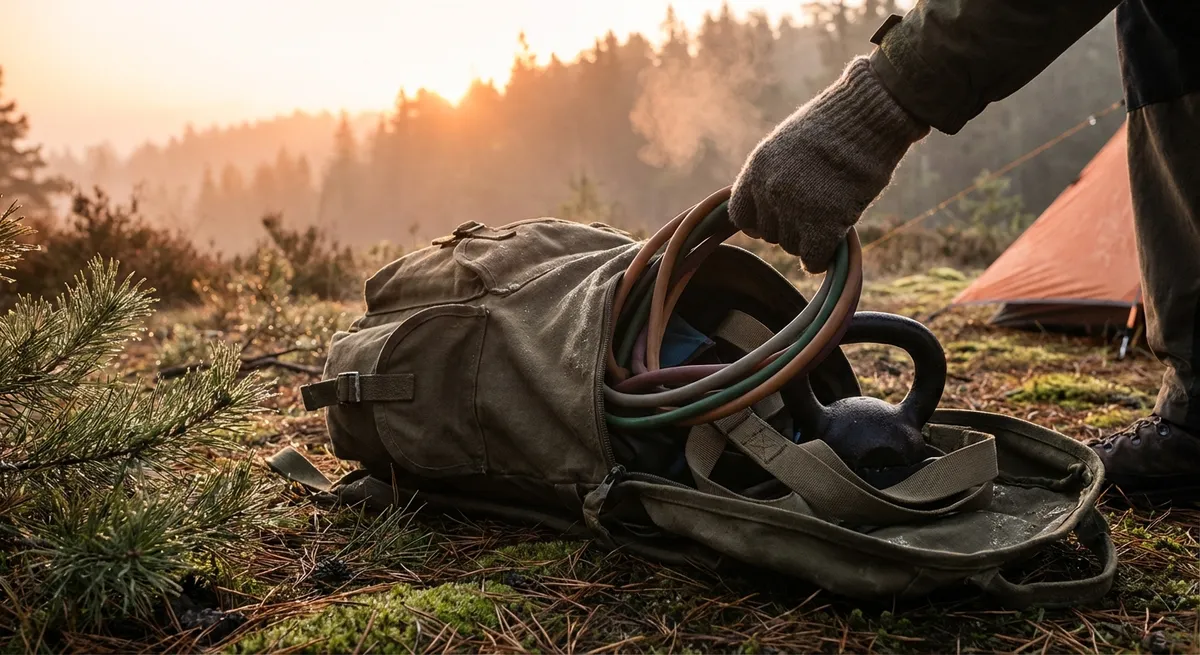
If your office view changes more often than your Zoom background, your training can’t depend on a local gym. Portable equipment is the secret weapon of travelers and digital nomads who want to stay strong without hauling a suitcase full of iron. Think of it as your trail-ready toolkit: compact, durable, and powerful enough to turn layovers, lunch breaks, and late nights into real training time.
This guide breaks down smart, packable gear and gives you five field-tested fitness tips to stay adventure-ready wherever you open your laptop.
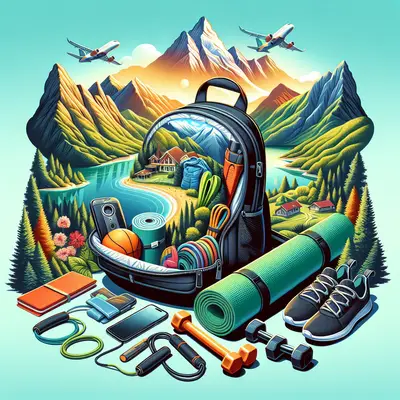
Build a “One-Bag” Training Kit
Before you start stuffing random gear into your carry-on, think like an ultralight backpacker: every item must earn its space and weight.
A solid one-bag training kit often includes:
- Long resistance band (loop or tube): Good for rows, presses, squats, and hip work.
- Mini loop bands: Perfect for glute activation, shoulder stability, and rehab-style work.
- Suspension trainer or doorway straps: Turns any solid anchor point into a full-body gym.
- Jump rope: Compact conditioning tool for when you don’t have space to run.
- Massage ball or mini roller: For working out desk and airplane stiffness.
Prioritize multi-use gear over single-purpose gadgets. A heavy loop band, for example, can replace a cable machine, assist with pull-ups, and add load to bodyweight moves. Aim to fit your kit into a packing cube or small pouch so it lives in your backpack, not buried at the bottom of your luggage.
Fitness Tip #1: Train a Movement, Not a Muscle Group
When you’re bouncing between cities, you don’t have time for complicated “chest day, back day” splits. Instead, organize your training around movement patterns you can hit anywhere:
- Push: Push-ups, band presses, dips between sturdy surfaces
- Pull: Band rows, suitcase rows with a backpack, towel rows anchored in a door
- Hinge: Hip hinges, single-leg Romanian deadlifts, good mornings with a band
- Squat: Split squats, goblet squats using a packed backpack
- Carry/Core: Suitcase carries, front-loaded carries, planks, dead bugs
This approach keeps your programming portable. In a tiny Airbnb, crowded hostel, or quiet patch of airport floor, you can run through these patterns with whatever you have available. Focus on slow, controlled reps and full range of motion—quality beats quantity when the “gym” is half a hotel room.
Fitness Tip #2: Use Bands to “Replace” Heavy Weights
Resistance bands are the nomad’s barbell—light in the bag, brutal on the muscles.
To get the most out of bands:
- Choke up on the band to increase tension when space is limited.
- Focus on time under tension: 3–4 seconds on the lowering phase of each rep.
- Try continuous tension sets (no rest at the top or bottom) for shoulder and arm work.
- Combine bands with bodyweight: banded push-ups, band-assisted pistols, banded hip thrusts.
You can mimic classic strength moves:
- Deadlift alternative: Stand on a heavy band, hinge at the hips, and drive up.
- Row alternative: Anchor the band in a door or around a post for horizontal rows.
- Press alternative: Step on the band and press overhead, or anchor behind you for band chest presses.
If you’re worried about durability, pick bands from reputable brands, avoid over-stretching, and inspect them for tiny cracks before you pull hard. Treated well, they’ll survive layovers longer than your patience.
Fitness Tip #3: Turn “Dead Time” into Micro-Sessions
Travel days can destroy routine—but they also hand you pockets of dead time that are perfect for short bursts of training.
Some portable tactics:
- 10-minute rule: Whenever you land in a new place, do one 10-minute mini-session before you open your laptop. Think: push-ups, band rows, squats, planks.
- Airport mobility: Use a quiet gate or corner for ankle rolls, hip circles, band pull-aparts, and neck stretches to undo the airplane fold.
- Work sprints: Every 60–90 minutes of laptop time, stand up for a 2–3 minute “reset” circuit: 10 band pull-aparts, 10 air squats, 20-second plank.
Micro-sessions add up. Over a full workday, six 10-minute blocks give you an hour of training without ever feeling like a full “workout.” The key is to decide in advance which tools you’ll use and where you’ll store them so they’re always within arm’s reach.
Fitness Tip #4: Choose Gear That Fits Each Travel Style
Not all nomads move the same way. Your perfect portable kit depends on how you travel.
- Backpack nomads and ultralight travelers:
Stick to a minimal kit—one long band, two mini loops, and a jump rope. This covers strength, mobility, and conditioning with almost no weight penalty.
- Slowmad apartment-hoppers:
You can add “semi-portable” gear like gymnastic rings, a compact suspension trainer, or a folding push-up bar. Leave them set up in your current base to anchor your routine.
- Road trippers and vanlifers:
You’ve got more space, so consider a weight-adjustable kettlebell or collapsible dumbbells. One heavy implement paired with bands can create brutally effective full-body sessions.
Whatever your style, avoid fragile gear that requires a perfect setup. If your equipment depends on a fancy frame, a specific doorway, or pristine surfaces, it will sit unused the moment your environment changes.
Fitness Tip #5: Anchor Recovery into Your Routine
Constant motion is hard on your joints, back, and sleep. A smart portable kit doesn’t just help you train harder—it helps you recover better, so you stay ready for the next hike, surf session, or surprise walking tour.
Simple portable recovery tools and tactics:
- Mini roller or massage ball: Work on calves, hip flexors, glutes, upper back, and feet after long travel days.
- Light band mobility: Shoulder dislocates, banded hip openers, and ankle mobilizations before and after flights or long work blocks.
- Floor time: Spend 5–10 minutes each night on the floor of your room doing gentle stretches and breathing—not scrolling.
Recovery doesn’t have to be a big event. Build tiny rituals: five minutes of banded mobility when you close your laptop, a few passes with the massage ball while your coffee brews, a short stretch sequence before bed. These small anchors give your body a consistent signal in an inconsistent environment.
Conclusion
You don’t need a fixed address to build a strong, capable body—but you do need a plan and the right tools. A well-chosen portable kit turns any space into a training ground: hotel floors, hostel courtyards, rooftop terraces, empty playgrounds, or quiet airport corners.
Lean on movement patterns instead of machines, use bands to create serious tension, break your training into travel-friendly micro-sessions, and pick gear that fits your style of motion. Treat your portable equipment like passport and power bank—non-negotiable essentials—and your body will stay adventure-ready, no matter where your next booking takes you.
Sources
- [American Council on Exercise (ACE) – Resistance Band Training: How-To, Benefits, and More](https://www.acefitness.org/resources/everyone/blog/7633/resistance-band-training-how-to-benefits-and-more/) - Overview of resistance band benefits, safety, and example exercises
- [Mayo Clinic – Exercise: How to Get Started](https://www.mayoclinic.org/healthy-lifestyle/fitness/in-depth/exercise/art-20048389) - Practical guidance on structuring exercise routines and making them sustainable
- [Harvard T.H. Chan School of Public Health – Physical Activity Guidelines](https://www.hsph.harvard.edu/obesity-prevention-source/obesity-prevention/physical-activity-guidelines/) - Evidence-based recommendations for activity levels and health outcomes
- [Cleveland Clinic – Deskercise: 20 Exercises You Can Do at Work](https://health.clevelandclinic.org/deskercise-20-ways-to-get-moving-while-you-work) - Ideas and rationale for short movement breaks during the workday
- [National Institutes of Health – The Benefits of Physical Activity](https://www.nhlbi.nih.gov/health/benefits-physical-activity) - Research-backed summary of how consistent physical activity supports long-term health
Key Takeaway
The most important thing to remember from this article is that this information can change how you think about Portable Equipment.