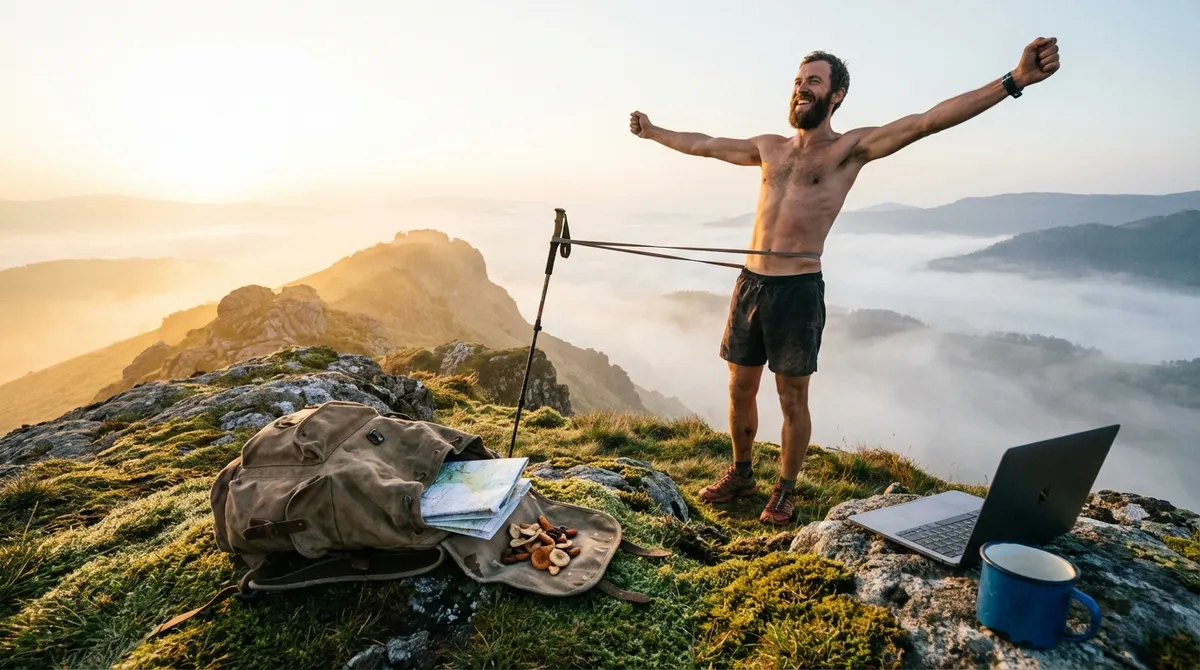
Your office might be a beach café in Portugal this week and a night train in Vietnam next week—but your body still has to haul your backpack, survive red-eyes, and power through spotty Wi‑Fi. Nomad health isn’t about chasing perfect routines; it’s about becoming durable enough to thrive in unpredictable conditions. Think of yourself as expedition gear: compact, reliable, and ready for impact.
This guide is built for travelers and digital nomads who want to stay strong without a “real” gym, rigid schedule, or checked luggage full of equipment. You’ll get five travel-tested fitness tactics you can deploy in tiny spaces, weird time zones, and long-haul days—no excuses, just portable solutions.
Build a “Non-Negotiable 10” for Days That Go Off the Rails
When flights get delayed, calls run long, and your hostel roommate snores like a chainsaw, a 60-minute workout is fantasy. A “Non-Negotiable 10” is a short, consistent fitness block you do daily, no matter what. It doesn’t replace full workouts—but it keeps your body primed and your habit alive.
Pick one time anchor you encounter every day on the road: waking up, post-shower, or right before you open your laptop. Then lock in a 10-minute mini-session tied to that anchor. For example:
- 2 minutes: brisk stair climbs or marching in place
- 3 minutes: push-ups (any variation)
- 3 minutes: air squats or lunges
- 2 minutes: plank holds or dead bug variations
The magic is in consistency, not intensity. On easy days, you’ll do more. On disaster days, this is your floor. Over weeks of travel, that ten-minute commitment adds up to hours of movement, better circulation during long travel legs, and a body that doesn’t feel like it’s starting from zero every Monday.
Treat your “Non-Negotiable 10” like brushing your teeth: boring, essential, and non-debatable.
Turn Transit Time Into a Mobility and Core Workshop
Your spine hates long-haul buses, economy seats, and those “ergonomic” airport chairs. Instead of surrendering to stiffness, use transit time as a stealth health window. You’re stuck there anyway; might as well leave the seat stronger than you found it.
On planes, trains, and buses:
- Every 30–45 minutes (as safety allows): stand, walk the aisle, roll your ankles, and do gentle calf raises.
- Seated hip reset: Sit tall, cross one ankle over the opposite knee, and gently press the elevated knee down for a hip stretch. Alternate sides.
- Neck and upper-back rescue:
- Slow neck circles within a comfortable range
- Shoulder rolls (forward and back)
- Scapular squeezes: pull shoulder blades together, hold 5 seconds, release
For your core, use micro-movements:
- Seated “anti-slouch” brace: Sit tall, exhale fully, gently brace your core like you’re preparing for a light punch, hold for 5–10 seconds, then release. Repeat periodically.
- Oblique activation: Hands on thighs, gently press right hand into right thigh as you resist with your core, hold 5 seconds, switch sides.
These aren’t Instagram-worthy workouts, but they’re practical armor against back pain, swollen ankles, and that post-flight “I’m 30 years older” feeling. Make mobility your transit ritual and you’ll arrive with more energy—and fewer emergency painkillers.
Pack a Micro-Toolkit: One Band, One Handle, Infinite Workouts
You don’t need a suitcase full of dumbbells. A single long resistance band with handles (or a loop band plus a door anchor) can turn almost any space into a portable training ground. It weighs almost nothing, takes up less room than a T-shirt, and slides into a side pocket of your backpack.
With one medium-resistance band, you can cover:
- Upper body: rows (anchor to a door hinge or railing), chest presses, overhead presses, triceps extensions, biceps curls, face pulls
- Lower body: banded squats, Romanian deadlifts (RDLs), lateral walks, hip thrusts (anchor under your back), glute bridges
- Core: Pallof presses (anti-rotation), woodchops, resisted dead bugs
Sample band session you can do in a hostel hallway or balcony:
- 12–15 band rows
- 10–12 band chest presses
- 10–15 band squats
- 8–12 band RDLs
- 8–10 Pallof presses per side
Repeat 2–4 rounds depending on time and energy. No gym, no problem.
If you want to level up while keeping your pack light, your micro-toolkit can include:
- 1 long resistance band (with or without handles)
- 1 mini-loop band
- Lightweight jump rope (if ceilings and neighbors allow)
This trio lets you build strength, power, and conditioning in a space the size of a budget hotel bathroom.
Use the City as Your Unofficial Training Ground
You don’t have to choose between exploring and exercising; you can make the city your workout partner. Instead of hunting for a gym, look for stairs, hills, parks, and public structures that invite movement.
Tactics to turn any destination into a training loop:
- Stair scouting: Airport stairwells, metro exits, hilltop viewpoints, old town ramparts. March, run, or lunge your way up; walk down under control.
- Park circuits: Bench push-ups, step-ups, Bulgarian split squats, triceps dips, and incline planks. Use a timer (e.g., 30 seconds on, 15 off) and rotate moves.
- Urban rucking: Load your daypack a little heavier than usual and walk the city instead of hailing a taxi. Keep a brisk pace, take the long route, and chase elevation when possible.
- Beach or trail sprints: If you’re near sand or dirt, do short, controlled sprints or hill repeats with long walks in between.
Combine exploration with intent: choose a neighborhood loop, mark a few “mini-gyms” (staircases, playgrounds, quiet plazas), and stop for movement breaks along the way. You’ll see more of the city, log thousands of extra steps, and keep your cardiovascular engine tuned without ever scanning a QR code for a day-pass.
Anchor Recovery to Your Sleep and Wi‑Fi Habits
Training hard on the road is useless if you’re chronically wrecked. Travel stress, irregular sleep, new foods, and constant decision fatigue can drain recovery faster than any workout. The key is to piggyback recovery onto things you already do: sleeping and scrolling.
Before bed, give yourself a 5–8 minute wind-down:
- 3–5 slow breaths: in through the nose for 4 seconds, out for 6–8 seconds.
- 60–90 seconds: gentle hamstring or hip flexor stretch per side.
- 60 seconds: chest and shoulder stretch (doorway or wall).
- Optional: 1–2 minutes of legs-up-the-wall if space allows to ease lower-body fatigue.
When you instinctively reach for your phone or laptop, trade the first two minutes of scrolling for simple recovery “taxes”:
- Wi‑Fi loading tax: While your VPN connects or a big file uploads, hold a plank, do 15–20 air squats, or run through some shoulder mobility.
- Notification tax: Every time you open social media, take 3 slow breaths and drink a few sips of water first.
Add basic nutrition guardrails that survive any country:
- Aim for a source of protein at each meal (eggs, yogurt, tofu, beans, meat, fish).
- Keep a backup stash of portable options (nuts, jerky, roasted chickpeas, protein packets/bars) for long transit days.
- Use the “one anchor meal” rule: even when your day is chaos, pick one meal where you prioritize whole foods, hydration, and veggies.
Sustainable nomad health is less about perfection and more about stacking these small, repeatable recovery habits onto the rhythms you already have.
Five Travel-Ready Fitness Tips in One Snapshot
Here are the core tactics you can keep in your back pocket as you roam:
- Lock in a daily “Non-Negotiable 10.” A short, consistent routine beats occasional heroic workouts.
- Treat transit time as movement time. Sneak in mobility, core bracing, and brief walks every 30–45 minutes.
- Carry a micro-toolkit. One band (plus a mini-loop if possible) gives you a full-body strength system in any room.
- Use the city as your training ground. Stairs, parks, and streets can cover your cardio and strength if you move with intent.
- Anchor recovery to sleep and screen time. Pair breathing, stretching, and hydration with your existing digital and bedtime habits.
Conclusion
You don’t need home turf to build a strong, adventure-ready body. You need portable tools, flexible plans, and a willingness to treat every layover, alleyway, and hostel corridor as potential training ground. Nomad health is about becoming robust enough to handle missed buses, red-eye flights, and surprise hikes without falling apart.
Travel will always be messy. Your workouts don’t have to be perfect—they just have to be consistent, compact, and clever. Pack your band, claim your “Non-Negotiable 10,” and let every new city test—not break—your strength.
Sources
- [Centers for Disease Control and Prevention – Physical Activity Guidelines](https://www.cdc.gov/physicalactivity/basics/index.htm) - Overview of recommended activity levels for adults and why consistency matters
- [World Health Organization – Physical Activity Factsheet](https://www.who.int/news-room/fact-sheets/detail/physical-activity) - Global guidance on activity benefits and minimum movement targets
- [Harvard Health – The Importance of Stretching](https://www.health.harvard.edu/staying-healthy/the-importance-of-stretching) - Evidence-based insights on flexibility, mobility, and injury prevention
- [Cleveland Clinic – How to Improve Your Sleep Schedule](https://health.clevelandclinic.org/how-to-fix-your-sleep-schedule) - Practical strategies for stabilizing sleep, useful when switching time zones
- [American Council on Exercise – Resistance Band Training Basics](https://www.acefitness.org/resources/everyone/blog/744/8-benefits-of-resistance-bands/) - Benefits and best practices for safe, effective band workouts
Key Takeaway
The most important thing to remember from this article is that this information can change how you think about Nomad Health.