Your passport has more stamps than your gym membership has visits—but your body still craves real work. You don’t need a squat rack to feel like a powerhouse on the move; you just need a plan that fits in a backpack and survives delays, detours, and dodgy Wi‑Fi.
This is your field guide to staying strong on the road: no hotel gym required, no perfect schedule needed, just portable strategies that travel as hard as you do.
Build a “Micro-Session” Mindset, Not a Perfect Routine
Travel shreds routines: red-eyes, time zones, and last‑minute tours make a 60‑minute workout fantasy-level unrealistic. Instead of waiting for the perfect window, shrink your expectations and multiply your opportunities.
Think in “micro-sessions”: 5–15 minute hits you can drop anywhere—gate areas, hostel courtyards, Airbnb balconies, quiet streets. Three micro-sessions in a day can rival one long workout: a strength block in the morning, mobility mid‑day, conditioning in the evening. This approach works with jet lag instead of fighting it: when you wake up at 4 a.m. in a new time zone, that’s a built‑in movement slot. Short, frequent movement also helps counter long‑haul stiffness, improves circulation, and keeps your nervous system alert so you’re less tempted to crash on every couch you see.
Stop chasing a perfect program; chase consistency you can actually execute in transit. The win is not “I did everything,” it’s “I moved, again, today.”
Tip 1: Turn Your Backpack into a Traveling Gym
That pack on your shoulders is more than a luggage problem—it’s a portable weight set.
First, standardize your load: aim for 8–15 kg (18–33 lbs) in your main backpack when possible so you can reliably use it for training. Pack heavy items (electronics, books, chargers, water bottle) close to your spine so the bag sits tight and doesn’t flop around mid‑set.
Now treat it like gear:
- Backpack front squats: Hug the pack to your chest, feet shoulder-width, sit deep, drive up hard.
- Backpack rows: Hinge at the hips, neutral spine, pull the pack to your ribs, pause, lower with control.
- Backpack presses: Stand tall, press overhead, lock out, lower slowly—great on balconies and in parks.
- Loaded stair climbs: In hostels, hotels, or metro stations, climb stairs with your pack for a serious leg hit.
- Farmer carries (if you have two smaller bags): One in each hand, walk tall, brace your core.
Anchor these moves to daily travel: every check‑in could mean 3 sets of squats and rows, every stairwell a mini leg session. The bag that slows you down becomes the reason you stay strong.
Tip 2: Use Bodyweight “Clusters” to Fight Long Travel Days
When your day is broken by flights, trains, or endless bus rides, you need something that fits into weird little pockets of time and space. Enter “clusters”: tight bundles of 2–3 bodyweight moves that you repeat several times across the day.
Pick a cluster that fits your environment:
- Airport cluster: Wall push‑ups, slow calf raises, deep air squats.
- Hotel room cluster: Incline push‑ups on the bed, split squats, deadbugs for your core.
- Outdoor cluster: Bench dips, step‑ups, incline push‑ups on a park rail.
Example pattern: every time you get up to use the bathroom on a long flight or during a layover, hit one round of your cluster: 10–15 reps per move. Over a 10–12 hour travel window, you might sneak in 5–8 rounds—essentially a full workout, distributed so it never feels brutal.
Clusters keep your joints from locking up, reduce that “I’ve been folded in half all day” feeling, and maintain movement patterns (push, pull, squat, hinge, core) even when you’re living in economy seating.
Tip 3: Pack One Tiny Piece of Gear That Multiplies Your Options
You don’t need a suitcase of equipment; you just need one thing that dramatically expands your training menu without wrecking your carry‑on.
Two reliable options for nomads:
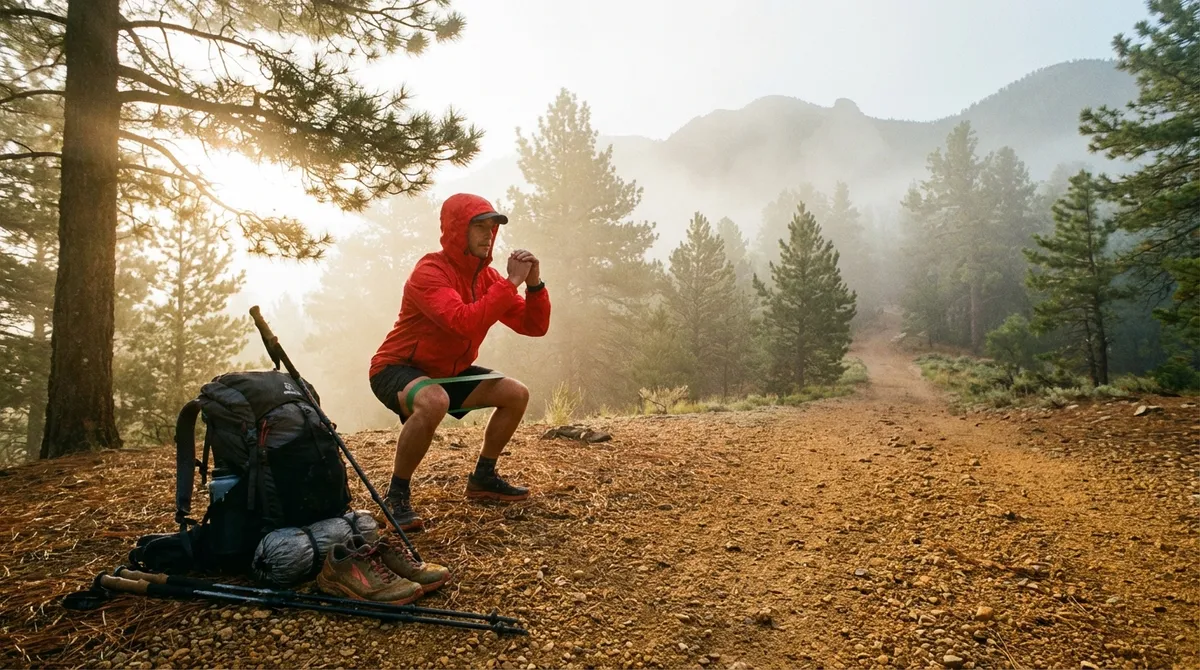
- Mini resistance bands (loop bands):
- Glute bridges with band
- Lateral walks in hotel hallways (quiet and joint‑friendly)
- Banded rows around a bedpost or railing
- Banded push‑up plus (wrap the band across your back, under your palms)
- A lightweight suspension trainer or strong travel yoga strap:
- Rows off any sturdy door or beam
- Assisted single‑leg squats
- Chest fly variations
- Assisted mobility work for tight hips and shoulders
Store your chosen item in the most accessible part of your bag so it’s the first thing you see when you drop your backpack in a new room. Your friction to start becomes almost zero: door, band, go.
A single band or strap weighs almost nothing but can turn a bare-bones hostel or a remote mountain guesthouse into a fully functional training zone.
Tip 4: Sync Your Movement with the Landscape You’re In
Your environment is free equipment. Each location offers its own “terrain advantage”—use it and your training becomes part of the adventure instead of something you squeeze in.
Urban jungle?
- Stair sprints on metro steps, fast walks between landmarks, single-leg step‑ups on benches.
- Treat every city hill as a hill repeat opportunity; walk up hard, stroll down.
- Sand sprints or walking lunges on the shore.
- Planks and push‑ups where the tide line meets firm sand.
- Barefoot walking (where safe) to wake up your feet and ankles.
- Brisk hikes as low-impact conditioning.
- Pack-loaded hill climbs for leg strength and serious cardio.
- Log or rock carry variations if you’re in a safe, stable area.
Coastal town?
Mountains or countryside?
Instead of “I missed leg day,” think “I trained specifically for where I am.” Your lungs remember the hill repeats in Lisbon. Your calves remember the temple stairs in Kyoto. Your glutes remember slogging up that Andean side trail with a loaded pack. Training becomes another way of exploring, not a chore competing with your bucket list.
Tip 5: Create a 15-Minute “Any Room” Workout You Can Do from Memory
You need one reliable, no-thinking-required session you can run in almost any space: hotel room, dorm, cabin, airport quiet corner. Memorize it once so you can deploy it when you’re tired, rushed, or overwhelmed.
Here’s a sample full-body template you can adapt:
Warmup (3 minutes)
- 20 arm circles (forward/backward)
- 10 slow bodyweight good mornings (hinging at hips)
- 15 hip circles each side
- 10 deep squats with reach overhead
Main circuit (10 minutes)
Rotate through, repeating as many quality rounds as you can in 10 minutes:
- 10–15 push‑ups (full, incline on bed/desk, or from knees)
- 12–16 split squats (each leg, using a chair or bed for balance if needed)
- 8–12 backpack rows (or towel/sheet rows if you can safely anchor)
- 20‑second plank (front) + 20‑second side plank per side
- Slow forward fold, 30–45 seconds
- Hip flexor stretch each side, 30 seconds
- Chest/shoulder doorway stretch or arms behind back, 30 seconds
Cool down (2 minutes)
Keep the structure, but customize the moves as you get stronger or encounter different types of spaces. The goal: if your phone dies, the Wi‑Fi fails, and your plans change, you still have a complete, portable session in your head that demands nothing but floor space and gravity.
Conclusion
Travel doesn’t have to be the enemy of your strength—it can be the proving ground for it. When you train with backpacks instead of barbells, stairs instead of step machines, and micro-sessions instead of marathon workouts, you build a body that matches your lifestyle: adaptable, resilient, and ready for whatever the map throws at you next.
You might never see the same gym twice, but your body doesn’t care about brand logos; it cares about tension, consistency, and effort. Pack light, move often, and let every border crossing double as another chapter in your training log.
Sources
- [Centers for Disease Control and Prevention – Physical Activity Basics](https://www.cdc.gov/physicalactivity/basics/index.htm) - Guidelines on recommended weekly activity levels and benefits, useful for framing travel workouts around evidence-based targets
- [World Health Organization – Physical Activity](https://www.who.int/news-room/fact-sheets/detail/physical-activity) - Global recommendations on movement for health, including relevance for adults with sedentary (e.g., travel-heavy) lifestyles
- [Harvard T.H. Chan School of Public Health – Benefits of Physical Activity](https://www.hsph.harvard.edu/nutritionsource/benefits-physical-activity/) - Summarizes research on short and accumulated bouts of activity, supporting the micro-session approach
- [American Heart Association – Staying Active While Traveling](https://www.heart.org/en/healthy-living/fitness/getting-active/staying-active-while-traveling) - Practical strategies and tips for fitting in movement during trips
- [Mayo Clinic – Travel and Deep Vein Thrombosis](https://www.mayoclinic.org/diseases-conditions/deep-vein-thrombosis/in-depth/travel-dvt/art-20046098) - Explains why movement during long travel (e.g., flights, buses) is important for circulation and health
Key Takeaway
The most important thing to remember from this article is that this information can change how you think about Travel Workouts.