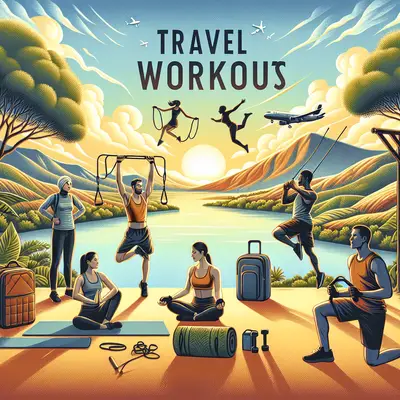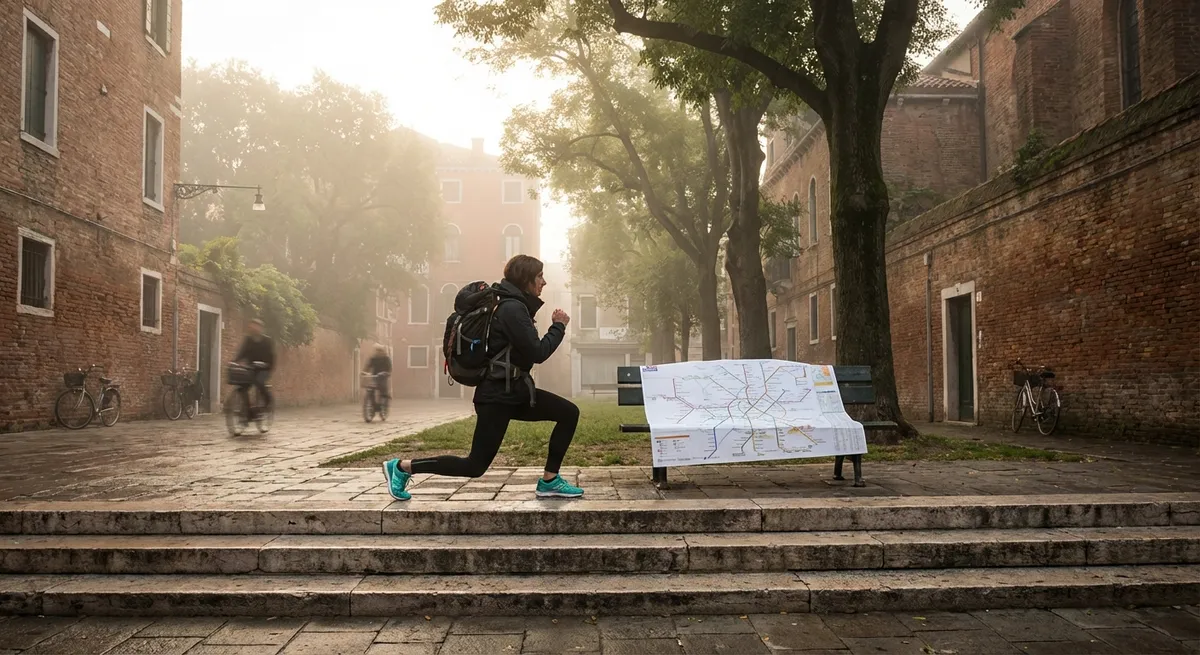
When your life is measured in border crossings and booking confirmations, “I’ll start when I’m home” doesn’t cut it. Your body has to be as ready as your passport. This isn’t about beach abs; it’s about building a travel-tough engine that keeps you hiking farther, carrying heavier packs, and bouncing back faster from red-eyes and long work days.
If you’re a traveler or digital nomad, your gym is wherever your backpack lands. Here’s how to turn every stopover into a training ground—and stay strong enough to chase the next horizon.
Build a “No-Excuse” Micro-Workout Ritual
When your environment changes constantly, habits need to be ultra-simple and ultra-portable. Instead of chasing perfect 60-minute sessions, design a “micro-ritual” you can run anywhere in 10–15 minutes—hostels, airport corners, or tiny apartments.
Pick 4–6 moves that require zero equipment and hit major patterns: push (push-ups or incline push-ups), pull (doorframe isometrics or backpack rows), squat or lunge, hip hinge (good mornings), and core (planks, dead bugs, or hollow holds). Run them as a circuit for time instead of strict reps—say 30 seconds on, 15 seconds off, 2–4 rounds.
Tie this ritual to an existing travel anchor: right after you brush your teeth in the morning, or as soon as you close your laptop for the day. The goal isn’t perfection; it’s consistency. Even on “travel chaos” days, commit to just one round. Often, once you start moving, you’ll want to keep going—but even the minimum dose keeps your body primed between big adventures.
Turn Transit and Sightseeing Into Stealth Training
Travel days and exploration time don’t have to be training black holes; they can be the workout if you manage intensity on purpose. Think of your day in layers: base movement, short strength hits, and brief higher-intensity bursts.
Walk whenever distance and safety allow. Take the long way through new neighborhoods, climb actual stairs instead of escalators, and pick a landmark just far enough away that you have to hustle a bit to make your dinner reservation. Use the “10-minute rule”: if somewhere is a 10–15 minute walk, that’s an automatic walk, not a ride.
During layovers or long train waits, break up sitting with “stealth” strength: slow calf raises while you stand in line, wall sits near your gate, hip flexor stretches in quiet corners, and suitcase or backpack farmer carries up and down the terminal. You’re not trying to crush yourself—just drip small doses of work into otherwise idle time. Over a multi-leg trip, those sneaky micro-sessions add up to serious volume.
Pack One Versatile Tool and Master Bodyweight Basics
You don’t need a traveling gym; you need one reliable tool and a strong bodyweight foundation. If you like having gear, a single medium-strength resistance band or a lightweight suspension trainer can turn any door, tree, or balcony into a strength station without triggering airline baggage drama.
But gear is useless if you haven’t mastered the fundamentals. Prioritize variations you can scale up or down depending on your energy and space: elevated push-ups on a bed frame, slow tempo squats, split squats using a chair, hip thrusts on a couch, and “wall pull” isometrics where you try to pull yourself toward a sturdy edge without actually moving. Play with tempo, pauses, and single-leg versions to keep progression alive even without heavier weights.
Use your environment as training architecture: suitcases become deadlift loads, water bottles become light dumbbells, towels become sliders on smooth floors. If it fits in your carry-on and doesn’t attract TSA attention, it’s fair game for creative resistance.
Sync Workouts With Time Zones and Sleep Recovery
Your nervous system doesn’t care that you’re excited to explore; if your sleep is wrecked, hard training can dig you into a hole. On heavy travel days and the first 24–48 hours in a new time zone, treat your training like a “systems reboot,” not a test of toughness.
Early local-time light movement—walking outside, easy mobility, and a short, low-intensity circuit—can help anchor your circadian rhythm, especially if you get morning sunlight while you move. Think gentle, compound moves: bodyweight squats, light band rows, cat-cow and thoracic rotations, deep breathing. This combo supports blood flow, reduces stiffness from sitting, and helps your brain register the new schedule.
Save higher-intensity intervals or demanding strength work for when you’ve had at least one decent night’s sleep in the new zone. When in doubt, underdose intensity and overdose consistency. A sustainable pattern of “good enough” sessions beats a heroic workout that knocks you out for two days of your trip.
Use Simple Metrics to Stay Strong on the Road
Progress is harder to measure when you don’t have the same barbell or machines every week, so you need travel-friendly benchmarks. Pick a few bodyweight standards you can test every 2–4 weeks no matter where you are: max strict push-ups, time for a 1 km run or uphill walk, max hang from a pull-up bar or stable ledge, and plank or wall sit holds.
Track how many quality reps or seconds you can maintain before form breaks. If you’re holding or slowly improving these numbers while juggling flights, Wi-Fi battles, and language barriers, your travel training is doing its job.
Use a simple weekly checklist instead of chasing perfection:
- 2–3 strength-focused sessions (15–40 minutes)
- Most days with at least 7–8k steps or equivalent movement
- 1–2 higher-intensity or “breathing hard” efforts (sprints, hill climbs, stairs)
- Daily mobility snack (5–10 minutes of hips, shoulders, and spine work)
Check off what you hit rather than obsessing over what you missed. The road is unpredictable; your plan needs enough structure to keep you honest and enough flexibility to survive delays, detours, and surprise adventures.
Conclusion
Travel doesn’t have to be a detour from your fitness—it can be the training ground that makes you more capable, adaptable, and resilient than any stationary routine. When your workouts fit in a backpack and your “gym” is whatever city you wake up in, strength stops being a place you go and becomes something you carry.
Keep your ritual simple, your gear minimal, and your expectations realistic but consistent. The goal isn’t to train around your adventures; it’s to train in a way that lets you say yes to more of them.
Sources
- [CDC Physical Activity Basics](https://www.cdc.gov/physicalactivity/basics/index.htm) - Guidelines on weekly movement, intensity, and health benefits
- [American College of Sports Medicine – Exercise on the Road](https://www.acsm.org/docs/default-source/files-for-resource-library/exercising-on-the-road.pdf) - Practical recommendations for staying active while traveling
- [Harvard Health – The Importance of Strength Training](https://www.health.harvard.edu/staying-healthy/the-importance-of-strength-training) - Why maintaining muscle and strength matters for long-term health and function
- [National Sleep Foundation – Crossing Time Zones](https://www.thensf.org/getting-good-sleep-when-traveling-and-crossing-time-zones/) - How travel and jet lag affect sleep and strategies to adjust
- [Mayo Clinic – Fitness: Tips for Staying Motivated](https://www.mayoclinic.org/healthy-lifestyle/fitness/in-depth/fitness/art-20047680) - Behavior strategies for consistency when routines and environments change
Key Takeaway
The most important thing to remember from this article is that this information can change how you think about Travel Workouts.