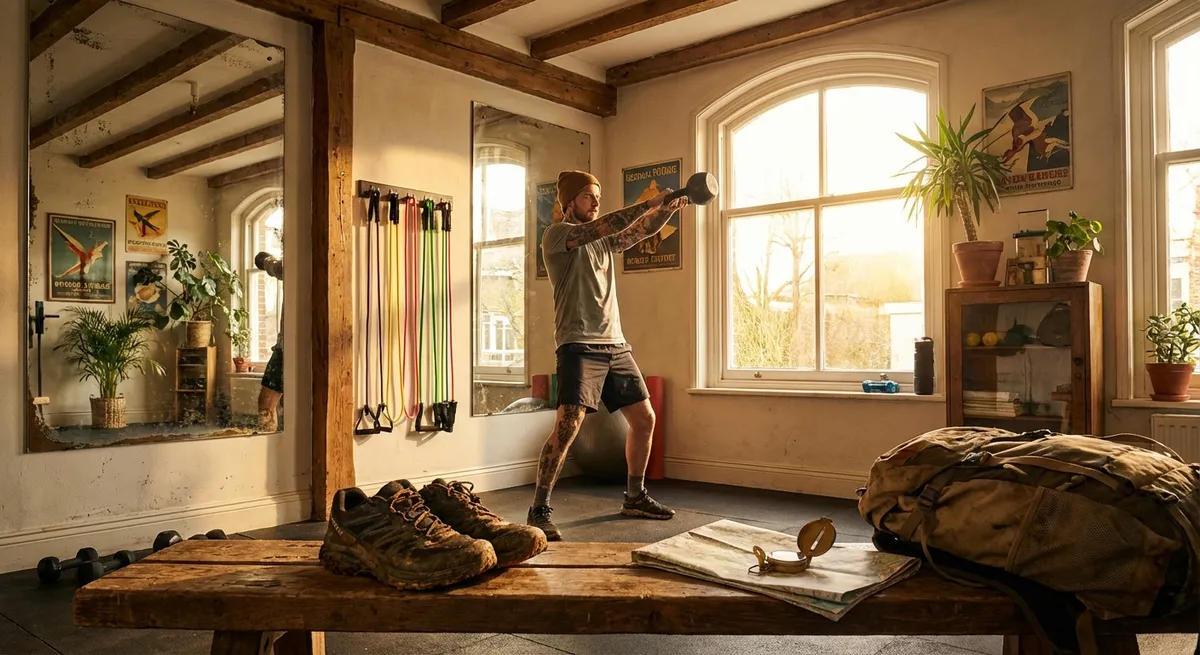
Hotel room key in one hand, Wi‑Fi password in the other, and a full day of exploring on the horizon—where does fitness fit in? For travelers and digital nomads, staying strong on the road isn’t about perfect routines or fancy facilities. It’s about portable habits that move with you, from capsule hotel to five-star suite.
This guide is your field manual for making hotel gyms, lobbies, and even stairwells work in your favor—so your body can keep up with your passport stamps.
Rethinking the Hotel Gym: From Afterthought to Adventure Base
Most travelers treat the hotel gym like the “maybe later” button on a software update: always there, never used. Flip that script and think of it as your daily launch pad.
Before you even unpack, scout the hotel’s fitness options like you’d scout a new trail. Take a quick walk-through: check the dumbbell range, any cable machines, cardio gear, and whether there’s enough floor space for bodyweight work. Snap a couple of photos so you can plan sessions in your room without guessing what’s available.
If the gym is tiny, crowded, or closed, don’t bail—adapt. Hallways, stairwells, and even that strip of carpet between the bed and the window can become training ground with the right plan. The goal isn’t a perfect workout; it’s consistent movement that keeps your joints mobile, your core awake, and your head clear for the day’s adventures.
By reframing the hotel gym as your daily “systems check”—instead of a chore—you’ll start each day feeling less jet-lagged and more expedition-ready, no matter the city.
Tip 1: Turn Mornings Into a 15-Minute “Adventure Warmup”
Think of your first 15 minutes on the ground as pre-expedition prep, not doom-scroll time.
Roll out of bed and move through a simple sequence that wakes up your hips, spine, and shoulders. Start with slow neck rolls and shoulder circles, then cat-cow or standing spine waves to undo flight posture. Add dynamic moves like reverse lunges with a reach, hip circles, and ankle rocks to prime your joints for long walking days. Finish with a short burst—maybe 30 seconds of fast air squats or mountain climbers—to spike your heart rate.
This “adventure warmup” does two key things: it reduces stiffness from flights and mattresses your body isn’t used to, and it mentally anchors your day around movement. No equipment, no gym, no excuses—just a ritual between waking up and whatever the day throws at you.
To keep it travel-friendly, memorize a base routine you can run on autopilot. When you’re jet-lagged, the last thing you want is decision fatigue about what to do next. Set a 15-minute timer, hit play on a favorite playlist, and move until it buzzes.
Tip 2: Pack a Micro-Kit That Multiplies Hotel Options
You don’t need a full gym in your suitcase—just a few strategic pieces that turn any hotel into a training zone.
A lightweight resistance band or two can become a portable cable machine: anchor it in a door frame or around a sturdy table leg for rows, presses, pulls, and hip work. A mini-loop band fits in your back pocket and turns glute bridges, clamshells, and lateral walks into serious strength builders. If you can spare a bit more space, a compact suspension trainer lets you use doorways and beams for rows, presses, and core drills.
The real magic is stacking your micro-kit with hotel furniture. Use a desk chair for elevated pushups and Bulgarian split squats. Use a suitcase as a weight for goblet squats or loaded carries down the hallway. Even a rolled towel can become a slider for hamstring curls or core work on slick floors.
By carrying a simple kit, you stop being dependent on whatever random equipment the hotel happened to buy. Your body gets consistency; your training doesn’t get derailed by a broken treadmill or a single dusty dumbbell.
Tip 3: Build “Exploration Intervals” Into Your Travel Days
Instead of separating workouts and adventure, layer them.
Walkable cities are stealth cardio goldmines. Turn sightseeing into an informal interval session: power-walk between landmarks, then slow down to explore, take photos, or grab coffee. Use hills, long staircases, or bridges as natural intensity spikes—climb them with purpose, then recover as you wander the next street.
If you’re working remotely, break up laptop marathons with movement missions. Between calls, climb hotel stairs for 5–10 minutes, then drop into a few sets of pushups or air squats back in your room. That pattern—short bursts of effort throughout the day—can rival a single, longer workout in health benefits, especially for cardiovascular fitness and blood sugar control.
The key is intent. When you leave the hotel, decide how you’ll move, not just where you’ll go. The city becomes your training ground: park benches for step-ups, railings for incline pushups, empty plazas for walking lunges. You’re not “fitting in” exercise; you’re living it as you explore.
Tip 4: Anchor Strength Training to a Daily Habit You Already Have
When time zones blur, willpower gets unreliable. Habit hooks save you.
Tie your strength work to something you never skip—like brushing your teeth, your first coffee, or shutting your laptop for the day. For example, “After my morning shower, I do my 10-minute strength block,” or “When I close my laptop at night, I hit three rounds of my core circuit before I check messages again.”
Choose 4–6 moves that hit your whole body with minimal setup: pushups or an incline variation, squats or split squats, a hinge (like hip bridges), a pull (band rows or suitcase rows), and a core move (dead bugs, hollow holds, or plank variations). Keep the reps modest and consistent—enough to feel challenged, not wrecked. You want something sustainable for a week in Tokyo and a month in Lisbon.
By attaching strength to a daily ritual, your training stops being dependent on your schedule, mood, or jet lag. It becomes part of the scaffolding of your day—portable, automatic, and surprisingly resilient to chaos.
Tip 5: Use Recovery as Your Secret Performance Edge on the Road
Adventure doesn’t reward the most exhausted traveler; it rewards the one who recovers well enough to say yes to tomorrow’s hike, surf session, or sunrise walk.
Sleep is your primary performance enhancer. Use hotel tools to stack the deck: black out the room with curtains or an eye mask, block hallway noise with earplugs or a white-noise app, and keep your phone out of arm’s reach to avoid midnight scrolling. If you’re crossing time zones, aim for natural light exposure in the morning and keep screens dim in the evening to help your internal clock recalibrate.
Your “cooldown kit” can be just as minimal as your training kit. A tennis ball or lacrosse ball doubles as a portable massage tool for calves, glutes, and upper back against a wall. Simple legs-up-the-wall or feet-on-the-bed positions after long travel days can help with circulation and reduce lower-body heaviness. Gentle stretching or mobility work before bed signals your nervous system that it’s time to downshift.
On the road, you’re always making trade-offs. Protecting your recovery—hydration, sleep, and a few minutes of mobility—means you can keep stacking experiences without your body waving the white flag halfway through the trip.
Conclusion
Your passport might say “tourist,” but your habits can say “expedition-ready.” Hotel fitness isn’t about chasing perfect programs or hunting for the fanciest gym; it’s about making wherever you land work for your body and your goals.
With a 15-minute morning warmup, a small but mighty gear kit, exploration-based intervals, anchored strength habits, and deliberate recovery, you can stay strong, clear-headed, and ready for whatever new city, trail, or timezone comes next.
Travel doesn’t have to put your fitness on pause—it can be the ultimate testing ground for how adaptable, resilient, and adventure-ready you really are.
Sources
- [American College of Sports Medicine – Staying Active While Traveling](https://www.acsm.org/docs/default-source/files-for-resource-library/staying-active-while-traveling.pdf) - Practical guidance from ACSM on maintaining activity levels on the road
- [Mayo Clinic – Exercise: 7 Benefits of Regular Physical Activity](https://www.mayoclinic.org/healthy-lifestyle/fitness/in-depth/exercise/art-20048389) - Overview of health benefits that support why travel movement matters
- [Harvard Health Publishing – Why Stretching Is Important](https://www.health.harvard.edu/staying-healthy/why-stretching-is-important) - Explains how mobility and stretching help counteract stiffness from travel
- [NIH – Sleep and Health Fact Sheet](https://www.nhlbi.nih.gov/health/sleep-deprivation) - Details the impact of sleep on performance and recovery, critical for travelers
- [CDC – How Much Physical Activity Do Adults Need?](https://www.cdc.gov/physicalactivity/basics/adults/index.htm) - Baseline activity recommendations that can be adapted to hotel and travel contexts
Key Takeaway
The most important thing to remember from this article is that this information can change how you think about Hotel Fitness.