Checking into a new hotel doesn’t have to mean checking out of your training. Whether you’re a digital nomad, a sprint-in-sprint-out business traveler, or a long-haul wanderer chasing new horizons, your hotel can double as a compact adventure gym—if you know how to work it. This guide gives you portable, no-excuses tactics so your strength, stamina, and mobility travel as far as your passport.
Map Your “Micro Gym” Before You Unpack
Instead of tossing your bag on the bed and scrolling Wi‑Fi details, scout your space like you’re mapping a route.
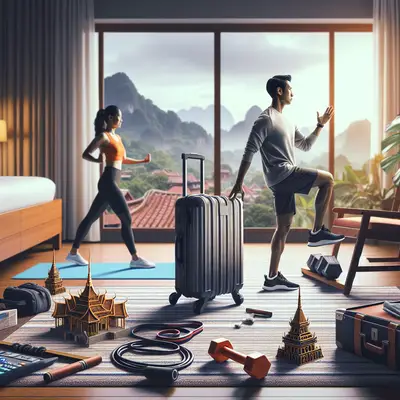
Walk the room and identify three zones: a movement zone (clear floor for bodyweight work), a hinge zone (bed edge or sturdy chair for step-ups, dips, and hip thrusts), and a “rig” (doorframe or heavy desk for isometrics and mobility). This quick recon takes less than two minutes and instantly turns a generic room into a training ground.
If the hotel has a fitness center, treat it as a bonus, not a crutch. Elevators become conditioning tools (take the stairs), hallways become low-impact “tracks,” and even the bathroom counter can support calf raises and balance work. The goal: you land in any room on earth and instantly see options, not obstacles.
Tip 1: Use “Luggage Lifts” to Build Strength on the Road
Your suitcase is more than a vessel for wrinkled T‑shirts; it’s a portable weight set that never leaves your side.
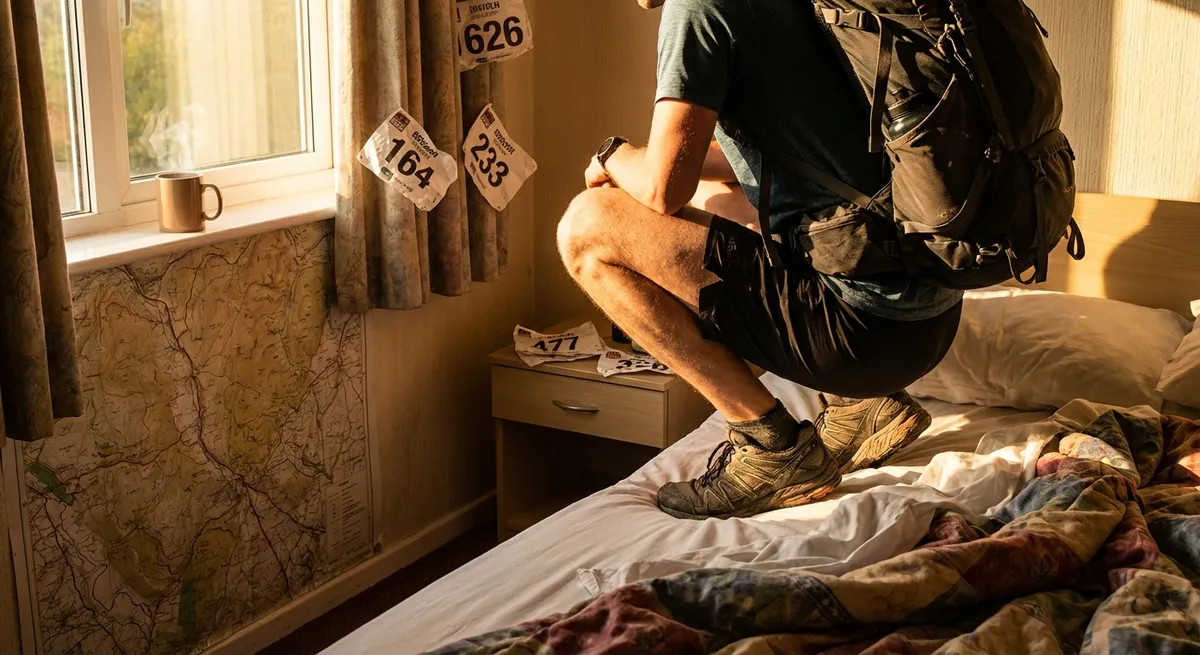
Start by loading your carry-on or backpack with dense items—books, electronics, water bottles—until it has a manageable but challenging weight. Now you have a single “kettlebell” or “dumbbell” for loaded squats, suitcase deadlifts, rows, and overhead presses (if your shoulders tolerate it). Hold the bag in one hand for uneven loads that challenge your core and stabilizers.
In tight spaces, work in controlled tempo: 3 seconds down, 1 second up. This boosts intensity without needing heavy weights. Keep your form strict—neutral spine, engaged core, shoulders away from your ears. You’ll be surprised how fast your heart rate climbs just from methodical sets of loaded squats and rows in a hotel room the size of a postage stamp.
Tip 2: Turn Transitions Into Training Windows
Long travel days make “I’ll do it later” dangerously easy. Instead of waiting for a perfect 45-minute block, hook your movement to the transitions you can’t avoid.
Every time you unlock your hotel door? Drop your bag, hit 10–15 air squats and 10 push-ups. Waiting for the shower to warm up? Calf raises on the edge of the tub and a 30-second wall sit. Morning coffee brewing? Slow, controlled hip hinges and arm circles to shake off airplane stiffness.
These micro-sessions stack. Several 5–8 minute bursts across the day can match or beat one long workout, especially if you alternate patterns: one burst for legs, another for pushing, another for pulling or core. Anchor movement to habits you already do (wake up, pre-laptop, post-dinner) and your body stops relying on motivation—and starts running on routine.
Tip 3: Bring a “Pocket Gym” That Actually Fits in Your Bag
You don’t need a trunk full of gear—just a few ultra-portable tools that punch above their weight.
Pack a light to medium resistance band with handles or a long loop band. It takes up less space than a T‑shirt and unlocks rows, presses, pulldowns, hip abductions, and banded good mornings. Add a mini loop band for glutes and shoulders. If you have room, a lightweight jump rope turns any patch of concrete or carpet into a conditioning zone.
Make a simple band circuit: band rows anchored to a door hinge (check stability first), overhead presses standing on the band, band pull-aparts for posture, and banded squats or lateral walks. Rotate through for 10–15 minutes at a steady pace. You’ll hit major muscle groups, strengthen your upper back after laptop marathons, and carry a “gym” that weighs less than your toiletries kit.
Tip 4: Use Hotel Architecture for Cardio Adventures
If your hotel treadmill is a battle for territory or smells like regret, the building itself is your endurance playground.
Stairwells are built-in interval stations. Walk up one or two flights at an easy pace, then descend and rest. Progress to marching two steps at a time, then “ladder” intervals: one floor easy, one floor moderate, one floor strong. Keep a hand lightly on the rail, wear proper footwear, and stay aware of security (daylight or busier hours are best).
No stairs? Explore halls for “quiet sprints”: 30–45 seconds of brisk walking or light jogging from one end to the other, then 30–60 seconds strolling recovery. You can also pair hallway walks with bodyweight stations every few doors: door 3 = 10 squats, door 6 = 10 push-ups on the wall, door 9 = 20 walking lunges. It’s structured enough to feel like training, flexible enough to fit between calls or check-ins.
Tip 5: Protect Your “Travel Engine” With Mobility and Sleep Rituals
Chasing new cities is fun—chasing jet lag and back pain is not. To keep your engine reliable, guard mobility and sleep the way you guard your passport.
At minimum, run a 5–10 minute nightly “reset” before bed: ankle circles, gentle hamstring sweeps (hinge at the hips, hands sliding down your thighs), slow neck rolls, and a long exhale-focused breathing drill (4 seconds in, 6–8 seconds out). This downregulates your nervous system after travel chaos and screen time.
Improve your sleep environment with small tweaks: use the hotel’s extra towels or pillows to elevate your knees if you’re a back sleeper or hug a pillow between your knees on your side to ease hip and low-back tension. Aim for consistent sleep and wake times across time zones whenever possible, and pair them with the same pre-bed ritual (light stretch, breathing, phone away). Strong bodies are built on repeatable recovery—not just hero workouts.
Conclusion
Your passport might get stamped, but your training doesn’t have to. Every new hotel can be a fresh training canvas instead of a fitness setback. With loaded luggage lifts, transition-based micro-sessions, a pocket-sized gear kit, stairwell adventures, and nightly resets, you can stay strong, mobile, and energized anywhere a check-in desk exists.
Core On Tour isn’t about waiting until you’re “back home” to dial in your health. Home is wherever you drop your backpack and start moving.
Sources
- [American College of Sports Medicine – Staying Active While Traveling](https://www.acsm.org/docs/default-source/files-for-resource-library/staying-active-while-traveling.pdf) - Practical guidance from ACSM on maintaining physical activity during travel
- [Mayo Clinic – Exercise: How to Get Started](https://www.mayoclinic.org/healthy-lifestyle/fitness/in-depth/exercise/art-20048389) - Covers fundamentals of safe, effective exercise routines you can adapt on the road
- [Harvard T.H. Chan School of Public Health – Physical Activity Guidelines](https://www.hsph.harvard.edu/obesity-prevention-source/obesity-causes/physical-activity-guidelines/) - Summarizes evidence-based recommendations for weekly movement and intensity
- [CDC – How Much Sleep Do I Need?](https://www.cdc.gov/sleep/about_sleep/how_much_sleep.html) - Outlines sleep duration guidelines crucial for recovery while traveling
- [Cleveland Clinic – Benefits of Stretching](https://health.clevelandclinic.org/benefits-of-stretching) - Explains how mobility and stretching support performance and reduce stiffness
Key Takeaway
The most important thing to remember from this article is that this information can change how you think about Hotel Fitness.