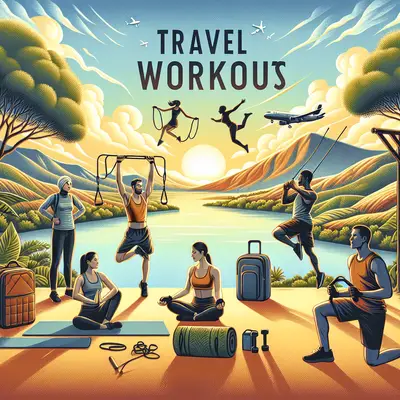
Your passport has more stamps than your local coffee card, your “office” changes weekly, and your step count looks impressive—until your back starts nagging and your energy tanks mid-adventure. Being a traveler or digital nomad doesn’t mean accepting a slow slide into stiffness and fatigue. With a bit of intent (and almost no gear), you can turn constant movement into a strength advantage instead of a recovery debt.
This isn’t about squeezing in random push-ups in a hostel hallway. It’s about building a simple, portable training system that fits inside a backpack and survives flight delays, visa runs, and last-minute bus rides.
Build a Non-Negotiable 15-Minute Movement Ritual
When your time zone, bed, and schedule keep changing, your ritual matters more than your reps. The goal isn’t a perfect workout plan—it’s a daily minimum that happens no matter what.
Pick a 15-minute window that travels with you: first thing after waking, right before your first work block, or just before dinner. Then set a simple structure like:
- 3 minutes: joint mobility (neck rolls, arm circles, hip circles, deep squats)
- 8 minutes: bodyweight circuit (for example: 10 squats, 8 push-ups, 10 glute bridges, 20-second plank — repeat)
- 4 minutes: stretch and breathe (hamstrings, hip flexors, chest, back)
You’re not chasing exhaustion—just consistency. This ritual acts as your “fitness anchor”: a familiar physical reset that makes new cities feel less chaotic. Travel throws curveballs, but 15 minutes is short enough to protect, even when a border crossing or delayed flight hijacks your day.
Turn Transit Time into Strength and Mobility Sessions
Airports, train stations, and bus lines are usually where posture goes to die. But they’re also loaded with benches, railings, and empty corners—perfect for sneaky training.
While waiting at gates or platforms:
- Walking lunges down the hallway (or marching in place if space is tight) keep your hips awake after long sits.
- Incline push-ups on benches or sturdy seats reduce wrist and shoulder strain while building upper-body strength.
- Suitcase carries: Grab your heaviest bag and walk slowly with perfect posture—shoulders down, core tight. This mimics a farmer’s carry and trains grip, core, and upper back.
- Calf raises on the edge of a step or curb keep blood moving and prevent that heavy, swollen-leg feeling from flights.
On the plane or bus, you’re limited, but not helpless: ankle circles, seated marches, and glute squeezes keep circulation going. The goal isn’t a full workout; it’s to stop your body from “locking in” to the sitting shape that makes you feel wrecked when you arrive.
Pack One Tiny Tool That Multiplies Your Options
You don’t need a travel gym; you just need one versatile piece of gear that weighs almost nothing and changes everything. Two of the most travel-proof options:
- Mini resistance bands (loop bands)
- Glutes: lateral walks, monster walks, banded bridges
- Hips and shoulders: external rotations, warm-up drills
- Core: banded dead bugs or resisted holds
- A light suspension trainer or DIY strap (even a yoga strap or sturdy belt)
Slip them over your knees, ankles, or wrists and you can train:
Hook it over a door, stair rail, or tree branch and you’ve got rows, assisted squats, reverse lunges, and core work—no gym required.
Choose one, commit to packing it every trip, and design a “default” workout around it. For example, a band-only session might be:
- 12 banded squats
- 10 band rows (anchored to a pole/door handle)
- 12 banded glute bridges
- 10 overhead band presses or band pull-aparts
Repeat for 3–4 rounds. Having this go-to layout eliminates decision fatigue—vital when your brain is already juggling bookings, navigation, and client calls.
Train for the Way You Actually Travel, Not for a Fantasy Routine
Your training should match your real travel style, not the routine you wish you had.
If you mostly:
- Walk all day exploring cities
- Strength (legs, back, core) to handle miles of pavement
- Short mobility sessions for ankles, calves, and hips
- Daily calf and hamstring stretching before sleep
- Sit and work for long hours as a digital nomad
- Upper-back and glute strength (rows, hip hinges, glute bridges)
- “Movement snacks” every 60–90 minutes: 1–2 minutes of squats, wall slides, or band pull-aparts
- Hip flexor and chest stretches to undo chair time
- Switch environments constantly (fast travel)
- Short and flexible (10–20 minutes)
- Similar no matter where you are (same 4–6 exercises, different scenery)
- Intensity-based, not location-based (slow & controlled when tired, faster circuits when recovered)
You’re already getting low-intensity cardio. Prioritize:
You’re battling desk posture in rotating cafés and coworking spaces. Focus on:
Your biggest enemy is disruption. Keep training:
Aligning your workouts with how you move and work makes your training sustainable, not another “should” you abandon after the first overnight bus ride.
Use Micro-Goals to Stay Motivated Across Borders
When you’re constantly on the move, long-term goals like “get shredded this year” feel disconnected from your daily reality. Instead, tie your fitness goals to your journeys, not the calendar.
Examples:
- “By the end of this month in Portugal, I want to hold a 60-second plank.”
- “By the time I leave Southeast Asia, I’ll be able to do 12 controlled push-ups from the floor.”
- “During this 6-week Euro trip, I’ll train at least 4 days per week, even if it’s only 15 minutes.”
Track with something ultra-simple and travel-proof:
- Notes app checklist
- Google Sheet
- Bullet journal page in your travel notebook
Each session, log what you did: exercises, reps, and how you felt. You’re not trying to create a perfect training log—just leaving yourself a breadcrumb trail of proof that you’re building strength across continents. The psychological effect is huge: you stop feeling like you’re starting over in every new city and start feeling like you’re carrying hard-earned momentum in your backpack.
Conclusion
The road will never hand you the perfect training window, immaculate gym, and ideal sleep schedule wrapped in one tidy package. That’s fine. Your edge as a traveler or digital nomad is adaptability—use it.
A daily 15-minute ritual, smarter transit time, one well-chosen piece of gear, travel-aligned training, and micro-goals are enough to keep you strong, mobile, and ready for whatever border crossing or mountain pass comes next.
You don’t need to pause your adventures to “get back in shape.” You can get stronger while moving—from hostel floors and bus stations to mountaintop viewpoints. The world is already your gym. Now you’ve got a plan to train in it.
Sources
- [Centers for Disease Control and Prevention – Physical Activity Guidelines](https://www.cdc.gov/physicalactivity/basics/adults/index.htm) - Evidence-based recommendations for weekly activity and why consistency matters
- [American Council on Exercise – Benefits of Resistance Training](https://www.acefitness.org/resources/everyone/blog/7639/10-benefits-of-strength-training-for-people-of-all-ages/) - Explains why maintaining strength is critical, especially for frequent travelers
- [Harvard T.H. Chan School of Public Health – Physical Activity and Health](https://www.hsph.harvard.edu/nutritionsource/physical-activity/) - Overview of health impacts of regular movement and simple ways to integrate it
- [Mayo Clinic – Travel and Deep Vein Thrombosis Prevention](https://www.mayoclinic.org/diseases-conditions/deep-vein-thrombosis/in-depth/dvt-prevention/art-20046097) - Supports the importance of movement and circulation during long flights and bus rides
- [NHS (UK) – Strength and Flex Exercises](https://www.nhs.uk/live-well/exercise/strength-and-flex-exercises/) - Practical examples of bodyweight and mobility movements you can adapt on the road
Key Takeaway
The most important thing to remember from this article is that this information can change how you think about Travel Workouts.