Every border crossing, layover, and side street is a chance to make your body more capable for whatever comes next—summiting a volcano, chasing a sunrise bus, or hauling your backpack up five flights of stairs in an old guesthouse. You don’t need a fixed gym to train like your passport depends on it. You just need a plan, a bit of grit, and gear that fits in your daypack.
This guide is built for travelers and digital nomads who want their bodies to match their itineraries: strong, mobile, and adventure-ready. Let’s turn your moving life into a moving workout.
Building an “Adventure-Ready” Fitness Mindset
If you think of training as something that only happens in a gym, travel will wreck your routine. But if you treat your trip like a constantly shifting obstacle course, everything changes.
Instead of chasing perfect conditions, aim for “good enough, done often.” A short workout in a cramped hostel room beats waiting three weeks for the perfect Airbnb gym. Your standard becomes: move daily, push hard a few times per week, and stay ready for any trail, trek, or tide you stumble into.
Mentally, anchor your training to the adventures you care about. Want to hike with a heavy pack without gassing out? Think lunges and step-ups. Dreaming of surf trips or long paddle days? Prioritize shoulders, core, and hip mobility. The clearer your “why,” the easier it is to choose squats over scrolling when you’re jet-lagged and tempted to skip.
Travel will throw chaos at you—late buses, weird check-in times, rain that ruins your beach plan. Your edge is treating chaos as a feature, not a bug, and letting your training flex with it.
Tip 1: Use Micro-Workouts to Beat Jet Lag and Time Zones
Long flights, overnight buses, and back-to-back time zones can leave you foggy and stiff. Instead of forcing a 60-minute workout that may never happen, break your training into micro-sessions scattered through the day.
Think in 5–10 minute blocks:
- After waking: 3 rounds of 10 squats, 10 pushups (elevated on the bed if needed), 20 seconds of jumping jacks
- Midday break: a 7-minute EMOM (Every Minute On the Minute) of 5 burpees + 10 glute bridges
- Evening reset: 5 minutes of slow mobility—hips, ankles, shoulders—on the floor beside your bed
The goal isn’t to maximize fatigue; it’s to switch on your brain and body, fight stiffness, and nudge your circadian rhythm into the new time zone. Short bursts of movement increase blood flow and alertness, which can improve sleep quality after travel-heavy days.
Tie these micro-workouts to actions you already do: brushing your teeth, making coffee, or waiting for laundry at the hostel. When training becomes as automatic as packing your passport, consistency stops being a struggle—even when your sleep schedule is chaos.
Tip 2: Turn Local Terrain into Your Training Ground
Every destination comes with built-in training tools if you bother to look for them. Stairs, hills, beaches, parks, piers, and even quiet alleys can turn into rugged workout zones without a single dumbbell.
Some portable ideas:
- Stair intervals: Pick a staircase at a train station, temple, or hillside path. Power-walk or jog up, walk down to recover, repeat. Great for leg strength and cardio when you’re prepping for future treks.
- Hill marches: Load your daypack with water bottles or groceries and walk repeated laps up a hill. Control the pace on the way down to build knee resilience.
- Park circuits: Use benches for step-ups, incline/decline pushups, and triceps dips. Add lunges and sprints or fast walks between trees for a full-body burner.
- Beach sand sessions: If you’re near the coast, perform short runs, shuffles, and walking lunges on soft sand to challenge stabilizing muscles and build ankle strength.
Always clock your surroundings for safety—lighting, traffic, loose dogs, and local norms. Early mornings tend to be calmer and cooler, with fewer crowds and better conditions for focused training. You’re not just exercising; you’re learning the terrain of a new city with your own two feet.
Tip 3: Pack One Piece of Gear That Does Serious Work
You don’t need a suitcase of equipment, but one well-chosen item can massively expand your training options while still fitting in a corner of your backpack.
Two travel-friendly MVPs:
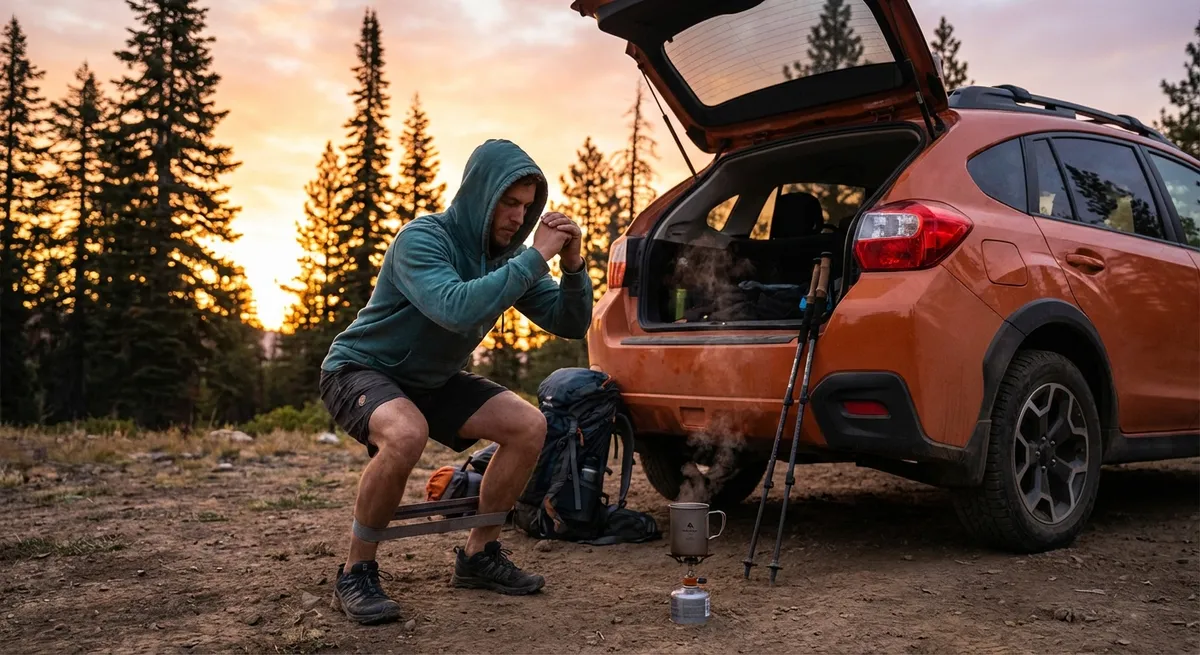
- Resistance bands (loop or long): Lightweight, cheap, and infinitely versatile. Use them for rows (attach to a door or sturdy pole), shoulder work, hip strengthening, and assisted pullups when you find a bar or sturdy branch.
- Suspension trainer (like TRX-style): Clips to doors, beams, or railings and turns almost any spot into a gym. You can hit rows, squats, lunges, planks, and single-leg work with adjustable difficulty simply by changing your body angle.
- Band rows
- Band-resisted squats or good mornings
- Overhead or chest press
- Lateral band walks for hips
- Pallof press (anti-rotation core)
A simple “everywhere” session with a single band:
Build a 20-minute routine out of 8–12 reps per exercise, cycling through 3–4 times. That one device means you can keep your back, hips, and core strong even if every “gym” you see on the road is just a faded sign and a broken treadmill.
Tip 4: Lock in a Simple Strength Template You Can Do Anywhere
Travel crushes overcomplicated programs. You don’t need fancy variations; you need a bare-bones template you can run in a hostel dorm, on a balcony, or beside your bunk on a sleeper train.
Use a simple structure like this 4-move, go-anywhere circuit:
- Squat pattern: Bodyweight squats, split squats, or step-ups onto a bench or curb
- Push pattern: Pushups (hands on bed, floor, or a wall depending on strength)
- Hinge or posterior chain: Hip thrusts on the bed, single-leg Romanian deadlifts with your backpack, or glute bridges on the floor
- Core stability: Planks, side planks, or suitcase holds with your backpack
Perform 8–15 reps (or 20–40 seconds) per exercise, rest briefly, and repeat 3–5 rounds. If you’re stronger, add tempo—slow 3–4 second lowers—to increase difficulty without added weight.
Aim to hit this kind of strength session 2–4 times per week, depending on how demanding your adventures are. If you’re hiking big elevation days or surfing multiple sessions, dial volume down. Your training should support the adventure, not sabotage your recovery.
Tip 5: Protect Your Joints and Energy Like They’re Travel Documents
The fastest way to derail travel fitness is getting hurt or completely cooked from overdoing it. You need your body to be both strong and durable enough to handle spontaneous plans: a surprise volcano hike, a last-minute climbing session, or a city day that turns into 25,000 steps.
Layer in simple “maintenance” habits:
- Daily mobility snack: 5–10 minutes of hip, ankle, and thoracic spine (upper back) mobility in the morning or before bed. Think deep squats, ankle rocks, cat-cow, and arm circles.
- Walk as your default: When in doubt, walk. It boosts recovery, mood, and local immersion without frying your nervous system.
- Chill on combination overload: If you’ve just done a brutal stair workout, maybe skip the 25 km “just exploring” walk the same afternoon. Balance intense days with lighter ones.
- Hydration and protein: Travel often means dehydration and carb-heavy street food. Drink more water than you think you need, and aim to get protein at most meals—eggs, yogurt, beans, tofu, fish, or meat—to support muscle repair.
Think of this as insurance: small, consistent habits that keep knees from barking, backs from seizing up, and energy from crashing. The fitter you are between adventures, the more adventures you can actually say yes to.
Conclusion
Your passport doesn’t have to be the enemy of your progress—it can be the reason you get stronger, more resilient, and more capable. You’re not waiting to “get back home” to restart a routine; the constantly changing landscapes are the routine.
Travel gives you stairs instead of step machines, beaches instead of treadmills, and backpacks instead of barbells. With a flexible mindset, a minimalist plan, and a few smart tools, every border you cross becomes another training ground.
Stay curious, stay moving, and treat every new city like a fresh chapter in your strength story.
Sources
- [Centers for Disease Control and Prevention – Physical Activity Guidelines](https://www.cdc.gov/physicalactivity/basics/adults/index.htm) - Evidence-based recommendations for how much weekly activity adults need for health and performance
- [American Council on Exercise – Benefits of Short Exercise Bouts](https://www.acefitness.org/resources/pros/expert-articles/5148/are-short-workouts-worth-it/) - Explores why brief, frequent workouts (micro-sessions) can still be effective
- [Harvard Health Publishing – The Importance of Strength Training](https://www.health.harvard.edu/staying-healthy/the-importance-of-strength-training) - Outlines why resistance training matters for longevity, joint health, and functional strength
- [Mayo Clinic – Resistance Bands: How They Work](https://www.mayoclinic.org/healthy-lifestyle/fitness/expert-answers/resistance-bands/faq-20057983) - Explains benefits, safety, and versatility of resistance bands for portable strength work
- [Sleep Foundation – Exercise and Sleep Quality](https://www.sleepfoundation.org/physical-activity) - Discusses how physical activity can help regulate sleep, useful for managing jet lag and irregular schedules
Key Takeaway
The most important thing to remember from this article is that this information can change how you think about Travel Workouts.