You checked in for the Wi-Fi and hot shower—but your body’s craving more than a soft pillow and room service. Whether you’re a digital nomad hopping cities or a traveler squeezing in work between flights, your hotel can be more than a place to crash. It can be a launchpad for stronger lungs, tougher legs, and a clearer mind—if you know how to use it.
This isn’t about perfect routines or giant gyms. It’s about portable tactics you can drop into any city, any room, any timezone, and still feel like you’re moving the needle on your strength, endurance, and mobility.
Build a “Zero-Equipment” Base You Can Do in Any Room
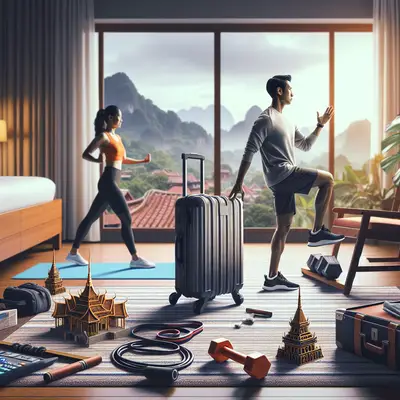
Think of this as your emergency fitness kit—no gear, no excuses, no overthinking. You want a small core of movements you can do in the tightest studio, the fanciest suite, or the weirdly shaped hostel room.
Aim for a short strength circuit you can complete in 15–20 minutes:
- Push pattern: Push-ups (regular, incline on the bed or desk, or knee push-ups if needed)
- Pull pattern (hotel-friendly): Slow “doorframe isometrics” (hands on the frame, gently pull like a row for 20–30 seconds), then towel rows around a heavy table leg if available
- Legs: Squats, split squats using the bed or chair, or wall sits
- Core: Planks, side planks, dead bugs, or slow mountain climbers
- Cardio burst: Fast high knees, jumping jacks, or modified low-impact step jacks if neighbors are below you
Keep it simple: 3–5 moves, 30–45 seconds each, 15–30 seconds rest. Repeat 3–4 times. This gives you strength, light cardio, and a mental reset without needing a gym.
Travel advantage: a familiar mini-routine like this anchors you in a new city, cuts jet lag fog, and reminds your body, “We’re still in training,” even if your environment changes every few days.
Turn Hotel Architecture into Your Adventure Playground
If the gym is tiny, crowded, or non-existent, the building itself is your training terrain. Treat the hotel like a small urban mountain environment:
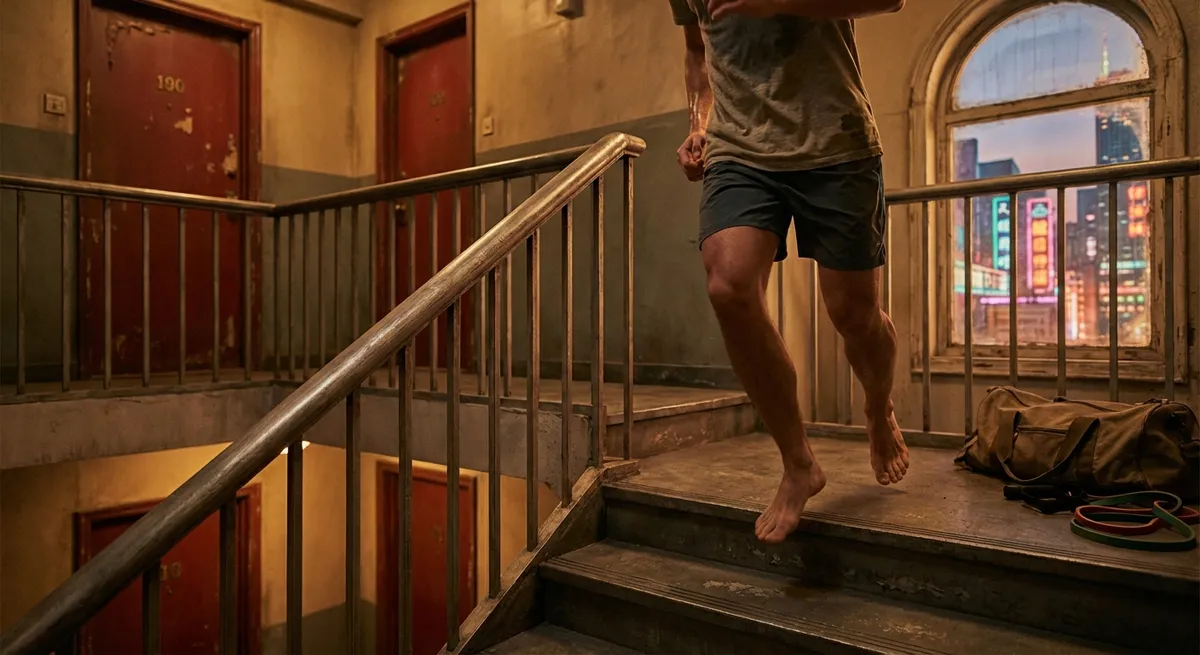
Stairwell climbs
- Turn stairs into hill repeats: hike up 3–6 floors at a steady pace, then walk back down as recovery.
- Add intervals: 1 floor fast, 1 floor easy, repeat.
- Use the handrail for balance but not for pulling, so your legs and lungs do the work.
Hallway conditioning
Check for foot-traffic and noise rules, then use the longest hallway you can find:
- Walking lunges, backward walking (careful), side shuffles
- “Every-door-frame” challenge: at each door frame, do 3 squats or 3 calf raises
- Marching suitcase carries: grab your backpack or suitcase and walk, focusing on posture and core engagement
In-room mini climbs
- Step-ups on a sturdy chair, ottoman, or low windowsill (test stability first)
- Bulgarian split squats using the bed edge
- Elevated push-ups on the desk or chair for varying difficulty
You’re not just “getting some steps in.” You’re turning anonymous carpet and concrete into a deliberate, structured workout that mimics hiking, hill climbing, and loaded walking—perfect for travelers who want real-world strength, not just treadmill miles.
Pack One Piece of Gear That Multiplies Your Options
If you only bring one fitness tool in your bag, make it earn the weight. Aim for something that’s light, packable, and turns any hotel into a fully functional micro-gym.
Smart options:
- Long resistance band or loop bands: Great for rows, presses, pull-aparts, hip work, and mobility drills. Loop it around a heavy bedframe, bathroom door (secured), or a table leg.
- Skipping rope (if your ceiling allows): Fast, potent cardio with minimal space. If jump-rope isn’t possible, use it for band-style warmups or coordination drills.
- Suspension trainer (like TRX-style): If you know you’ll have solid doors or beams, this can replace most machines—rows, presses, squats, core, everything.
To keep it practical for nomads with limited space, pair your one piece of gear with your zero-equipment base:
- Swap push-ups with band-resisted push-ups or band chest presses
- Use bands for rows, one of the hardest patterns to hit without gear
- Add banded good mornings or hip thrusts to keep your posterior chain alive after long hours of sitting and flying
This way, your setup scales: if the hotel gym is usable, your band upgrades machines. If the gym is a treadmill graveyard, your band is the gym.
Sync Your Hotel Training with Your Travel Rhythm
Instead of forcing your old home routine onto a new city, sync your training to your travel days and work blocks.
Useful frameworks:
- Anchor to non-negotiables: Link your workout to something that always happens—first coffee, morning shower, or final email check.
- Use “micro-sessions”: If your brain rebels at “a 45-minute workout,” go for three 10-minute bursts spread through the day:
- Morning: mobility + activation (hips, back, shoulders)
- Midday: 10-minute strength circuit
- Evening: light core and stretching to wind down
- Plan around transit:
- Night arrival? Do 5–10 minutes of easy mobility and breathing to loosen up.
- Morning arrival? Hit a brisk stair session to reset circadian rhythm and wake the nervous system.
Travel and remote work often mean fragmented days, random calls, and unpredictable check-ins. Embrace that: short, consistent efforts beat heroic “I’ll fix it later” workouts that never happen.
Use Movement as Your City-Exploration Strategy
Your hotel fitness doesn’t have to stay inside the building. Let movement be the way you meet the city instead of something you squeeze in afterward.
Tactics that blend adventure with training:
- Run or power-walk from the lobby: Map a simple out-and-back route: 10–15 minutes away from the hotel, then turn around. Use landmarks (bridges, parks, waterfronts) as your route markers.
- Stairs and viewpoints: Ask staff for nearby viewpoints, hills, or stair-heavy landmarks. Climb them. Turn tourist attractions into interval training.
- Carry your daypack with intention: Load a small backpack with your laptop, water, and essentials and walk instead of cabbing short distances. You’re basically doing light weighted carries through the city.
- Hotel-to-park routine: Use the park bench for step-ups, incline push-ups, tricep dips, and single-leg squats. Cool down with an easy walk back.
This approach keeps you from feeling like you’re “losing time” training. Movement becomes the storyline: every city you visit leaves a record in your lungs, legs, and memory—not just in your photo roll.
Conclusion
You don’t need a perfect gym, a checked bag full of gear, or a flawless schedule to stay sharp on the road. You need a core routine that fits any room, a willingness to treat the building like a training tool, one piece of smart gear, and the mindset that movement is part of the adventure—not separate from it.
Hotels will blur together. What won’t blur is how you showed up in each one: lungs burning in the stairwell, sweat drying as the city lights flickered outside your window, body reminding you that you’re not just passing through—you’re building something that travels with you.
Sources
- [Centers for Disease Control and Prevention – Physical Activity Basics](https://www.cdc.gov/physicalactivity/basics/index.htm) - Guidelines on recommended weekly activity levels and why short, regular movement matters
- [American Council on Exercise – Designing Effective Hotel Room Workouts](https://www.acefitness.org/resources/pros/expert-articles/6655/how-to-work-out-in-your-hotel-room/) - Practical examples of hotel-friendly exercises and setups
- [Mayo Clinic – How to Stay Fit While Traveling](https://www.mayoclinic.org/healthy-lifestyle/adult-health/in-depth/fitness/art-20048269) - Evidence-backed suggestions for keeping up activity on the road
- [Harvard Health Publishing – The Benefits of Strength Training](https://www.health.harvard.edu/staying-healthy/the-importance-of-strength-training) - Why maintaining strength matters for health and function, especially with sedentary travel
- [Sleep Foundation – Exercise and Sleep](https://www.sleepfoundation.org/physical-activity) - Research-based overview of how movement helps reset sleep patterns disrupted by travel and jet lag
Key Takeaway
The most important thing to remember from this article is that this information can change how you think about Hotel Fitness.