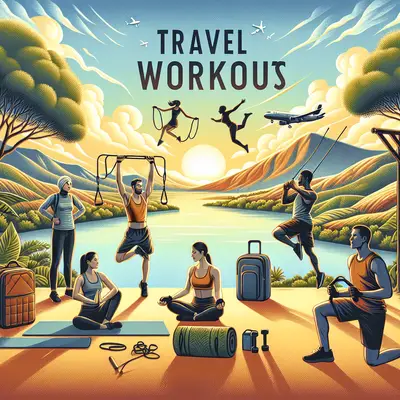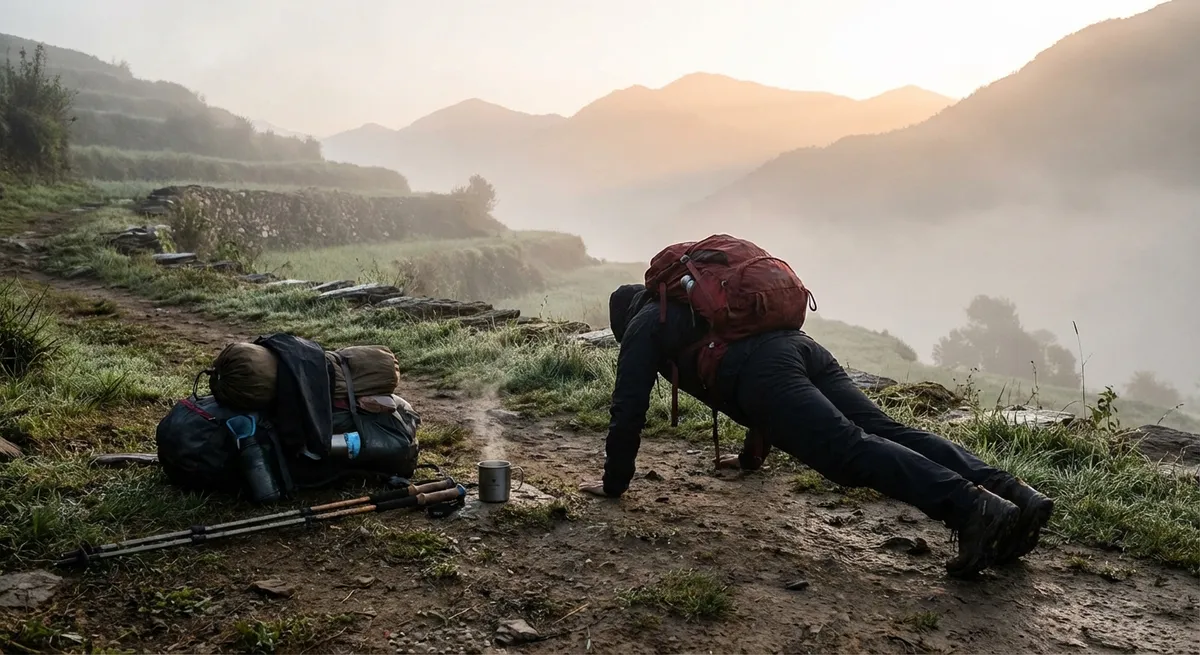
Your backpack’s packed, the boarding pass is in your pocket, and your step counter thinks you’ve retired. Life on the road can turn even the strongest routines into chaos—but your body doesn’t have to be collateral damage. With a little creativity and a “use what’s in front of me” mindset, your training can be just as mobile as your passport.
This isn’t about perfect programs or gym selfies. It’s about building a body that can haul a pack up a loose scree field, sprint for a gate change, or sit through a 12‑hour night bus without your spine filing a formal complaint.
Let’s turn wherever you are into a training zone.
Build a “No-Excuse” Movement Ritual
Travel wrecks routines—time zones, late check-ins, and mystery Wi‑Fi. Instead of chasing a perfect workout window, build a tiny daily ritual that follows you everywhere.
Anchor it to something you always do: brushing your teeth, your first coffee, or returning to your room at night. Right after that anchor, drop in 5–10 minutes of simple moves:
- 10–15 squats
- 5–10 push-ups (wall, incline, or floor)
- 20–30 seconds of plank
- 10 hip hinges (no weight, slow and controlled)
- 30–60 seconds of easy stretching for hips and chest
The goal isn’t intensity; it’s identity. You’re the traveler who moves, even on “off” days. That tiny ritual keeps your joints awake, your muscles talking to your brain, and your body ready when you do have time for a bigger session.
Over time, you can add reps, slow down the tempo, or toss in a balance challenge (single-leg squats to a chair, one-arm support planks). The ritual stays short, but the return compounds.
Tip 1: Turn Transit Delays into Micro-Workouts
Flights, trains, ferry terminals—delays are guaranteed. Instead of doom-scrolling, train.
You don’t need to sweat through your clothes or attract security. Focus on low-key strength and mobility:
In airports or stations (no gear, minimal attention):
- Marching lunges in place: Step long, drop the back knee toward the floor, push through the front heel.
- Wall push-ups: Hands on a pillar or wall, body straight, lower with control.
- Single-leg calf raises: One hand on a wall for balance, slow up/down.
- Ankle circles and foot scrunches: Great if you’re stuck sitting.
On buses or planes (seat-bound tactics):
- Seated glute squeezes (10–20 seconds on, 10 seconds off)
- Seated heel raises and toe raises
- Gentle seated twists for your spine
- Neck nods and rotations (slow, pain-free range)
Think of it as “stealth maintenance.” These micro-sessions won’t replace a full workout, but they prevent you from turning into a statue—and they make that next proper session feel much better.
Tip 2: Use Your Pack and Surroundings as a Mobile Gym
You’re already carrying resistance: luggage, water, books, and whatever gear made the cut. Put it all to work.
Backpack strength circuit (hotel room, hostel, or campsite):
Fill your pack with clothes, books, or a water bladder. Make it heavy-ish but safe to handle.
- Backpack squats: Pack hugged to your chest, sit back like you’re finding a low chair.
- Backpack rows: Hinge at the hips, flat back, pull the pack to your lower ribs.
- Overhead press (if shoulders are healthy): Press the pack overhead, avoid arching your back.
- Suitcase deadlifts: Use a duffel or suitcase, hinge at the hips, stand tall by driving through your heels.
Do 2–4 rounds, 8–15 reps each, resting as needed. On the road, consistency beats heroics.
Environment hacks:
- Benches and curbs: Step-ups, triceps dips, incline push-ups.
- Stairs: Power climbs, lateral steps, or short, intense sprints if it’s safe.
- Doorways: Isometric holds—push your arms outward against the frame for 10–20 seconds.
Your rule of thumb: if it’s stable, non-destructive, and safe, it’s potential training equipment.
Tip 3: Choose Compact Gear That Punches Above Its Weight
You don’t need a traveling gym, just a few multi-use tools that disappear into your bag. Prioritize durability and versatility.
High-impact, low-space options:
- Mini resistance bands (loop bands): Great for glute work (lateral walks, hip extensions), shoulder activation, and light pulling.
- Long resistance band with handles or loop: Lets you mimic rows, presses, pulldowns, and assisted squats anywhere with an anchor point.
- Jump rope: Cardio, coordination, and footwork in something barely bigger than your hand.
- Light suspension trainer (optional): If you don’t mind the bulk, it turns any door or sturdy tree branch into a complete training station.
Portable full-body band session:
- Band rows anchored around a post or door
- Band chest presses (anchor behind you)
- Band-resisted squats or split squats
- Band pull-aparts for upper back
- Band overhead presses or “thrusters” (squat + press)
Cycle through 8–15 reps for 3–4 rounds. Adjust difficulty by stepping further from the anchor or shortening the band.
Focus on gear that would earn its space in your pack even on a long trip. If it only does one thing, it probably stays home.
Tip 4: Train for What Your Trip Actually Demands
Adventure travel is a performance sport disguised as leisure. Tailor your workouts to the real-world demands of your itinerary.
If your trip is hiking-heavy:
- Prioritize single-leg strength: split squats, step-ups on benches or curbs, single-leg Romanian deadlifts (bodyweight or with pack).
- Build ankle durability: single-leg balance, calf raises on a step, lateral band walks.
- Add short stair or hill repeats when you find terrain, focusing on controlled descents to toughen knees and quads.
If you’re city-hopping with lots of walking and work:
- Mix brisk walks or light jogs with mini strength breaks (every 5–10 minutes, drop for 10 squats or push-ups).
- Take “movement meetings”: walking calls, audio-only Zooms you join while pacing.
- Strength focus: posture and core—planks, backpack rows, band pull-aparts, wall slides.
If you’ll be surfing, climbing, or paddling:
- Train grip and shoulders: towel hangs from a sturdy bar, band external rotations, scapular push-ups (protraction-retraction).
- Core with rotation: suitcase carries (one-hand pack hold), standing band rotations, side planks.
Travel changes your training goal from “abstract fitness” to “can I actually do the things I came here for?” Let your workout reflect that.
Tip 5: Protect the Engine: Sleep, Mobility, and Recovery on the Move
No program survives if your joints are wrecked and your sleep is chaos. On the road, recovery is half the adventure.
Sleep tactics when you’re ping-ponging time zones:
- Chase light and dark, not clock time: get morning sunlight when you land, keep nights dim and screen-light minimal.
- Keep the pre-sleep ritual consistent even if the time shifts: 5 minutes of gentle stretching, 2–3 slow breaths, screens down.
- Use an eye mask and earplugs to turn questionable rooms or buses into semi-sleep caves.
Mobility to undo travel positions:
After flights or long rides, run this 5–10 minute reset:
- Cat-cow spine flows (on hands and knees)
- Hip flexor stretch (half-kneeling lunge, gentle tilt of pelvis)
- Chest opener against a wall or doorframe
- Ankle rocks and circles
- Slow deep breathing in a relaxed lying or seated position
Load management:
You don’t have to prove anything to Instagram on day one. If you’ve been on three flights and two buses in 48 hours, that’s already a stress load. Keep the first workout light—think activation, not annihilation—and let your body catch up before pushing the gas.
Conclusion
You don’t need a perfect gym or a stable zip code to build a capable, adventure-ready body. You need a simple ritual, a willingness to use what’s in front of you, and a plan that bends with your itinerary instead of breaking every time the airline does.
Treat every stop—bus terminal, hostel, mountain hut, cowork, beach—as potential training ground. Stack small, repeatable efforts over the miles, and your body becomes part of your travel kit: strong enough for the long hauls, agile enough for the detours, and resilient enough to say “yes” when the real adventures show up unannounced.
Sources
- [Centers for Disease Control and Prevention – Physical Activity Basics](https://www.cdc.gov/physicalactivity/basics/index.htm) – Guidelines on recommended weekly activity levels and benefits of regular movement
- [American College of Sports Medicine – ACSM Guidelines for Exercise Testing and Prescription](https://www.acsm.org/education-resources/books/guidelines-exercise-testing-prescription) – Evidence-based recommendations on resistance, aerobic, and flexibility training
- [Harvard Health Publishing – “How to Work Out When You Have No Time”](https://www.health.harvard.edu/staying-healthy/how-to-work-out-when-you-have-no-time) – Supports the effectiveness of short, frequent exercise bouts for busy schedules
- [Sleep Foundation – Jet Lag: Symptoms, Causes, and Treatment](https://www.sleepfoundation.org/jet-lag) – Research-backed strategies for managing sleep and circadian disruption while traveling
- [Mayo Clinic – Resistance Bands: How to Use Them Safely](https://www.mayoclinic.org/healthy-lifestyle/fitness/multimedia/resistance-bands/sls-20076813) – Guidance on safe use and benefits of portable resistance bands
Key Takeaway
The most important thing to remember from this article is that this information can change how you think about Travel Workouts.