Your passport has more stamps than your dumbbells have rust spots—but your body still needs a reliable way to feel strong, sharp, and ready for whatever the road throws at you. This isn’t about squeaky hotel gyms or influencer-approved “airport ab hacks.” It’s about crafting a travel-proof workout ritual you can run anywhere: bus station, guesthouse rooftop, or a pocket of shade between overnight trains.
This guide gives you five adventure-ready fitness tips that slot into real nomad life—time zones, tight carry-ons, and all.
Anchor Your Day With a 15-Minute “Non-Negotiable”
On the road, long workouts die first. Your “maybe I’ll work out later” window gets hijacked by delayed flights, surprise invites, or a sunset you can’t ignore. The fix: build a tiny, unshakeable daily ritual.
Choose a 15-minute session that never moves on your calendar. Morning works best for most travelers because time zones and plans haven’t wrecked the day yet. Think of it like brushing your teeth: not optional, not dramatic, just done.
Keep the structure simple so you don’t negotiate with yourself:
- 5 minutes: dynamic warm-up (arm circles, leg swings, hip circles, cat-cow, shoulder rolls)
- 8 minutes: strength circuit (3–4 bodyweight moves, repeat continuously)
- 2 minutes: slow breathing + stretch (focus on hips, hamstrings, chest)
Even if your day goes off the rails, this micro-session keeps your nervous system grounded, your joints oiled, and your identity anchored: “I’m a person who moves every day,” regardless of what country you woke up in.
Use a 3-Move Template You Can Run Anywhere
When you’re jet-lagged or overloaded with new city logistics, decision fatigue is real. A simple template you can deploy in any space keeps you moving without overthinking: one push, one pull (or core brace), one leg pattern.
Here’s a practical travel-friendly trio that needs nothing but floor space:
Push Option – Strength + Stability
- Incline push-ups (hands on bed, bench, desk)
- Standard push-ups on the floor
- Slow eccentric push-ups (3–5 seconds down, normal up)
- Backpack rows: load your pack with books, water bottles, or gear, hinge at the hips, pull to your ribs
- Towel isometric rows: loop a towel around a solid object (pillar, bedframe), lean back and “row” by pulling hard without movement
- Plank variations: forearm plank, side plank, plank shoulder taps
- Split squats: rear foot on backpack or low step
- Reverse lunges: step back to reduce knee stress
- Single-leg Romanian deadlifts (hinge on one leg, reach down toward the floor, keep back flat)
Pull/Core Option – If You Don’t Have a Pull-Up Bar
Leg Option – Strength + Balance
Sample circuit you can do in a hostel, small room, or park corner:
- 10–15 incline or floor push-ups
- 12–15 backpack rows (or 30-second towel row hold / plank)
- 10–12 split squats per leg
Rest 30–45 seconds and repeat 3–5 rounds. If you practice this same template across countries, your body learns the pattern and your brain doesn’t waste energy deciding “what to do today.”
Pack One Piece of Gear That Multiplies Your Options
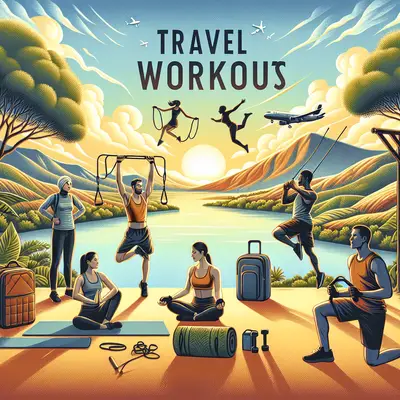
You don’t need a portable gym, but one smart piece of kit can turn cramped rooms and random parks into an actual training ground. The key is low weight, high versatility, and fast setup.
Three ultra-portable options:
- Long resistance band (looped): tiny, light, adds resistance to nearly everything
- Band rows around a tree, pole, or balcony
- Band deadlifts or squats by standing on the band
- Band presses by looping behind your back
- Suspension trainer (like TRX-style straps): clips to doors, beams, or sturdy trees
- Rows, presses, single-leg squats, hamstring curls, fallouts
- Jump rope: packs small, turns any courtyard or empty street into a conditioning zone
- Intervals: 30 seconds on, 30 seconds off for 10–15 minutes
- Great warm-up before strength work
Pick one, learn 6–8 solid movements with it before you leave home, and treat it like your “field kit.” The more fluent you are with your gear, the less tempted you’ll be to skip training just because the hotel gym looks like a museum of broken treadmills.
Treat Cities and Landscapes as Your Moving Gym
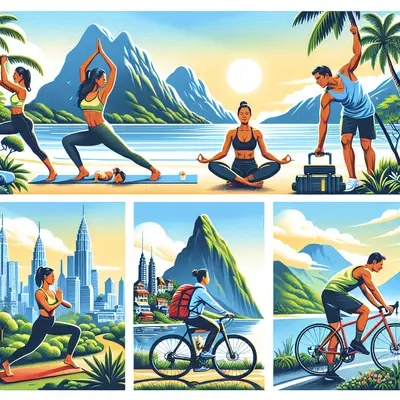
The best travel workouts aren’t always “formal sessions”—they’re woven into how you explore. Instead of chasing 10,000 steps on a watch, design your days so movement is built in.
Tactical ways to turn wandering into training:
- Choose stairs over elevators and escalators—always. Carrying your backpack up several flights turns travel days into leg days.
- Use walking or cycling as your main commute: skip short rideshare trips and walk 15–30 minutes between coworking spaces, cafés, and lodging.
- Micro-challenges: pick a landmark (top of a hill, last set of stairs, end of a pier) and walk briskly or jog to it; slow down only once you hit that checkpoint.
- Play with the environment:
- Park bench: step-ups, incline/decline push-ups, triceps dips
- Railings: supported squat holds
- Beach: barefoot walks or light runs for foot and ankle strength (start short to avoid overuse)
This approach keeps you conditioned without needing a “perfect block of time.” When movement is part of your adventure story instead of a separate chore, consistency gets much easier.
Use a Simple Rule System to Stay Consistent Across Time Zones
Digital nomad life can wreck routine: late-night client calls, overnight buses, coworking marathons. Instead of rigid programs that collapse under chaos, run your fitness on simple rules you can follow in any time zone.
Here’s a practical travel code you can adopt and customize:
- Movement floor: Move with intention for at least 15 minutes every day (walk fast, strength circuit, yoga flow).
- Strength rhythm: Aim for 2–3 strength-focused days per week (using your 3-move template or band/suspension setup).
- Active breaks on long travel days: Every 60–90 minutes of sitting (on planes, buses, or at a laptop), stand up for 2–3 minutes of walking, calf raises, shoulder rolls, or gentle squats.
- Sleep-aware intensity: If you slept fewer than 6 hours, keep it lighter—mobility, walking, easy band work instead of max-effort sessions.
- Recovery anchor: One evening per week is dedicated to slower mobility (hips, back, shoulders) to reset the damage from backpacks and screens.
Write your rules in your notes app and treat them like a personal travel treaty: flexible in specifics, unbreakable in spirit. Your goal isn’t perfection—it’s staying ready. Ready to hike that volcano, sprint for a last-minute train, or carry your life on your back without your body complaining.
Conclusion
Your training doesn’t have to pause just because your life is stamped across continents. A small daily ritual, a repeatable three-move template, one smart piece of gear, and a city-as-gym mindset are enough to stay strong, mobile, and adventure-ready wherever you land.
You don’t need more time, more equipment, or a perfect setup—you need a simple code you can follow in any country, then the discipline to hit “play” on it, day after day, hostel after hostel.
Pack light, move with intent, and let your workouts become part of the story you’re writing across the map.
Sources
- [Centers for Disease Control and Prevention – Physical Activity Guidelines](https://www.cdc.gov/physicalactivity/basics/adults/index.htm) - Baseline recommendations for weekly movement and strength work
- [World Health Organization – Physical Activity Factsheet](https://www.who.int/news-room/fact-sheets/detail/physical-activity) - Global guidelines and benefits of regular activity for adults
- [American Council on Exercise – “How to Exercise While Traveling”](https://www.acefitness.org/resources/pros/expert-articles/5321/how-to-exercise-while-traveling/) - Practical strategies and example travel workouts
- [Harvard Health Publishing – “The importance of strength training”](https://www.health.harvard.edu/staying-healthy/the-importance-of-strength-training) - Why resistance training matters for health and longevity
- [Mayo Clinic – “Fitness basics: Building a better workout”](https://www.mayoclinic.org/healthy-lifestyle/fitness/in-depth/fitness/art-20046462) - Guidance on structuring simple, effective exercise sessions
Key Takeaway
The most important thing to remember from this article is that this information can change how you think about Travel Workouts.