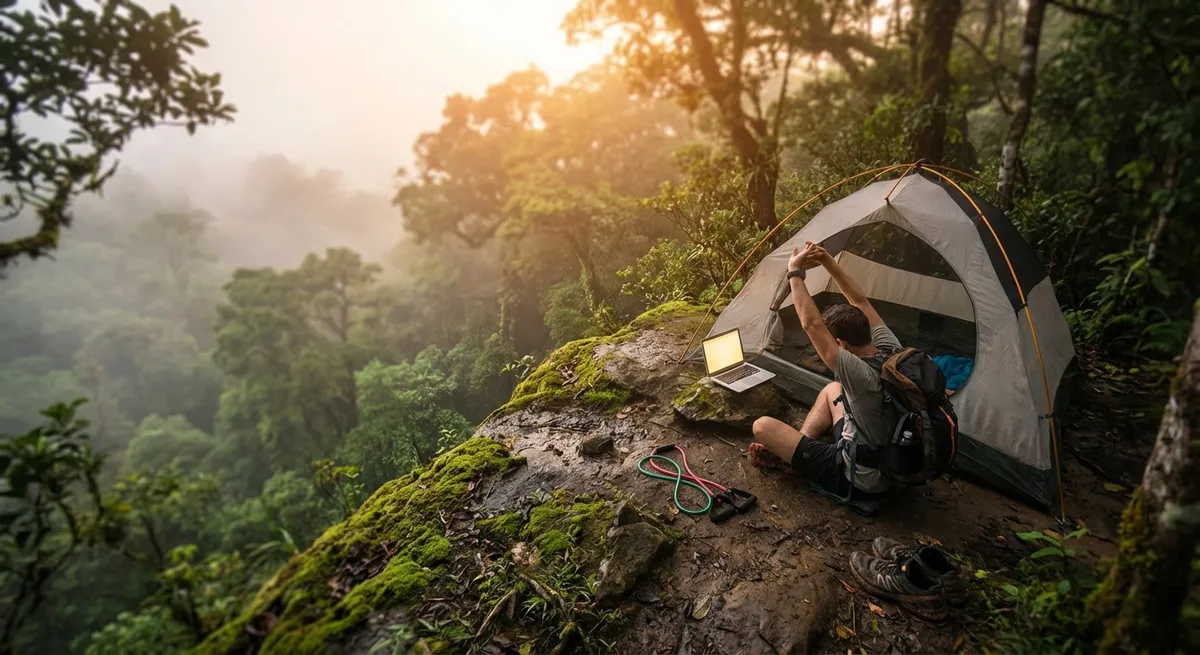
Life on the move is addictive: new cities, new trails, new stories. But constant motion can shred your routines faster than a budget airline shreds your luggage. Wild schedules, random beds, and mystery food stalls can either turn you into a resilient performance machine—or a jet-lagged mess. This guide leans into the adventure while keeping your body ready for the next flight, trek, or co-working sprint, with portable, no-excuses health tactics and five battle-tested fitness tips built for nomads, not gym regulars.
Nomad Health Isn’t “Vacation Mode”—It’s Expedition Mode
Most travel advice treats trips like temporary detours from “real life.” If you’re a traveler or digital nomad, movement is your normal. Your body isn’t on holiday; it’s on expedition.
That means your health strategy has to be rugged, flexible, and light enough to fit in a daypack. Forget fragile routines that crumble if you don’t have your favorite gym or blender nearby. Instead, think in terms of systems:
- Environment-agnostic habits that work in a hostel, tent, or airport lounge.
- Low-friction decisions—behaviors that require almost no willpower once set up.
- Portable tools that earn their pack weight because they work anywhere.
- Recovery rituals that keep you sharp whether you’re coding in a café or hauling a backpack through a new city.
You’re not trying to replicate home. You’re building a body and brain that can thrive in flux.
The Nomad Health Base Camp: Sleep, Hydration, and Movement Anchors
Before stacking “hacks,” you need a stable base camp. Three anchors do most of the heavy lifting: sleep, hydration, and basic daily movement.
Sleep: Changing time zones and beds wrecks your rhythm. Prioritize consistency where you can: similar sleep and wake windows, limiting screens 60 minutes before bed, and keeping your room as dark and cool as possible. A tiny sleep kit—earplugs, eye mask, and a lightweight buff or scarf—can turn a noisy guesthouse into a sleep cave instantly.
Hydration: Flights, AC, sun, and coffee add up to silent dehydration, which quietly tanks focus, mood, and performance. Carry a collapsible or lightweight bottle. Every time you sit down to work or eat, top it off. Simple rule: clear-to-pale-yellow urine most of the day means you’re in the right zone.
Movement: The goal isn’t smashing yourself with workouts; it’s avoiding long-term stagnation. Give your body at least a baseline: walking or light mobility every single day. When routines keep getting disrupted, these anchors turn into your constant—your health GPS that reorients you in any new place.
Five Nomad-Ready Fitness Tips That Fit in Carry-On Life
These five tips are built for travelers who can’t depend on a gym, fixed schedule, or reliable space. Each one is designed to be portable, adaptable, and durable over months on the road.
1. Turn Transit Into a Micro-Training Zone
Travel days don’t have to be lost days. They’re actually perfect for small, strategic movement bursts.
- Airport walks: Instead of scrolling at the gate, walk laps between terminals. Aim to burn off stiffness from flights and long rides—10–20 minutes of relaxed walking per layover.
- Standing mini-sessions: While waiting in lines, shift weight, do subtle calf raises, gentle hip circles, or engage your glutes by lightly squeezing and relaxing them. It’s invisible but effective.
- Seat mobility: On buses and planes, cycle through ankle circles, seated marches (lifting each knee a few centimeters), and shoulder rolls every 30–45 minutes to keep blood moving.
This mindset shift—seeing transit as training support instead of a health hazard—keeps your body from sliding into “all day sitting” mode.
2. Build a Three-Move “Anywhere Strength” Circuit
You don’t need a full gym to build functional strength. You need structure and consistency. Create a simple, no-equipment strength circuit you can do in a few square feet:
- Push pattern (e.g., push-ups, incline push-ups on a desk, or suitcase presses if you have a bag).
- Hinge or squat pattern (e.g., air squats, split squats using a chair for balance, or hip hinges with a packed backpack held like a weight).
- Core / anti-rotation (e.g., plank hold, side plank, or dead bug variations on the floor or bed).
Example structure you can adapt to your level:
- 8–15 push-ups
- 10–20 squats or split squats (per leg if split)
- 20–30 seconds plank or side plank (per side)
Repeat 3–5 rounds with 30–60 seconds rest between rounds. If you’re tight on time, do just one round—but do it daily. The point is to give your nervous system the signal: “We’re still strong. Don’t downgrade this body.”
3. Pack One High-Value Tool and Learn Ten Uses for It
Minimalism is key, but one small piece of gear can dramatically expand what you can do on the road. Pick something that’s light, durable, and versatile—then wring every use out of it.
Popular options:
- Resistance band (loop or long band): Rows using a doorframe, banded squats, overhead presses, lateral walks, face pulls, assisted pull-ups on sturdy bars.
- Jump rope: Conditioning anywhere, warm-ups, coordination drills.
- Lightweight suspension trainer: If you’re okay with the extra bulk, it turns any sturdy door or tree into a training station.
Commit to learning at least ten exercises with your chosen tool. Save them in your notes or as a photo gallery on your phone. That way, when you walk into a new room, you don’t waste mental energy figuring out “what to do”—you just execute.
4. Use the “First 10 Minutes” Rule in Every New Place
When you land in a new city, hotel, or homestay, your first instincts often set the tone: you either drop into the bed and scroll, or you explore and claim the space. Use that critical window to anchor your health.
Make a simple ritual:
- Drop your bag.
- Drink water.
- Move for 10 minutes.
That movement can be:
- A quick mobility flow (neck, shoulders, spine, hips, ankles).
- A short strength burst (one or two rounds of your three-move circuit).
- A recon walk around the neighborhood to map food options, parks, or safe routes.
This “First 10 Minutes” rule tells your brain, This is a place I move, not just a place I crash. It prevents the passive slide into “I’ll work out later” that often turns into “not at all.”
5. Cycle Your Effort: Don’t Try to Peak Every Stop
Constant travel already taxes your system—new microbes, different beds, shifting schedules. Expecting to train at 100% all the time is a fast route to burnout or injury.
Instead, think in waves:
- High-output days: When sleep and energy are good and your schedule allows, go harder—add more rounds, push intensity, or extend your walks/hikes.
- Maintenance days: When you’re in transit, slightly underslept, or mentally fried, hit the “minimum effective dose”: a short circuit, light mobility, and some walking.
- Recovery days: When your body feels beaten up, prioritize gentle movement, stretching, and earlier sleep over forceful training.
This approach keeps progress steady without clashing with the chaos of travel. You remain durable enough to catch last-minute buses and spontaneous side quests without nursing chronic exhaustion.
Eating Like an Explorer Without Imploding Your Health
Food on the road can either be the best perk or your worst liability. You don’t need perfect nutrition; you need reliable patterns that travel well.
Think “anchor meals,” not strict diets. Try to make at least one meal per day predictable and nutrient-focused—often breakfast or your first meal. That might mean yogurt and fruit, eggs and vegetables, or oatmeal with nuts and seeds. In many countries, simple staples like rice, beans, and local produce are easy, cheap wins.
Scan for protein and plants first. At street food stalls, cafés, and markets, your first question is: Where is the protein? Where are the vegetables? Build your plate from there, then add starch and fun extras. Over time this reduces decision fatigue and lowers the odds you live off pastries and instant noodles.
Prep tiny insurance policies. A zip bag of mixed nuts, a small stash of shelf-stable protein (like tuna packets or jerky where culturally appropriate), or a small container of electrolyte packets can rescue you on long buses or in food deserts. It’s not about being fussy—it’s about giving yourself options when the only visible choice is candy and chips.
Recovery Rituals That Don’t Require a Spa
You won’t always have access to a spa, massage, or yoga studio—but you can recover like an athlete using almost nothing.
- Floor time: Spending 5–10 minutes a day on the floor (hotel, homestay, or hostel common area) to stretch your hips, hamstrings, and thoracic spine keeps your body from “locking” into screen posture.
- DIY mobility tools: A tennis or lacrosse ball weighs almost nothing and can double as a trigger point tool for your back, glutes, and calves against a wall or floor.
- Tech cutoffs: Set an alarm to end screens 30–60 minutes before bed. Light reading, journaling, or simple breathwork is enough to drop your nervous system out of “on-call” mode.
- Breathing reset: When anxiety or overstimulation spikes in unfamiliar environments, 3–5 minutes of slow nasal breathing (about 4–5 seconds inhale, 5–7 seconds exhale) can tilt your body back toward rest-and-digest mode.
Recovery is what allows you to hike the volcano at sunrise and still be sharp on a video call that afternoon. It’s not luxury; it’s infrastructure.
Conclusion
Nomad life is a stress test for your body—but it’s also an unmatched training ground. If you can stay strong, clear-headed, and resilient while crossing borders and time zones, regular life starts to feel easy. Health on the road isn’t about perfection or rigid plans; it’s about portable systems, tiny rituals, and a willingness to treat every new city as a fresh training ground.
Your body is the only piece of gear you can’t replace mid-trip. Travel like an explorer, train like a minimalist, recover like a pro—and let every border crossing upgrade your resilience instead of eroding it.
Sources
- [Centers for Disease Control and Prevention – Traveler’s Health](https://wwwnc.cdc.gov/travel/page/healthy-travel) - Guidance on staying healthy while traveling, including sleep, hydration, and illness prevention
- [World Health Organization – Physical Activity Factsheet](https://www.who.int/news-room/fact-sheets/detail/physical-activity) - Evidence-based recommendations for movement and its health benefits
- [Harvard T.H. Chan School of Public Health – Nutrition Source](https://www.hsph.harvard.edu/nutritionsource/) - Research-backed information on building healthy, flexible eating habits
- [National Sleep Foundation – Sleep and Travel](https://www.thensf.org/sleep-and-travel/) - Practical science-based strategies for managing sleep disruptions across time zones
- [American Council on Exercise – Bodyweight Training Basics](https://www.acefitness.org/education-and-resources/lifestyle/exercise-library/) - Exercise library and guidance for effective no-equipment and minimal-equipment workouts
Key Takeaway
The most important thing to remember from this article is that this information can change how you think about Nomad Health.