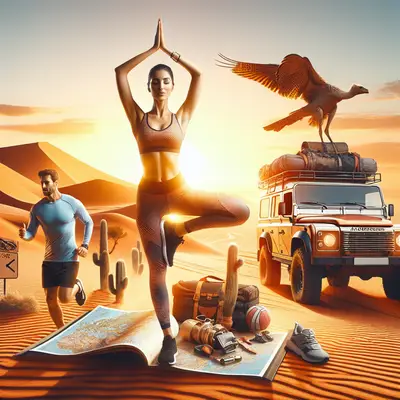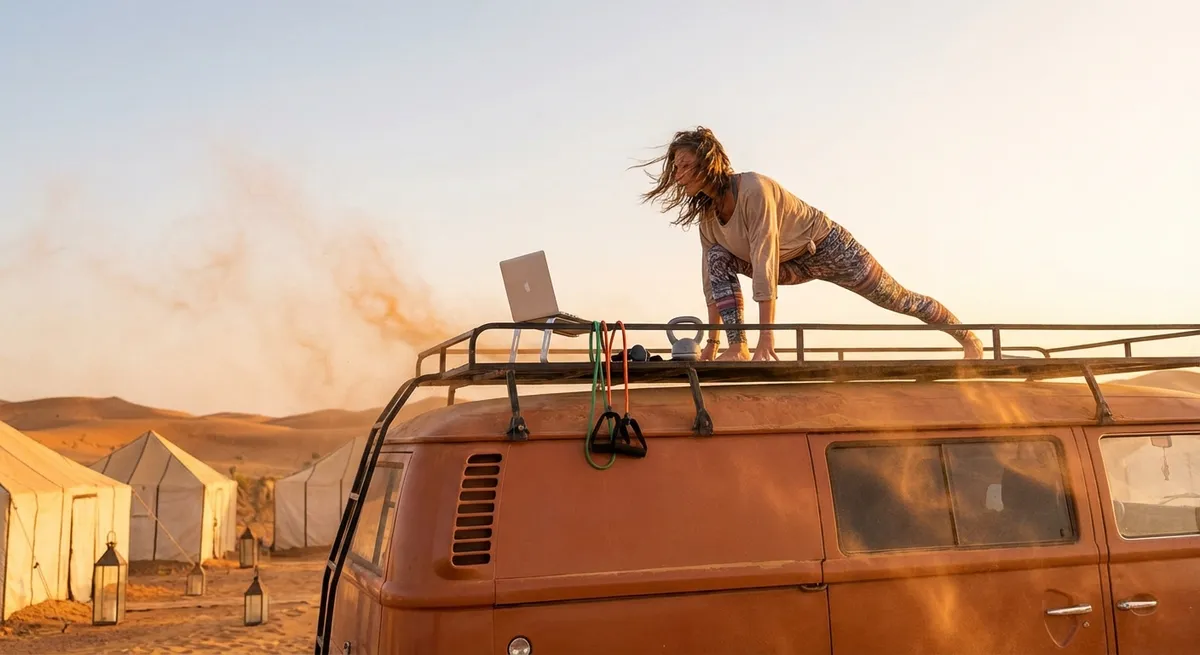
Your office is a hostel kitchen, your commute is a sunrise hike, and your “home gym” is whatever’s within arm’s reach of your backpack. Nomad life is the dream—until your body starts to feel like it’s made of airplane seats and hostel bunks. The good news: you don’t need a squat rack, a perfect schedule, or a permanent address to stay strong. You just need a flexible plan that travels as hard as you do.
This guide breaks down portable, adventure-ready tactics and five field-tested fitness tips designed for travelers and digital nomads who want more from their bodies than just “good enough to haul a backpack.”
Build a Nomad-Proof Fitness Mindset
Your biggest training tool on the road isn’t a resistance band or an app—it’s your mindset.
Forget the idea of “perfect” programs and eight-week phases. Travel shreds structure: flights get delayed, co-working passes fall through, and “quiet rooms” become 1 a.m. karaoke clubs. Instead of chasing perfection, commit to a set of non-negotiable principles:
- Something every day: A five-minute movement break still beats another hour hunched over a laptop.
- Minimum effective dose: Short, intense efforts (10–20 minutes) can maintain strength, cardio, and mobility when time or space is tight.
- Opportunistic training: Stairwells, parks, empty gates at the airport, and ferry decks all become training zones.
- Health over heroics: Prioritize sleep, joints, and consistency over flogging yourself for missed “workouts.”
Treat fitness like brushing your teeth: part of your daily operating system, not a special event that requires perfection.
Make the World Your Gym: Training Without a Base
Your environment is constantly changing—use that to your advantage instead of fighting it.
When you land somewhere new, do a quick “movement reconnaissance”:
- Is there a park with bars, benches, or steps?
- Does your building have stairs, a roof, or a quiet hallway?
- Is there a safe walking or running loop near your stay?
- Any public sports courts (basketball, soccer, calisthenics parks)?
This five-minute scan tells you what your “gym” looks like for the next few days.
Build your training around categories, not fixed exercises:
- Push (push-up variations, dips on benches)
- Pull (doorframe towels, playground bars, TRX-style straps)
- Hinge (hip hinges, single-leg deadlifts with your backpack)
- Squat/Lunge (air squats, split squats, walking lunges)
- Carry (farmer’s carries with water jugs or a loaded backpack)
- Move Fast (sprints, stair runs, shuttle runs)
Once you know the category you want to hit, pick the variation your location allows. This is how you keep training consistent even when your scenery doesn’t match.
Five Field-Tested Fitness Tips for Travelers & Digital Nomads
1. Lock in a “First 10 Minutes” Morning Ritual
Before Wi-Fi, emails, or messages, give your body the first 10 minutes of the day.
Example “anywhere” circuit (no equipment, no excuses):
- 2 minutes: easy joint circles (neck, shoulders, hips, knees, ankles)
- 3 minutes: walking lunges + bodyweight squats
- 3 minutes: push-ups (regular or incline) + glute bridges
- 2 minutes: light stretching (hip flexors, hamstrings, chest)
Keep the pace easy. The goal isn’t to “crush it”—it’s to wake up your nervous system, reset your posture, and remind your body it’s built for more than hunching over a keyboard.
Why it works on the road:
- Anchors your day with a win before chaos can derail you
- Counteracts stiffness from flights, buses, and new beds
- Creates a “bare minimum” habit—anything else you do is a bonus, not a burden
2. Use Your Backpack as a Portable Weight Room
Your backpack isn’t just a gear hauler—it’s a compact, adjustable weight set.
How to turn it into training gear:
- Load it smart: Use water bottles, books, or packing cubes as weight. Water is perfect because you can dump it before flights and refill anytime.
- Front pack squats: Hug the loaded pack to your chest and do squats. Great for legs and core.
- Backpack rows: Hold the top handle with both hands, hinge at the hips, and row to your ribs.
- Overhead press (if shoulders are healthy): Press a lighter pack overhead, keeping ribs down and core tight.
- Farmer’s carries: Carry your backpack in one hand like a suitcase for distance—switch sides. An elite way to build grip and core stability.
Backpack training gives you resistance work without committing to extra gear, and it’s scalable: heavier when you’re fully packed, lighter for higher reps on day trips.
3. Train in “Movement Snacks” Between Work Blocks
If your days are laptop-heavy, waiting for a perfect 45–60 minute training window is a great way to never move at all.
Instead, break your training into movement snacks between deep work blocks:
Pick 2–3 simple exercises and sprinkle them through your day:
Example combo:
- 10–15 air squats
- 5–10 push-ups
- 20–30 seconds plank
Do a round every 60–90 minutes. Over a full workday, you may accumulate:
- 60–100 squats
- 30–60 push-ups
- Several minutes of core work
Zero “gym time,” significant training effect.
This style is perfect for:
- Long visa runs in cafés or co-working spaces
- Rainy days where you’re stuck indoors
- Transit days where you’re popping up for quick breaks between calls
4. Keep a Micro Kit: One Band, One Strap, Big Results
You don’t need a trunk full of tools. One resistance band and one lightweight suspension strap can turn almost any space into a serious training ground.
Why they’re nomad gold:
- Space-efficient: They fit in your daypack or even a jacket pocket.
- Versatile: Rows, presses, pulls, hinges, core work—most major patterns are covered.
- Anchor-friendly: Wrap around doors, poles, trees, bed frames (check stability!).
Sample band/strap workout for a park, hostel patio, or small room:
- Band or strap rows
- Band chest press or push-ups
- Split squats (bodyweight or with band assistance/resistance)
- Band pull-aparts or face pulls for posture
- Strap-assisted pistol squats or Romanian deadlifts
Run 3–4 rounds, 8–15 reps per move, 2–3 times a week. This is enough to maintain or slowly build strength while your main adventures happen outside the gym.
5. Use Your Destination as Cardio, Not a Background
Instead of grinding away on hotel treadmills, build your cardio into how you explore.
Nomad-friendly ways to turn exploration into conditioning:
- Stair hunts: Choose routes that climb—castle steps, hillside viewpoints, subway stairs instead of escalators.
- Weighted walks: Wear your daypack or light backpack and walk a little faster than comfort pace.
- City sprints: Find a quiet street, beach, or park path and do short sprints—20–30 seconds fast, 60–90 seconds walk, 6–10 rounds.
- Trail missions: Turn easy hikes into power hikes—focus on steady, brisk uphill sections, relax on the descents.
Not only does this keep your heart and lungs honest, it makes you earn your views, your meals, and your photos. Your cardio is no longer something you check off a list—it’s baked into the way you experience a place.
Travel Health Foundations: Sleep, Recovery, and Not Falling Apart
You can’t out-train jet lag and junk recovery. Nomad health isn’t just about reps; it’s about staying operational long-term.
Key pillars:
- Sleep like it matters:
- Use an eye mask and earplugs; they’re tiny and life-changing.
- Stick to a rough sleep window even when your time zone hops—your body loves rhythm.
- Get morning light exposure wherever you land to help reset your internal clock.
- Hydrate harder than you think:
Flights, coffee, alcohol, and hot climates all gang up on your hydration. Aim to drink consistently through the day, not just chug when you remember.
- Move after transit:
The first thing you do after a long bus/flight: walk 10–20 minutes and run through a few light mobility drills. This drastically reduces stiffness and brain fog.
- Play the long game with joints:
Taking five minutes for hip, ankle, and shoulder mobility a few times a week will pay off more than chasing some heroic one-off workout.
Think of your body as your primary visa—it has to get stamped in every new country. Protect it like you protect your passport.
Conclusion
You don’t need a fixed address, a perfect routine, or a full gym to stay strong, mobile, and ready for the next border crossing. You need a mindset that welcomes chaos, a few portable tools, and a handful of habits you can deploy in any timezone.
Turn your backpack into a barbell. Use your city as your cardio machine. Break your training into bite-sized movement snacks that fit between flights and deadlines. When the world is your gym, fitness stops being something you “try to squeeze in” and becomes the way you travel.
Your next destination is already on the map. Make sure your body is just as ready as your passport.
Sources
- [World Health Organization – Physical Activity Guidelines](https://www.who.int/news-room/fact-sheets/detail/physical-activity) – Global recommendations on weekly activity levels for adults
- [U.S. Department of Health & Human Services – Physical Activity Guidelines](https://health.gov/paguidelines) – Evidence-based guidance on strength, cardio, and movement frequency
- [CDC – Healthy Travel Tips](https://wwwnc.cdc.gov/travel/page/healthy-travel-tips) – Official advice on staying healthy and managing fatigue while traveling
- [Harvard Health – The Importance of Stretching](https://www.health.harvard.edu/staying-healthy/the-importance-of-stretching) – Explains why mobility and stretching matter, especially for people who sit and travel a lot
- [Sleep Foundation – Jet Lag and Sleep](https://www.sleepfoundation.org/jet-lag) – Research-backed strategies for managing jet lag and improving sleep when changing time zones
Key Takeaway
The most important thing to remember from this article is that this information can change how you think about Nomad Health.