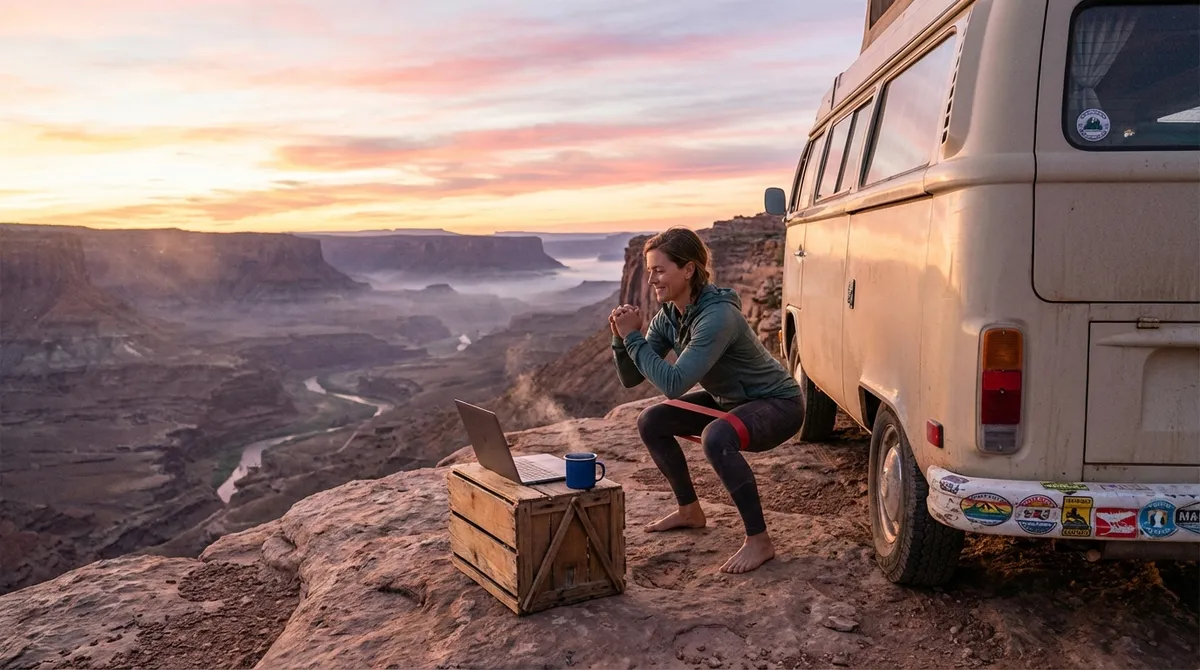
You don’t need a home gym, perfect schedule, or stable zip code to be strong. You need a body, a backpack, and a willingness to move when the rest of the airport is glued to their phones. Nomad health isn’t about perfection; it’s about building a body that can hike volcanoes after red-eyes, haul bags through subway stairs, and still have energy left for sunrise missions. This is your portable blueprint for staying fit while the map keeps changing.
Build a “Non‑Negotiable 15” You Can Do Anywhere
When your location changes every few days, long workouts become fantasy. What does work: a 15‑minute, no‑equipment “non‑negotiable” routine you repeat so often it becomes muscle memory.
Pick 3–5 compound moves that hit most of your body with minimal floor space: think squats, push-ups, hip hinges (like good‑morning hinges), lunges, and plank variations. Run them in a simple circuit: 40 seconds of work, 20 seconds of rest, cycling through for 15 minutes. Keep reps controlled but challenging, and focus on full range of motion to offset long travel days.
The key is consistency, not creativity. Do your “Non‑Negotiable 15” first thing in the morning or immediately after dropping your bag in a new place. Treat it like brushing your teeth—non negotiable, no debate. Over time, this small daily dose of intensity builds durability, so flights, buses, and border crossings don’t wreck you.
Treat Transit Days Like an Endurance Sport
Travel days act like a stealth workout: long static holds (sitting), awkward loads (bags), and strange breathing patterns (stress, altitude, bad sleep). Instead of writing them off, treat them like an event you’re actively managing.
Before boarding, walk the terminal for at least 10–15 minutes instead of camping in the gate area. After you sit, set a timer to stand, stretch, and move every 45–60 minutes—ankle circles, calf raises in the aisle, and seated spinal twists go a long way in cramped spaces. On trains and buses, use stops as micro‑movement breaks: a few slow air squats, shoulder circles, or gentle hip openers.
Hydrate like you’re prepping for a long run: a steady drip of water, not a last‑minute chug. Lightly salting snacks or meals can help maintain fluid balance on long flights. When you land, resist the urge to crash immediately; instead, walk outside for 10–20 minutes to reset your body clock and loosen the travel stiffness before you sit again.
Turn Your Luggage Into a Mobile Gym
Your backpack or suitcase is more than a container; it’s a ready‑made training tool that always travels with you. With a little creativity, you have a portable weight set built into your lifestyle.
Use a loaded backpack for goblet squats, split squats, and Romanian deadlifts. Grip the top handle of a small suitcase for one‑arm rows, suitcase carries, or farmer’s carries down a quiet hallway or hotel courtyard. If you have a daypack, hug it to your chest for thrusters (squat into overhead press) or bear‑hug carries to challenge your core and upper back.
To make this safe and repeatable, pack with intention: keep heavier dense items closer to your back and centered, so the load doesn’t torque your spine during squats or carries. If your pack is very light, add a water bottle, books, or even groceries from the local market before your session. This style of “improvised load” training not only builds strength but also makes your travel-specific muscles—grip, core, upper back—shockingly resilient.
Anchor Your Day With Movement “Checkpoints”
Nomad days blur: new city, new Wi‑Fi password, new sleep pattern. Instead of trying to “find time” to work out, embed micro‑workouts into your existing anchor points: wake-up, work blocks, meals, and wind-down.
After waking, do 5–10 minutes of mobility: neck rolls, cat‑cow, hip circles, and deep squats to reintroduce motion after sleep and strange beds. Between work blocks or online meetings, set a non-negotiable movement checkpoint—like 20 slow squats, 10–15 push-ups against a wall or desk, and a 60‑second plank. These short bursts help offset hours of laptop posture.
Before meals, stack in tiny strength snacks: one minute of wall sit, 10 single-leg RDLs each side using your backpack for balance, or a few slow calf raises off a step. In the evening, walk 10–20 minutes after dinner instead of collapsing into screens. These checkpoints turn your entire day into a low‑key training platform, keeping your joints moving and your metabolism awake even when you can’t carve out a full session.
Use the Local Terrain as Your Adventure Gym
One of the best parts of nomad training is that “gym” can mean stairs in Lisbon, jungle trails in Chiang Mai, or a beach in Mexico. Instead of hunting for the perfect fitness studio, use what’s already in front of you.
Stairs become interval machines: power walk or lightly run up, walk down, repeat. Parks and playgrounds are outdoor calisthenics zones—use rails for inverted rows, benches for step-ups and incline push-ups, and low bars for hanging to decompress your spine. If you’re near water, soft sand amplifies bodyweight moves: walking lunges, lateral shuffles, and short sprints turn into serious work with less joint impact.
Let your environment dictate the session: hillier cities favor hill repeats and hiking; flatter towns support long brisk walks or runs; small hotel rooms encourage compact circuits and isometric holds. Framing your training as “exploration with purpose” means you accumulate fitness while hunting viewpoints, markets, and hidden alleys—your workout becomes part of the story of the place.
Conclusion
Nomad health isn’t about clinging to the routine you had back home; it’s about building a body that adapts as fast as your itinerary. A simple 15‑minute ritual, smart transit strategies, loaded packs, movement checkpoints, and terrain‑driven sessions are enough to keep you strong, mobile, and adventure‑ready anywhere on the map. The world is your training ground. Pack light, move often, and let every border crossing make you a little stronger than the last.
Sources
- [Centers for Disease Control and Prevention – Physical Activity Basics](https://www.cdc.gov/physicalactivity/basics/index.htm) - Guidelines on weekly activity levels and why even short bouts of movement matter
- [World Health Organization – Physical Activity Fact Sheet](https://www.who.int/news-room/fact-sheets/detail/physical-activity) - Global recommendations for physical activity and health impacts of inactivity
- [Harvard Health Publishing – The Importance of Stretching](https://www.health.harvard.edu/staying-healthy/the-importance-of-stretching) - Explains benefits of mobility and stretching, especially after long periods of sitting
- [Mayo Clinic – Travel and Deep Vein Thrombosis](https://www.mayoclinic.org/diseases-conditions/deep-vein-thrombosis/in-depth/travel-and-dvt/art-20046037) - Details why moving during long flights or drives is critical for circulation and safety
- [American Council on Exercise – Bodyweight Training: No Gym Required](https://www.acefitness.org/education-and-resources/lifestyle/blog/6644/body-weight-exercise-no-gym-required/) - Provides evidence-based insights and examples of effective no-equipment workouts
Key Takeaway
The most important thing to remember from this article is that this information can change how you think about Nomad Health.