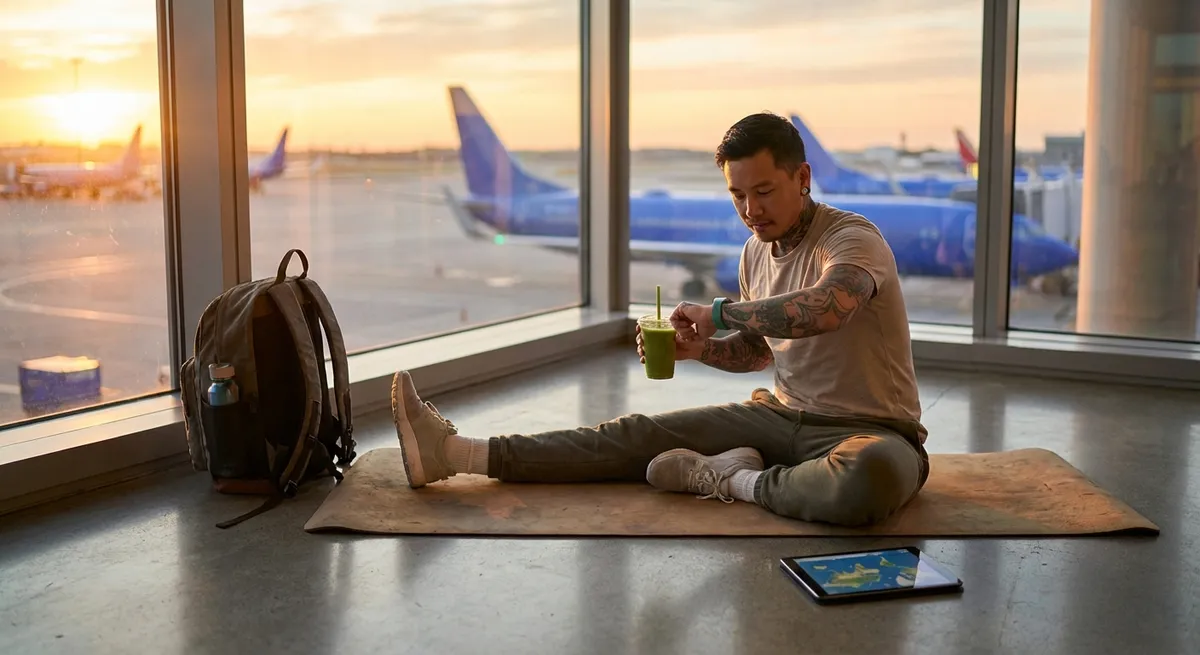
You can live out of a backpack, chase sunsets across continents, and still feel powerful in your own skin. Nomad health isn’t about perfection—it’s about staying mission-capable when your “home base” is a carry-on and a half-charged laptop. This is your field guide to feeling strong, clear-headed, and ready for whatever the next border crossing throws at you.
Nomad Health as Survival Gear, Not Self-Care Fluff
For travelers and digital nomads, health isn’t a side project—it’s your operating system. When your routines are vaporized by red-eyes, surprise delays, and patchy Wi‑Fi, your body becomes your only constant basecamp.
Instead of chasing “ideal” workouts or perfect meals, think in terms of operational readiness: Can you think clearly on three hours of sleep? Carry your bag without your back complaining? Crank through deep work after a night train? That’s the standard.
Your toolkit needs to be:
- Portable enough to live in your backpack.
- Flexible enough to work in micro-gaps of time.
- Simple enough to run even when you’re jet-lagged and half-awake.
The goal: a durable, travel-proof body and brain that can handle long hauls, random beds, and work deadlines without falling apart.
Five Field-Tested Fitness Tactics for the Moving Target Life
These five tips are built for layovers, hostels, tiny Airbnbs, and border crossings. No memberships, no perfect gym, no excuses.
1. Build a “10-Minute Anywhere” Movement Protocol
Forget 60-minute gym sessions. Your base unit is 10 minutes—something you can drop into any day, anywhere, with no gear.
Here’s a rugged, full-body circuit you can run in an airport corner, hotel room, or rooftop:
- 40 seconds bodyweight squats
- 20 seconds rest
- 40 seconds push-ups (elevate hands on bed/bench if needed)
- 20 seconds rest
- 40 seconds hip hinge good-mornings (hands on hips, hinge at waist)
- 20 seconds rest
- 40 seconds reverse lunges or step-backs
- 20 seconds rest
- 40 seconds plank or dead bug hold
- 60 seconds rest
Repeat 2–3 rounds when time allows.
Make this your “non-negotiable minimum.” If you’re wrecked, do just one round. The point is to keep the system online, not to chase PRs.
2. Pack One Piece of “Micro-Load” Gear
You don’t need a mobile gym. You need one tiny tool that multiplies your options.
Pick ONE of these and make it part of your permanent kit:
- Light resistance band (loop or tube): Turns doors, beds, and your own body into a strength station (rows, presses, pull-aparts, hip work).
- Jump rope: Cardio in a parking lot, rooftop, or quiet street in 5–8 minutes.
- Suspension trainer alternative (lightweight straps or gymnastic rings): Clips to doors, trees, or beams for full-body pulling and core work.
- 15–20 band rows
- 10–15 band presses
- 10–15 band good-mornings
- 10–15 band pull-aparts
Attach a clear plan to the gear. For example, if you carry a loop band:
Run 2–4 rounds in 10–15 minutes. That’s your “hotel strength block” anywhere.
3. Use Transit Time for Mobility, Not Just Doomscrolling
Planes, buses, and trains are basically joint-compression machines. Instead of letting travel lock your body up, steal back range of motion while everyone else goes numb.
Simple, low-key mobility you can do in a seat or terminal:
- Ankle pumps & circles: 20–30 per side to keep blood moving.
- Seated hip figure-4 stretch: Cross ankle over knee, hinge forward gently.
- Neck mobility: Slow rotations and side bends, staying out of pain.
- Thoracic rotations: Hands together at chest, rotate gently side to side.
- Walk the aisle or terminal for 2–3 minutes.
- Do 10 calf raises and 10 mini squats.
In long-haul travel, set a timer (or use boarding calls as cues). Every 60–90 minutes, stand up if possible and:
Think of it as “joint maintenance” to keep you functional when you land.
4. Anchor Your Day With One Non-Negotiable Movement Window
Time zones will wreck your schedule if you let them. Instead of “I’ll work out when I can,” choose one reliable anchor in your day and defend it.
For example:
- Pre-work anchor: 12–20 minutes of movement before you open your laptop.
- Post-work anchor: 15 minutes of walking as a hard line when you close it.
- Wake-up anchor: 5–10 minutes of mobility before coffee or phone.
The anchor doesn’t have to be long—it just has to happen every day you’re not actively sick or injured. This trains your nervous system to expect movement, no matter the city or time zone. Over time, that consistency beats any perfect plan you can’t stick to.
5. Treat Walking as Your Default Travel Workout
You’re already moving through cities—turn that into training. Walking is low-impact, jet-lag-friendly, and sneaks in recovery instead of hammering a tired system.
Turn daily movement into a deliberate habit:
- Choose routes that add 10–20 extra minutes of walking to normal errands.
- Climb stairs instead of escalators when you’re not overloaded with bags.
- Use “work breaks” as micro-walk windows: 5–10 minutes between deep-focus blocks.
- On new city days, pick a distant café or workspace and walk there if it’s safe.
- Most days: at least one 20–30 minute continuous walk.
- Higher-output days: stack walks + short bodyweight sessions.
If you want a simple weekly target that travels well, aim for:
This is your cardio base, sightseeing engine, and de-stressor rolled into one.
Staying Rechargeable: Sleep, Fuel, and Screen Discipline on the Road
Strong muscles are useless if your brain is foggy and your sleep is wrecked. A nomad’s real superpowers are recovery and focus.
First, defend your sleep like a passport:
- Use an eye mask and earplugs—hostels, thin walls, and street noise are constant.
- As soon as you land, get daylight exposure within the first few hours; this helps reset your body clock.
- Avoid heavy late-night meals and big caffeine hits 6–8 hours before your planned sleep window when you can control it.
- Prioritize protein and fiber when you have control (markets, supermarkets, simple restaurant choices).
- In airports or gas stations, default to:
- Water first
- Protein source (yogurt, boiled eggs, jerky, nuts)
- Fruit or raw veg if available
- Treat “local food adventures” as events, not the base of every single meal.
- Stack your laptop so the top of the screen is near eye level (use books, boxes, or backpacks).
- Run in 45–90 minute work blocks, then stand, walk, or stretch for 3–5 minutes.
- Cut bright screens at least 30–60 minutes before bed when possible; if not, dial down brightness and use night modes.
Food doesn’t need to be perfect; it needs to be strategic:
Screens are your livelihood—but they’re also sleep and posture killers:
Think of your body like your primary device: movement is the charge, sleep is the shutdown-reboot, food is the power source, and screens are the battery-drain you need to manage.
Conclusion
Nomad health isn’t about being the fittest person in the hostel. It’s about being the one who still has energy after the overnight bus, the one who can hike the trail on a whim, carry their gear without drama, and hit deadlines without burning out.
You don’t need a permanent gym, a perfect kitchen, or a fixed address. You need small, repeatable systems: a 10-minute circuit, one piece of micro-gear, walking as default, a daily movement anchor, and recovery habits that travel as well as you do.
Dial these in, and your passport won’t be the only thing that stays stamped and ready—your body will too.
Sources
- [World Health Organization – Physical Activity Fact Sheet](https://www.who.int/news-room/fact-sheets/detail/physical-activity) – Overview of recommended activity levels and health benefits of regular movement
- [CDC – How Much Physical Activity Do Adults Need?](https://www.cdc.gov/physicalactivity/basics/adults/index.htm) – Evidence-based guidelines on exercise frequency, intensity, and duration
- [Harvard Medical School – The Secret to Better Sleep: Get Outside](https://www.health.harvard.edu/staying-healthy/the-secret-to-better-sleep-get-outside) – Explains how daylight exposure helps regulate circadian rhythm and improve sleep quality
- [Sleep Foundation – Travel and Sleep](https://www.sleepfoundation.org/travel-and-sleep) – Practical strategies to handle jet lag, irregular schedules, and sleep disruptions while traveling
- [Mayo Clinic – Walking: Trim Your Waistline, Improve Your Health](https://www.mayoclinic.org/healthy-lifestyle/fitness/in-depth/walking/art-20046261) – Research-backed benefits of walking as a simple, accessible form of exercise
Key Takeaway
The most important thing to remember from this article is that this information can change how you think about Nomad Health.